When Hate Becomes Play — and Politics
Across gaming chats, YouTube feeds, and political forums, humor and grievance merge into identity. A closer look at how technology, psychology, and culture intertwine to radicalize both the young and the old.

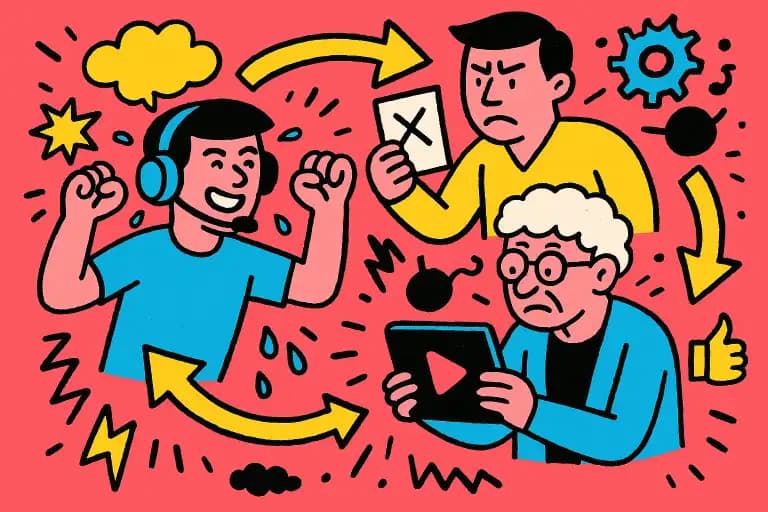
South Korea’s youngest generation is growing up in online spaces where hate is often disguised as humor. In game chatrooms and YouTube clips, teenagers trade insults and slang that originated from fringe far-right communities. What begins as a joke among friends can settle into everyday language, shaping how adolescents see themselves and others.
By their twenties, the same young men who laughed at memes in high school find those codes hardening into political attitudes. Surveys show that young Korean men are significantly more likely than their female peers to adopt anti-feminist views, a split that has reshaped electoral politics. Researchers warn that these views are not born in isolation but are the product of a cycle: exposure in youth, reinforcement through algorithms, and repetition across generations.
When Hate Sounds Like a Joke
In a 2024 survey by the National Youth Policy Institute, about 20.1% of Korean teenagers said they had experienced verbal abuse, insults, or harassment at least once online over the past six months. Among those surveyed, 61.5% reported encountering violent or harmful content on YouTube, and more than half acknowledged seeing explicit or hate-targeted content on the platform. While specific breakdowns for game chat exposure were not detailed in this report, other studies suggest that online forums, YouTube channels, and social media remain primary routes through which young Koreans are exposed to hate-motivated language.
For many students, the introduction to these words is not through manifestos or political pamphlets but through parody and memes. A slur shouted in a multiplayer game, or a satirical song shared on YouTube, is presented as entertainment. “It’s just a joke,” teenagers often say, and the laughter binds them together. What might be labeled hate in an adult context functions among peers as a form of belonging.
Psychologists describe adolescence as the stage of identity versus role confusion. The desire to be recognized and accepted is paramount, especially in societies where academic competition leaves little room for other forms of validation. Online communities, particularly gaming spaces, supply that recognition instantly. Inside jokes and hostile slang become markers of membership: you belong if you know the code.
The repetition is what normalizes. Communication scholars call this the process of normalization — when exposure transforms the unacceptable into the ordinary. Over time, language that once shocked adults becomes casual shorthand among youth. In some cases, the identification goes deeper. Researchers refer to identity fusion: when a person fuses their sense of self with the group identity, adopting its language and worldview as their own. Once that happens, reversing course is difficult.
This pattern is not uniquely Korean. A report by the European Commission’s Radicalisation Awareness Network noted that extremist recruiters in Europe use memes and jokes in gaming communities as a gateway to deeper ideological content. The tactic, according to the report, is effective precisely because it does not feel political at first. In Korea, where gaming is a dominant youth pastime, the same mechanics appear to be at work.
From Game Slang to Political Creed
By the time those teenagers enter their twenties, the playful language of adolescence has begun to carry heavier weight. University entrance, job searches, and mandatory military service confront young Korean men with a sense of constraint. The slang and jokes that once seemed like harmless fun are repurposed as explanations for why life feels unfair.
Election data makes the shift visible. In the 2025 presidential race, exit polls showed a stark divide: a majority of men in their twenties voted for the conservative candidate, while women of the same age leaned strongly progressive. Political scientists describe this as one of the widest gender gaps in voting behavior among democracies. Beneath the numbers lies a convergence of economic pressure and cultural resentment.
Researchers point to relative deprivation theory as one lens: when young men perceive that their obligations — military conscription, unstable employment, and delayed independence — are heavier than those of their female peers, frustration builds. Online communities supply a narrative that converts frustration into blame: women are benefiting unfairly, immigrants are taking jobs, social programs are rigged. This sense of victimhood, once validated by peers and reinforced by algorithmic feeds, hardens into ideology.
Psychologists warn that this process reflects more than simple political choice. It is the formation of identity. In studies of radicalization, scholars describe how young adults seek coherence — a story that explains personal hardship within a broader social struggle. Far-right communities, online and offline, offer that story. They transform individual grievances into collective identity, and in doing so, they deepen the bond between the group and the self.
The Korean case mirrors trends elsewhere. In Europe, far-right youth movements have flourished by framing young men as the “left-behind generation,” exploited by globalization and ignored by elites. In the United States, surveys show that men in their twenties are more likely than older cohorts to embrace online communities hostile to feminism and diversity initiatives. What distinguishes Korea is the intensity of the gender divide: in no other advanced democracy has political preference split so sharply along male-female lines in the same generation.
Yet the trajectory is not irreversible. Longitudinal studies in Switzerland and Germany suggest that radical attitudes often soften as young adults gain work experience, build relationships, and expand their social networks. What persists, however, is the imprint of early exposure. If the language of grievance becomes the foundation of identity in early adulthood, it can continue to shape political choices for decades.
The Screen That Talks Back
For Korea’s seniors, the pathway into digital echo chambers is different but no less powerful. Surveys by the Korea Information Society Development Institute show that people in their sixties and seventies rely on YouTube more than any other platform when searching for information. For many, the video site has replaced newspapers and television as the primary source of news.
The consequences are visible in both viewing habits and political attitudes. A 2024 government report found that older adults spend on average more than three hours a day on YouTube, a figure that surpasses younger generations. The platform’s recommendation system encourages repetition: viewers are served content that mirrors what they have already watched. The effect, according to mental health specialists, is reinforcement. Each time a video affirms an existing belief, it delivers a small psychological reward, making the next click even more likely.
The pattern has reshaped Korea’s political landscape. Senior voters form the backbone of conservative parties, and analysts note that YouTube has amplified this alignment. Entire networks of channels, some run by former journalists and others by political activists, cater specifically to older viewers with sensational headlines and partisan narratives. The audiences, already predisposed toward conservative views, become further entrenched in their positions as the algorithm feeds them a steady stream of validation.
This phenomenon is not uniquely Korean. In the United States, Pew Research Center surveys show that 65 percent of Americans over 65 use YouTube, and about one-third rely on it regularly for news. Men are disproportionately represented, and the content ecosystem leans conservative. European studies echo the concern, warning that seniors who shift from television to YouTube lose the editorial filters that traditional media once provided, leaving them vulnerable to misinformation and ideological bias.
The stakes are particularly high for Korea because of its demographics. Nearly one in five citizens is over 65, and their turnout in elections is consistently the highest of any age group. When a population segment this large depends on a single platform for political information — and when that platform is structured around engagement rather than balance — the result is not just individual bias but systemic distortion.
Engagement Above All Else
Behind the shifts in teenagers, young men, and seniors lies a common driver: the design of recommendation algorithms. Platforms like YouTube and TikTok are optimized to maximize viewing time, not to balance information. The outcome is a feedback loop that steers users toward content that is more engaging, often because it is more extreme.
Academic studies have begun to quantify the effect. Researchers at New York University created test accounts with conservative and liberal viewing habits. They found that conservative-leaning accounts were far more likely to be directed toward conspiracy channels and far-right commentary. One experiment showed that more than a third of conservative test accounts were recommended at least one piece of extremist content within a short browsing session. For teenagers, the spiral can be even faster: a recent investigation found that TikTok accounts posing as 14-year-old boys saw misogynistic material quadruple in their feeds within five days.
The mechanism is simple but powerful. Algorithms measure clicks, likes, and watch time, then serve more of the same. If a teenager pauses on a parody video mocking feminism, the system registers interest and pushes similar content. If a senior watches a news clip attacking the government, the next video in the queue is likely to escalate the tone. The process is invisible to the user, who may feel they are browsing freely while in reality being guided along a narrowing path.
Debate continues over whether the problem is primarily the algorithm or the predispositions of the audience. Some scholars argue that users already inclined toward certain views actively seek out confirming material. Others counter that algorithms amplify those tendencies far beyond what organic browsing would produce. The evidence suggests both forces are at play — but that the amplification effect is strongest for groups with less critical resistance, such as teenagers still forming their worldview and seniors less familiar with digital literacy.
The result is what communication theorists call an echo chamber, but with a twist: it is not constructed intentionally by users but engineered structurally by platforms. Exposure becomes self-reinforcing. Over time, the narrowing of perspective feels natural, even inevitable. For societies like Korea, where both youth and seniors are heavily reliant on digital platforms, the algorithm is less a passive tool than an active participant in shaping political identity.
How Division Loops Across Generations
At first glance, the paths of teenagers, young men, and seniors seem unrelated. But when placed side by side, they reveal a loop. A phrase tossed around in a teenager’s game chat — a joke that signals belonging — rarely stays where it began. As those teenagers grow older and face the pressures of military service, uncertain work, and delayed independence, the same words reappear, now carrying the weight of explanation. What once sounded like play becomes a way of naming grievances.
By their twenties, many young men find those grievances echoed back at them through online communities and social media feeds. Influencers and commentators repackage the language into sharper, more political forms, often framed around resentment of women or economic insecurity. The tone changes, but the vocabulary is familiar. It is the same language they once used as teenagers, now weaponized for identity.
Seniors sustain the process in a different way. Hours spent on YouTube deliver a steady stream of partisan videos, many produced by younger activists and tailored for an older audience. Watching, liking, and sharing, seniors pass these narratives through family networks and community groups, reinforcing them with the authority of age. In doing so, they give legitimacy to ideas that might otherwise remain on the fringes. The cycle comes full circle when those videos and commentaries are clipped, remixed, and recirculated into the digital spaces where teenagers spend their time, disguised once again as entertainment.
International observers warn that this pattern is not unique to Korea. The European Union’s Radicalization Awareness Network has described gaming platforms as “on-ramps” to extremist content, places where humor and camaraderie mask the first steps into ideology. The United Nations has noted that meme culture serves as a “soft shell” for extremist narratives, allowing them to spread widely before their intent is recognized. But in Korea the cycle runs faster and deeper, because the conditions line up so neatly: nearly every teenager plays online games, almost every senior voter consumes YouTube, and young adults sit in the middle, acting as both consumers and producers of digital content.
The result is a closed loop. Messages do not stay confined to one generation. They migrate easily from teens to young adults to seniors and back again, changing their tone but keeping their core. Breaking the loop will require more than fact-checking or channel bans. The drivers are cultural, psychological, and technological all at once. Without intervention, the same phrases that a teenager laughs at in a chat room today may determine his vote a decade later — and continue to shape the politics of his parents and grandparents along the way.
Breaking the Loop
This is not only a question of political leanings or the divide between generations. It is a portrait of how technology and daily life combine to deepen division. For teenagers, a misogynistic phrase shouted in a game chat might begin as a joke. It signals belonging in the group, not a political position. But years later, when those same young people face military service, unstable work, or an uncertain future, the language returns as explanation. It tells them who to blame.
Seniors follow a different path but arrive in the same cycle. Hours spent on YouTube bring a steady stream of clips that mirror their views. Each click confirms the last. What starts as habit becomes conviction, reinforced every day by the next recommendation. The videos they share ripple outward, shaping dinner-table arguments and neighborhood conversations, and in the process, giving fresh life to narratives that once circulated only among the young.
The mechanics are quiet but relentless. Algorithms care only about attention. Psychological needs — recognition for teenagers, coherence for young adults, validation for the elderly — make certain groups more susceptible. Social structures add fuel: gender expectations, job insecurity, and demographic pressure. Together, these forces turn humor into hostility, grievance into ideology, and information into propaganda.
Korea is hardly alone, but the combination is especially sharp here: nearly every teenager plays online games, YouTube dominates among seniors, and young adults serve both as consumers and as producers of digital content. With those pieces in place, the cycle renews itself with little resistance.
Breaking that cycle will take more than classroom lessons or fact-checking websites. Regulation can demand transparency from platforms, but culture matters just as much. Teenagers need spaces where recognition does not depend on hostility. Seniors need ways to find news that do not rely on endless repetition. And platforms themselves must be held accountable: algorithms designed only for engagement will continue to polarize unless they are redesigned to diversify what people see.
Without these changes, the same jokes that echo in a middle school chat room today may decide ballots a decade from now. With them, the cycle might finally be interrupted — not by suppressing voices, but by reshaping the digital environments where those voices are formed.
The Weekly Breeze
Keep pace with Busan's deep narratives.
Delivered every Monday morning.