U.S. Immigration Raids Undercut Its Own Manufacturing Revival
Raids on Korean workers at Hyundai–LG’s Georgia plant expose the contradiction between U.S. immigration policy and its reshoring agenda.

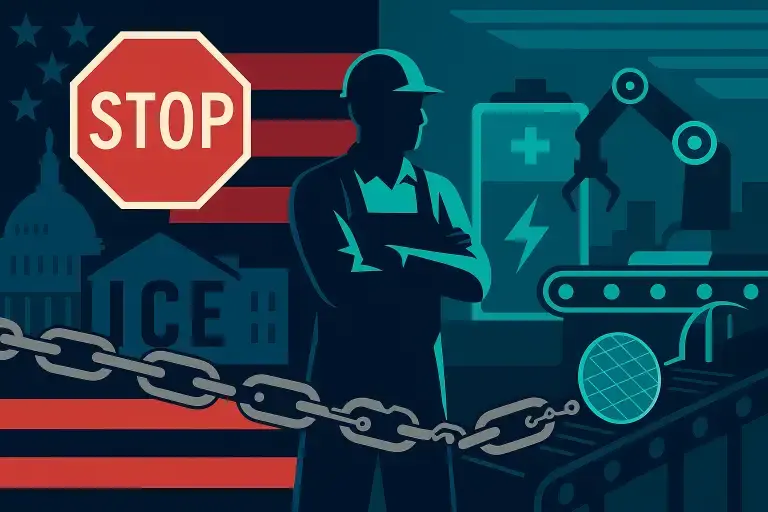
The September 2025 raid at Hyundai and LG’s battery plant in Georgia set off more than an immigration dispute. Federal agents detained hundreds of Korean technicians, some in visible restraints, and released images that traveled instantly across Seoul. The operation, carried out only days after a high-profile summit between the two governments, undercut Washington’s message of partnership and triggered a wave of anger in Korea’s press and parliament.
At issue is not only how the raid was conducted but the contradiction it exposed. The United States is investing billions of dollars to lure advanced manufacturing back home through the Inflation Reduction Act and the CHIPS Act. Yet the same government restricts or penalizes the entry of the skilled workers these projects cannot function without. The Georgia raid turned that tension into a public spectacle, raising questions about whether America’s industrial ambitions can be squared with its immigration enforcement.
When Industrial Policy Meets Enforcement
Agents entered the plant with little warning. Several hundred Korean nationals were taken into custody, many under short-term visas not designed for factory work. By ICE procedure, restraints were standard, but the decision to circulate images of chained workers altered the meaning of the raid. What could have remained a technical enforcement action quickly became a political flashpoint.
In Seoul, the reaction was immediate. News outlets led with the images, lawmakers called emergency hearings, and ministries demanded explanations through diplomatic channels. Public opinion framed the incident less as a matter of visa compliance than as the humiliation of a partner country’s workforce. The government faced pressure to show it could defend citizens abroad while justifying why so much national capital was tied up in U.S. projects.
Washington’s response exposed internal divisions. Industrial officials warned of delays to high-profile battery and semiconductor projects. Enforcement agencies insisted that the law had been applied evenly, regardless of nationality. The clash revealed a lack of policy coordination: one arm of government offering subsidies to foreign manufacturers, another carrying out raids that threaten to derail the same investments.
Factories Without Workers
The raid in Georgia was not an isolated mishap. It reflected a structural gap in U.S. industrial strategy. Billions of dollars in subsidies have drawn investment to the South and Midwest, but the workers needed to build and run these plants are not there. Construction firms struggle to fill basic trades. In advanced facilities, the shortage is sharper: electrode coating, cleanroom assembly, and maintenance require expertise that the domestic pipeline cannot supply at scale.
Companies have filled the gap by rotating in foreign engineers. Many arrive on business visas or under visa waiver programs that were never intended for sustained technical work. It is a stopgap solution born of necessity. Enforcement agencies then treat the practice as a violation, while industrial planners rely on it to keep schedules intact.
The contradiction is systemic. Industrial policy assumes capital and subsidies are enough to re-anchor supply chains. Immigration policy still operates on an enforcement-first model, with no channel tailored to project-critical specialists. The two agendas collide in real time on the factory floor. The Georgia raid simply exposed what insiders already knew: without lawful pathways for skilled mobility, reshoring timelines cannot be met.
An Ally’s Anger
In Korea, the raid was not seen as a narrow enforcement case. It was read as a political insult. The images of Korean engineers in shackles dominated headlines, and opposition lawmakers demanded that the government show it could protect citizens abroad. Ministers pressed Washington for explanations, insisting the issue was not only legal status but the treatment of workers sent under the banner of alliance-driven investment.
The incident forced Seoul into a delicate position. It had to calm public anger while safeguarding strategic projects in the U.S. The pressure was domestic as much as diplomatic: billions in Korean capital are now tied to American factories, and the public questioned whether those investments compromise national dignity.
For Washington, the problem was different. Industrial agencies continued to present Korea as a key partner in securing supply chains, while enforcement arms insisted on uniform application of immigration law. The dissonance created doubts in Seoul about whether the U.S. could deliver coherent policy. In the eyes of Korean policymakers, the raid suggested that domestic politics in Washington could easily override the promises made at summits.
The Limits of America’s Manufacturing Revival
Federal subsidies have triggered a visible wave of construction. Semiconductor fabs in Arizona, battery plants across the South, and electric vehicle facilities in the Midwest now dominate the industrial map. Billions of dollars have been committed, and global manufacturers have followed the incentives. On paper, the U.S. appears to be on the way to restoring its manufacturing base.
The reality is more constrained. Labor remains the critical bottleneck. Skilled trades are in short supply, and the advanced technicians needed for battery and semiconductor production cannot be trained at the pace projects demand. Higher wages help attract some workers, but turnover is high, and younger Americans show little interest in relocating to remote industrial sites.
Costs are another barrier. Even with subsidies, U.S. facilities face structural disadvantages against Asian competitors. Energy, construction, and compliance expenses are higher, eroding the price advantage of domestically produced goods. Without protectionist measures or continuous subsidies, many projects risk becoming uncompetitive once production begins.
Politics adds further uncertainty. Industrial policy today rests on acts passed under one administration, but future governments could scale back incentives or shift priorities. Labor disputes, environmental reviews, and local opposition have already slowed timelines. The gap between political slogans and operational feasibility remains wide.
In practice, the U.S. will succeed in bringing home parts of its strategic industries — semiconductors, defense-linked manufacturing, and selected segments of clean energy. But a broad return of mass manufacturing is unlikely. What is emerging is a hybrid model: symbolic reshoring to satisfy political goals, backed by foreign capital and foreign expertise, layered over a domestic labor market that cannot yet sustain it.
Korea’s Own Labor Paradox
South Korea faces a mirror version of the labor gap now stalling U.S. projects. Shipbuilding orders for LNG carriers and offshore platforms are at record levels, yet the workforce to deliver them has not returned since the downturns of 2008 and 2016. Younger workers avoid the yards, citing low pay, hazardous conditions, and the reputation of subcontract-heavy employment. Despite government subsidies and recruitment drives, the supply of domestic skilled labor remains insufficient.
To keep production schedules, Korean shipyards have steadily expanded their intake of foreign workers. Welding, painting, and outfitting crews from Southeast Asia now account for a substantial share of the shop floor. Temporary visa quotas have been raised, but the system is ad hoc and often leaves both employers and workers in uncertain legal status. What results is a structural dependency: without migrant labor, the yards cannot meet delivery timetables, yet reliance on short-term permits prevents long-term skill accumulation.
The paradox echoes what unfolded in Georgia. Both the United States and South Korea pursue industrial strategies that outpace their own labor pipelines. Both rely on foreign technicians to bridge the gap. And in both cases, immigration frameworks are poorly aligned with industrial needs. The outcome is predictable—bottlenecks, policy clashes, and exposure to political backlash.
Investment on Shaky Ground
U.S. Reshoring vs Immigration Enforcement — Key Facts at a Glance
Data points to ground reporting on the Georgia raid, labor shortages, and policy contradictions affecting Korean investment.
For Korean firms, the Georgia raid changed the calculus. Hyundai, LG, SK, and Samsung have pledged more than a hundred billion dollars for plants in batteries, semiconductors, and electric vehicles. These projects depend on predictable rules and stable visa channels. Instead, they now face the prospect that enforcement actions can disrupt schedules overnight. The message to boardrooms in Seoul is plain: subsidies are generous, but the operating environment is unstable.
The risks are tangible. Construction and commissioning delays drive up costs that incentives cannot offset. Reliance on short-term rotations of foreign specialists leaves companies exposed to further raids. Labor shortages remain unresolved, ensuring dependence on expatriates for years to come. Investors must now price in enforcement risk — a category that should not exist in an economy positioning itself as the world’s secure industrial hub.
Other global manufacturers are watching. TSMC in Arizona, Japanese battery makers, and European automakers all rely on foreign specialists in similar ways. If the U.S. cannot align its immigration framework with its industrial goals, capital may hedge by diversifying elsewhere. The Georgia raid thus became more than a bilateral issue. It signaled to the global market that America’s promise of reshoring may be undercut by its own internal contradictions.
The raid in Georgia exposed a policy contradiction that can no longer be ignored. The United States is spending heavily to rebuild strategic industries, yet its immigration system blocks or criminalizes the movement of the very specialists those industries require. Industrial subsidies and enforcement crackdowns are moving in opposite directions, and the result is uncertainty for allies and investors alike.
For Korea, the incident is more than a consular matter. It raises questions about whether its citizens will be treated as partners or liabilities inside America’s industrial revival. A stronger diplomatic stance is unavoidable, not only to protect workers but to press for structural fixes such as dedicated visa pathways for strategic projects. Without such measures, the risks of delay, reputational damage, and political backlash will remain.
Global investors will draw their own conclusions. If the U.S. cannot reconcile its industrial ambitions with a coherent labor and immigration framework, its credibility as a manufacturing hub will erode. The images from Georgia were stark, but their real impact lies in what they revealed: an industrial strategy built on subsidies without the labor policy needed to sustain it.
The Weekly Breeze
Keep pace with Busan's deep narratives.
Delivered every Monday morning.