The Best Car-Free Running Route in Busan? Try Eulsukdo Island
Eulsukdo Island in Busan offers more than a run—it offers a rare space to breathe, listen, and slow down. A story of movement and quiet renewal.
Just beyond the industrial spine of Busan, where the Nakdonggang River loosens its hold and begins to merge with the South Sea, lies an island that does not announce itself. Eulsukdo appears quietly—neither wild nor manicured, suspended somewhere between marsh and memory. For decades, it has existed in the city's periphery, both geographically and culturally. And yet, for those who venture there, the island offers a rare thing in a city built on speed: an invitation to slow down.
Though connected by road and reachable within an hour from central Busan, Eulsukdo remains uncrowded, bypassed by tourists chasing brighter lights and steeper hikes. The silence here isn’t the empty kind—it is textured, filled with birdsong, riverwind, and the sound of one’s own footsteps. It is not empty, but open.
In an age of constant movement, the island presents a form of silent travel—a movement that is both outward and inward, where walking or running is not a form of escape, but of return. With its traffic-free roads and ribboning trails, Eulsukdo offers a space where time dilates, and attention becomes tangible. It is not a destination in the conventional sense, but a landscape best experienced in motion—quiet motion.
From Reclamation to Regeneration
Long before the walking trails and reed beds, Eulsukdo was not a park, but a plan—a functional landscape caught in the currents of development.
In the mid-20th century, much of the island was shaped not by nature but by human intervention. Like many estuarine zones across Korea, the wetlands of the Nakdonggang River delta were once seen as underutilized space—prime territory for landfill, flood control, and expansion.
Throughout the 1960s and ’70s, parts of Eulsukdo were reclaimed and restructured, with embankments built to support infrastructure and industry. Its role as a habitat diminished as Busan grew outward, consuming edges to feed the center. By the early 1990s, ecological damage in the area was evident, and the region became a focal point for local conservationists and policy reformers, alarmed by the rapid loss of coastal wetland.
That pivot—from marginal zone to ecological resource—did not happen quickly. But in the early 2000s, a shift took hold. Portions of the island were officially protected. Wetland regeneration projects began. Public education centers were constructed. Eventually, Eulsukdo was recognized as a site of international ecological value, listed under the Ramsar Convention, a treaty for the conservation of wetlands.
Today, the island is home not only to over 150 species of migratory birds, but also to a growing cultural infrastructure: the National Youth Ecology Center, the Busan Museum of Contemporary Art, and the Eulsukdo Ecological Park, which integrates habitat protection with public access. What was once ground engineered for utility has become a space designed for reflection—ecological, architectural, and personal.
Eulsukdo’s transformation is not just a story of environmental repair. It is a testament to how landscapes can be reimagined, how something utilitarian can become sacred when left to breathe.
Between Earth and Asphalt
On Eulsukdo, movement begins with a choice.
The island offers two divergent paths, each shaped by the land it follows. To the west and north, there are unpaved trails—soft earth underfoot, grass brushing the shins, a meandering route that favors reflection over pace. These trails are intimate and sensory. The ground gives slightly with each step, the air smells green and humid, and runners move close to the reeds, sometimes startling birds into the air with the rustle of motion.
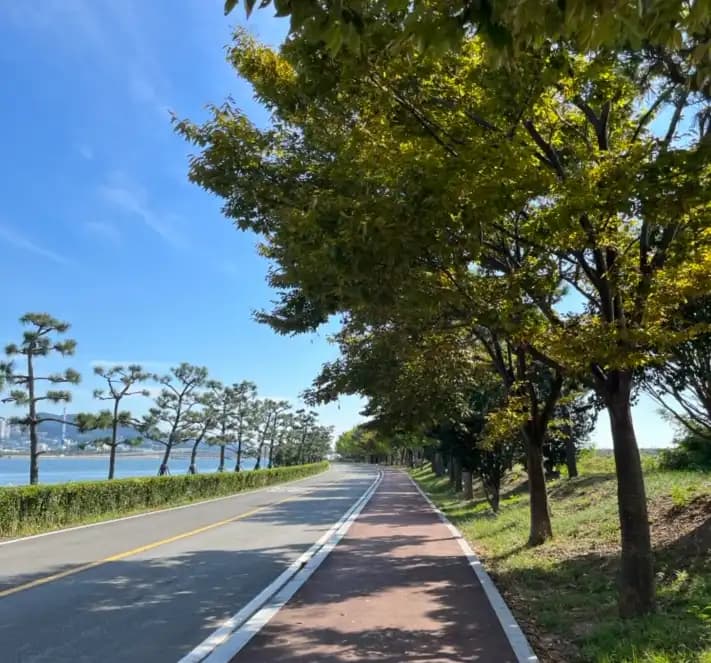
To the east and south, however, a different path awaits. A paved road, uninterrupted and curving, arcs gently through the center of the island. It is broad and empty—sealed to traffic, lined with silence, designed not so much for performance as for clarity. It is this road that draws those seeking stillness in motion.
The experience of running here is unlike any found in the city. There are no traffic lights, no curbs, no horns, no bicycles rushing past. The runner shares the road only with wind and light. It is a surface designed for uninterrupted rhythm—flat, clean, and forgiving. In a place where nature has reclaimed control, the paved road feels less like an intrusion and more like a line of conversation between the human and the landscape.
Depending on one’s capacity, the route offers options: a shorter loop of seven kilometers, or an extended circuit reaching ten. The path passes by the National Youth Ecology Center, brushes the edge of the Bird Sanctuary, and skirts open wetlands before returning to the cultural anchor of the Busan Museum of Contemporary Art.
There is no urgency here. No sense of the finish line. The pace is self-governed, and the reward is not in distance but in awareness—the kind that accrues quietly, one breath, one footfall, one silence at a time.
Where most city runs involve the management of space—dodging pedestrians, anticipating traffic—running on Eulsukdo’s road becomes a different act entirely. One that belongs not to escape or efficiency, but to a deeper kind of arrival.
Quiet Roads, Loud Minds
In most urban landscapes, running is an act of negotiation. One’s body navigates not only the terrain but the city’s competing rhythms—dogs straining at leashes, bicycles cutting corners, schoolchildren darting across footpaths, delivery scooters announcing themselves without apology. The runner must constantly adjust, dodge, anticipate. Listening becomes fragmented. Thought is shallow. Focus is peripheral at best.
On Eulsukdo’s paved roads, the negotiation ceases.
The runner is alone, or nearly so, flanked by water and sky, buffered by wetlands and wind. Without traffic, without crowding, without the low-grade hum of a city’s unrelenting presence, a different kind of engagement emerges. Not with surroundings, but with self. On these roads, the body moves, and the mind, at last, can follow.
Among local runners, the route has earned a quiet reputation—not for difficulty or prestige, but for what it offers in return: clarity. Some describe it as meditative. Others as productive. Several runners interviewed noted that Eulsukdo is the only place where they can truly listen—not just hear, but absorb.
“In the city, I put on podcasts, but I never finish them. There’s always something else pulling at me,” said Minjae, 41, a longtime Busan resident and weekend runner.
“But out here, I finish every episode. I remember the ideas. I go home and write them down.”
This kind of focused attention—rare in a digital age—is made possible not by technology, but by environment. On Eulsukdo, the absence of noise creates space for meaning. The cadence of a podcast aligns with the rhythm of the stride. The voice in the ear becomes a companion rather than background chatter. Words land more fully. Stories unfold more cleanly. The run becomes a classroom without walls, a form of thinking that uses muscle and breath as its medium.
For those less inclined to listen and more inclined to notice, the island itself becomes its own audio track: wind slipping through tall grasses, the rustle of wings, the tap of a shoe against the pavement. In this silence, even thought can echo—louder than traffic, sharper than urgency.
Where Breath Meets Thought
The loop ends where it began. But after seven, perhaps ten kilometers, the body has changed. So has the air. And for many who run Eulsukdo’s quiet roads, the natural conclusion is not a return to the noise of the city, but a step into stillness of another kind.
Set at the island’s eastern edge, just beyond the reach of the wetlands, the Busan Museum of Contemporary Art rises with the same restraint that characterizes the entire landscape. Its low-slung concrete form, glass planes, and subtle angles seem to echo the rhythm of the paths just run. There are no grand steps or banners demanding attention—only invitation.
Inside, the galleries are hushed and cool. The exhibitions shift with the seasons but frequently explore themes resonant with the land outside: climate, environment, the body in space. On some days, the rooms seem barely populated; one might stand in front of a vast installation and hear only the soft hum of the air system, and the slow breath of recovery.
It’s an unusual pairing—a long, silent run followed by contemporary art—but for many, the connection is instinctive. The act of running prepares the mind to receive, to hold stillness without resistance. What begins as motion becomes meditation, and what follows is a kind of contemplative openness—an ability to be with something without needing to name it.
The transition feels less like a shift than a continuation. Running had already been an aesthetic act, an attentional practice. Now, in the echo of the museum’s architecture, attention deepens.
“You arrive at the museum not just physically, but mentally. You’re emptied out. And then the art fills you again—but differently,” one visitor shared.
In this way, the Eulsukdo loop is more than a route. It is a cycle—from energy to presence, from exertion to reception, from the motion of the body to the stillness of the mind. And when one finally steps back outside, the island feels different too. Not because it has changed, but because the runner has.
A Place That Doesn’t Rush You
There are few places left in cities that allow for slowness without guilt. Few roads where progress isn’t measured in pace or productivity. On Eulsukdo, the path doesn’t press forward—it unfolds. It waits.
There are no signs counting calories, no runners chasing digital ghosts, no urgency in the curve of the asphalt. Everything on this island moves at the speed of awareness. The birds lift slowly from the river. The water turns with the tide. Even the trees seem to bend with intention.
The silence isn’t total, but it is structured—a stillness that holds space, not absence. In that quiet, attention returns to the body, and through the body, back to the self. For some, it may be the only time in a week when a thought is followed to completion, when a breath is felt all the way to its end.
Eulsukdo does not ask for your best time, or your personal record. It doesn’t track or compete or demand. Instead, it offers something quieter, rarer: permission. To go slowly. To pay attention. To finish something you started—be it a sentence, a story, or a single, steady run.
And perhaps that is its gift. Not just the run itself, but what remains after—the voice that stayed with you, the phrase that landed, the moment you forgot you were moving and simply existed, briefly, inside the rhythm of your breath.
The Weekly Breeze
Keep pace with Busan's deep narratives.
Delivered every Monday morning.