South Korea Reverses AI Textbook Policy After Public and Legal Pushback
South Korea has officially removed AI textbooks from its national curriculum, following technical failures, legal confusion, and mounting public opposition after just one semester of use.

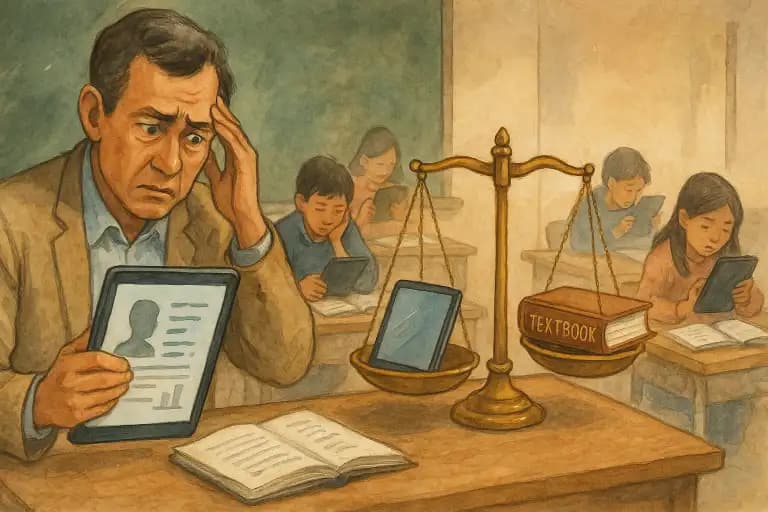
In 2023, South Korea set out to become a global leader in digital education. The government, led by ex-president Yoon Suk-yeol, announced that artificial intelligence would become the core of classroom learning. At the center of this plan was the AI digital textbook—software designed to assess student performance in real time and adjust content to suit individual learning styles. Supporters said it would help reduce academic inequality and modernize public education for the next generation.
At first, the idea drew attention for its ambition. The Ministry of Education revised existing guidelines to redefine textbooks to include intelligent learning platforms. That move, made through executive regulation rather than full legislation, allowed the policy to move fast. In 2023, the government committed at least ₩533.3 billion (roughly USD 400 million) to the project. Private publishers and tech companies added their own funding, encouraged by what seemed like a long-term national transformation.
By early 2024, AI textbooks were introduced in select schools. Third and fourth graders used them for English and math. First-year middle and high school students piloted them in math, English, and information technology. The system promised adaptive testing, instant feedback, and content tailored to student behavior. Schools received devices, and teachers were trained—albeit briefly—to run digital classrooms. The rollout moved ahead on a tight timeline.
But problems appeared quickly. In many schools, hardware was unreliable. Network failures delayed lessons. Teachers had to become IT support with minimal preparation. Some classrooms had to switch back to printed materials mid-semester. Despite government assurances, most teachers said they didn’t feel equipped to manage the technology while also focusing on instruction.
South Korea’s AI Textbook Policy (2022–2025)
| Date | Event | Description |
|---|---|---|
| Late 2022 | Policy Concept Introduced | Ministry of Education begins outlining AI-powered textbooks. |
| January 2023 | Regulation Revised | Executive order redefines “textbook” to include AI-based software. |
| 2023 Budget | ₩533.3 Billion Allocated | Government commits funds for development, training, and infrastructure. |
| Spring 2024 | Pilot Program Launched | AI textbooks used in grades 3–4 (elementary) and grade 1 (middle/high school) for math, English, IT. |
| Mid 2024 | On-Site Issues and Backlash | Teachers and parents raise concerns about readiness, training, and effectiveness. |
| Late 2024 | Education Act Revision Proposed | Bill submitted to define textbooks as printed/digital only; excludes AI software. |
| December 2024 | Bill Passed, Then Vetoed | National Assembly passes the bill; vetoed by acting president (Choi Sang-mok). |
| Early 2025 | Rollout Delayed | Mandatory adoption postponed; voluntary use allowed in select schools. |
| August 2025 | Final Bill Passed and Enforced | Law passed again and enacted immediately; AI textbooks officially reclassified as “educational resources.” |
The educational impact was also mixed. Some students appreciated the interactivity and instant feedback. Others struggled to focus. Without strong guidance, some used the devices for unrelated content. In homes, parents voiced concern about screen time and data privacy. Many felt excluded from key decisions and received little information before the new system was introduced.
Behind the scenes, deeper issues were surfacing. The policy had bypassed a full legal review. The Ministry had changed enforcement regulations to include AI textbooks in the national system, but critics argued that the Elementary and Secondary Education Act still defined textbooks narrowly. This discrepancy created a legal gray area. In late 2024, lawmakers from the opposition proposed a revision to the law: redefine “textbook” to mean only printed or e-book materials. AI-powered software would be considered a learning aid—not a textbook.
The first version of the bill passed the National Assembly but was vetoed by the acting president at the time. Still, momentum continued. With a shift in the legislative majority, the bill returned and passed again in mid-2025. This time, it was signed into law. The change took effect immediately.
That legal decision marked a sharp turn. AI textbooks were no longer recognized as official learning materials. They could still be used, but schools would have to purchase them independently, without public funding or government review. Public-private partnerships were thrown into uncertainty. Companies that had developed software under government agreements now faced financial losses. Some are exploring legal action, claiming they were misled by early promises.
For teachers and administrators, the reversal created operational chaos. Schools that had built digital classrooms now lacked support. Teachers had to rewrite plans again, this time returning to printed content. Many had already invested time adapting to the AI system and felt the shift came without clear direction or backup. The Ministry of Education promised guidelines, but support arrived slowly. Meanwhile, students caught between two systems were left with fragmented lessons.
The policy's failure wasn’t entirely technical. Many experts now see it as a governance breakdown. The pace was fast, but the foundations were weak. Critical decisions were made without full legal cover or input from schools and families. Feedback mechanisms were minimal. The AI textbooks were treated as a finished product, rather than a pilot to refine with time and participation.
When compared to other countries, Korea’s approach stands out. In the U.S., AI tools are used to supplement traditional lessons. Implementation is local, slow, and guided by teacher input. In China, digital transformation is coordinated centrally but backed by long-term investment and planning.
European countries like Sweden have taken a step back, reinstating print after observing negative effects from early digitization. Japan and India offer more modular models. Japan’s CoNETS platform supports voluntary adoption, while India’s DIKSHA platform prioritizes accessibility and training in low-resource areas.
South Korea aimed to leap ahead, but moved without safeguards. The policy relied on regulation instead of legislation. It treated AI as a standalone solution, not part of a broader ecosystem. It also underestimated the complexity of schools, where technology only works when people, training, and support systems are aligned.
Why the AI Textbook Policy Broke Down
From the outside, the idea behind AI textbooks seemed solid. But once the rollout began, it became clear that the project was built on weak foundations.
The first major issue was speed. Policy moved faster than schools could adjust. Teachers were given new systems without time to prepare, and schools were expected to absorb changes with limited support. Many teachers only received a few hours of training. They were then expected to manage adaptive learning platforms, diagnose technical issues, and still teach their regular curriculum.
Another problem was infrastructure. In schools across the country, devices malfunctioned. Internet connections were too slow for real-time learning. Some students had no access to working equipment, while others used tablets for entertainment instead of studying. These weren’t isolated cases—they happened in every region.
The third weakness was governance. The policy was introduced through an administrative regulation, not legislation. This left it vulnerable to legal challenge and political reversal. Once criticism mounted, there was little legal protection to keep the system in place.
Communication was another point of failure. Parents weren’t consulted. Teachers weren’t involved in shaping the tools. Many people affected by the policy only found out after decisions had already been made. When problems surfaced, responses from officials were slow or vague.
Finally, the system lacked flexibility. Once issues appeared in schools, there was no structured way to collect feedback or adapt quickly. Problems in one school were often repeated in others. Teachers improvised workarounds, but there was no clear national response.
In the end, the project relied too heavily on the assumption that technology could solve deep-rooted educational issues—without first fixing the human, legal, and logistical structures that support learning. The technology wasn’t the failure. The system around it was.
The Weekly Breeze
Keep pace with Busan's deep narratives.
Delivered every Monday morning.