South Korea Confronts a Digital Infrastructure It No Longer Fully Controls
Foreign-operated satellite networks, major data breaches and a government data-centre failure reveal how essential Korean services now depend on systems outside national authority, pushing operational sovereignty to the centre of Seoul’s policy agenda.

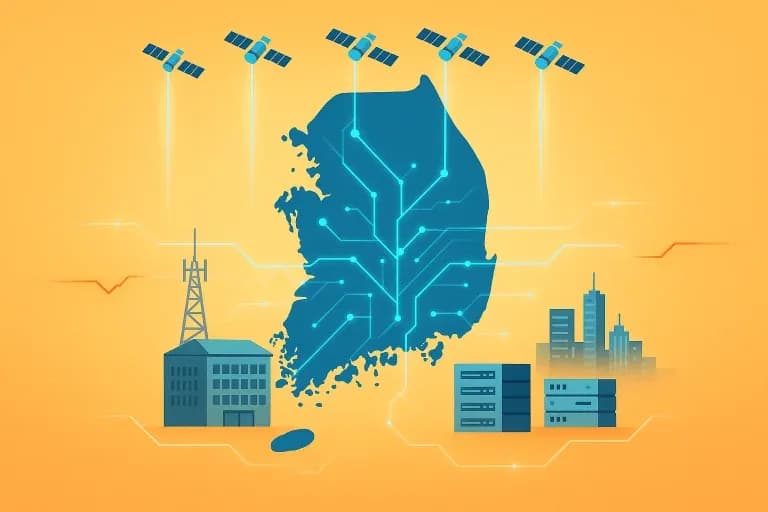
South Korea entered 2025 with the reputation of a country that had largely mastered the mechanics of digital life. Its mobile networks ranked among the world’s fastest, government services continued to migrate online, and daily commerce depended on platforms used by nearly every household. But over the course of the year, a series of unrelated disruptions exposed how deeply the nation’s essential functions rely on systems that operate outside the government’s direct control.
In April, attackers slipped inside SK Telecom’s core subscriber systems, extracting authentication keys, IMSI numbers and usage data tied to tens of millions of mobile accounts. By summer, intrusions at major retailers and cultural platforms had become routine. Then came the breach at Coupang, where credentials left active after an employee’s departure enabled months-long access to information on more than 33 million users — one of the largest commercial exposures in the country’s history. Each incident pointed to the same weakness: the private companies that now handle much of Korea’s logistical and commercial infrastructure had not built the defences expected of institutions carrying public-scale responsibility.
The vulnerabilities were not confined to the private sector. A fire at the National Information Resources Service data centre shut down hundreds of public services at once, disabling mobile identity verification, postal banking functions and administrative portals that citizens use for legal and financial transactions. The outage did not stem from a nationwide network failure; it came from the concentration of government operations in a single facility with limited redundancy.
At the same time, foreign networks were moving closer to the heart of Korea’s critical operations. Starlink entered the market with contracts to equip Korean airlines and shipping operators, tying long-haul communications to a satellite constellation governed abroad. Global cloud and security providers — essential to payments, authentication and content delivery — experienced disruptions that briefly froze services across multiple Korean sectors despite flawless domestic connectivity.
Taken together, the events of 2025 revealed a structural shift. The stability of Korea’s digital society no longer depends on the strength of its domestic networks alone. It hinges on a layered system in which core functions are distributed across private platforms, overseas cloud regions and foreign-operated satellite links — components that the state can neither fully inspect nor command. The year’s incidents forced a question to the surface: how much control does a digital nation require over the systems that allow it to function, and how much has already slipped beyond its grasp?
The Architecture Beneath Korea’s Digital Economy
The events of 2025 exposed weaknesses that did not originate in damaged cables or overloaded base stations. They emerged from the structure that now governs how Korea’s digital services actually run. The country’s physical networks remain among the most reliable in the world, yet many of the functions that determine whether a payment clears, a shipment is tracked or a public record is retrieved are executed on layers that sit far above the domestic infrastructure that carries the traffic.
Over the past decade, core elements of daily life migrated from government-run systems and on-premise servers to large private platforms. E-commerce companies built their own logistics engines, routing millions of deliveries through automated decision systems that operate independently of the state’s transport networks. Mobile carriers increasingly relied on outsourced security filtering and cloud-based authentication, shifting parts of their operational logic to foreign data centres. Banks and payment firms integrated third-party identity verification and fraud-detection tools that cannot function without uninterrupted links to external cloud regions.
For most users, these shifts were invisible. Transactions were fast, deliveries predictable and digital administration convenient. But the arrangement meant that the authority shaping how those systems behaved no longer aligned neatly with national jurisdiction. Some operational functions were managed by Korean corporations with varying levels of internal oversight. Others were governed by overseas providers whose outage, update cycle or security lapse could affect domestic services despite no fault in local networks.
The structure became more intricate as new technologies entered the market. Satellite connectivity expanded into sectors previously dependent solely on terrestrial networks, offering uninterrupted service for aircraft and vessels but placing parts of Korea’s long-distance communication under foreign control. Artificial-intelligence engines used in manufacturing, retail and logistics drew their models from cloud platforms whose training data and operational parameters were set abroad. Even routine activities — verifying a phone number, resolving a domain name, loading a payment widget — were increasingly dependent on global intermediaries.
This layered system functioned smoothly as long as every component behaved as expected. When any part faltered, the consequences spread quickly because the operational logic was no longer contained within Korea’s borders. What had once been a national network with supplementary external links had become a hybrid ecosystem in which essential services were divided across domestic carriers, private platforms and overseas infrastructure. The disruptions of 2025 did not create this structure; they revealed how extensively it had already taken hold.
A Year of Failures That Exposed Where Control No Longer Resided
The first clear signs of strain appeared in the spring, when a set of disruptions rippled across Korean services despite no malfunction in domestic infrastructure. A misconfigured update at an overseas security provider slowed authentication for banks, retailers and mobile operators, leaving users unable to log in to services that otherwise remained online. Hours later, a failure at a global content-distribution network caused payment pages to time out and logistics dashboards to freeze. The incidents were brief, but they demonstrated that essential digital operations now depended on systems governed outside Korea, where domestic regulators had no authority to demand logs, compel fixes or accelerate recovery.
Weeks later, a very different vulnerability emerged inside the country’s central government. A fire in a national data centre disabled hundreds of public services simultaneously — from mobile identity checks to postal banking and administrative record portals. The event did not reflect a nationwide outage but the concentration of government operations in a single facility built in an earlier era, when online services were fewer and redundancy was less critical. The blackout revealed that the state had retained physical control of its hardware while allowing operational continuity to hinge on a narrow, centralized point.
Around the same period, an intrusion at one of Korea’s largest e-commerce platforms exposed another form of structural fragility. Access credentials left active after an employee’s departure allowed months of unauthorized entry into customer information. The company responded with investigation and remediation, but the scale of the breach raised questions that went beyond corporate compliance. A platform that handles millions of transactions a day, stores detailed delivery histories and powers a nationwide logistics network had been operating without the internal controls expected of an entity performing functions that now border on public infrastructure. The vulnerability lay not in the country’s networks but in the governance of a private system supporting essential services.
A new dependency was forming offshore. Airlines and shipping operators began deploying low-Earth-orbit satellite terminals that promised uninterrupted connectivity over long-haul routes. The technology offered clear operational advantages, yet it shifted authority over critical communication channels to foreign operators. Routing decisions, service availability and technical constraints were determined outside Korean jurisdiction, adding an external layer whose failure or policy change could affect safety-critical operations without warning.
Each incident stemmed from different conditions — an overseas update error, a fire, an internal lapse, a new communication technology. But they converged on a single point: the systems that determined whether core functions worked were no longer under one coherent locus of control. Some belonged to global cloud and security providers, some to private platforms with limited oversight, some to public facilities designed for an earlier computational model, and now a growing share to foreign satellite networks.
By the end of the year, the pattern had become unmistakable. Korea’s digital operations had outgrown the architecture through which they were governed. Failures did not propagate because domestic networks faltered, but because the authority to operate, secure or repair essential systems was dispersed across jurisdictions and institutions that the country could not fully direct. The incidents of 2025 did not point to a single cause; they pointed to a single structural reality.
Nations That Moved Early to Reclaim Digital Control
While Korea confronted its own vulnerabilities through a series of domestic breaches and infrastructure failures, some governments had begun reshaping their digital architectures years earlier in response to the same structural pressures. Their reforms did not focus on building faster networks; they focused on ensuring that the systems running atop those networks could continue operating even when foreign providers failed, withdrew service or became subject to political constraints. These efforts offer a reference point for what operational sovereignty looks like when treated as a matter of national resilience, not market preference.
The European Union pursued the most extensive structural changes. After successive outages at U.S.-based cloud and security providers disrupted financial services, transportation systems and healthcare networks across member states, Brussels moved to reduce the concentration of operational control in foreign hands. The EU Data Act — now entering phased implementation — requires cloud providers to support seamless switching between vendors, prohibits technical and contractual lock-in, and grants regulators authority to audit how operational data is handled outside the bloc. Public agencies are instructed to maintain the ability to migrate essential workloads quickly if a provider becomes unreliable or faces legal conflicts that could compromise service continuity. Several member states have since built sovereign cloud environments operated solely by domestic personnel under EU law, created specifically for identity management, public records and emergency coordination.
A parallel shift took place in the United States, driven less by commercial concerns than by defence readiness. After years of centralizing military computing under single-vendor cloud contracts, the Pentagon abandoned the approach and distributed critical workloads across multiple providers. The change was motivated by a simple calculation: a single operational dependency created a strategic vulnerability, whether the threat came from a technical failure, a supply-chain compromise or coercive pressure from abroad. Under the new model, defence agencies must demonstrate that essential systems can fail over between cloud environments, preserve access to operational logs and maintain continuity even if one provider is unable or unwilling to deliver service. The federal government extended similar principles to civilian agencies, requiring redundancy across vendors for identity verification, cybersecurity filtering and hosted administrative systems.
A more extreme case emerged in Ukraine, where satellite communications became a lifeline after the destruction of terrestrial networks. The reliance on a privately operated global constellation highlighted the limits of state control when critical connectivity depends on a company headquartered abroad. Field commanders reported interruptions in coverage in contested zones, raising concerns about how far military operations could hinge on a network whose policies were ultimately determined by a foreign corporation. The experience accelerated Europe’s and NATO members’ investment in sovereign satellite constellations and ground infrastructure, aimed at ensuring that decisions about service availability are not delegated to commercial actors during periods of political or military stress.
Across these jurisdictions, the underlying principle was consistent: digital resilience required more than strong national networks. It required the ability to govern and, when necessary, replace the operational systems that made those networks useful — authentication services, routing infrastructure, cloud environments, satellite links and the data flows that sustain them. Where those systems were foreign-controlled, governments moved to define the conditions under which they could operate domestically. Where they were private, states imposed obligations aligned with their actual role in society rather than their corporate status.
The contrast with Korea was not in the scale of technology adoption but in the timing of institutional adaptation. By 2025, foreign jurisdictions had already treated dependency on external operational layers as a strategic issue. Korea, after a year of cascading failures, now faced similar questions without the benefit of reforms made in calmer conditions.
Industries Forced to Map Their Dependencies
The shifts that other governments confronted earlier arrived in Korea not through legislative debate but through the practical problems faced by industries that had woven external systems deep into their operations. For many companies, the disruptions of 2025 became the first clear accounting of where their own control ended.
In aviation, carriers preparing to introduce low-Earth-orbit satellite connectivity began mapping how much of their long-haul communication would depend on infrastructure beyond Korean oversight. Trials showed that the service could deliver stable bandwidth over oceanic routes, reducing the communication gaps that crews had long managed manually. But engineering teams also acknowledged that the ability to maintain real-time links would rest on routing decisions and technical policies set by operators abroad. The question was no longer whether the technology worked — it did — but whether Korean airlines could guarantee continuity during political disputes, commercial disagreements or regional service restrictions imposed without consultation.
Shipping companies confronted a similar calculation. Korea’s maritime sector had embraced digital fleet management, with engines for predictive maintenance, weather-routing and fuel-efficiency modelling running continuously through cloud-based analytics. When overseas authentication services slowed during the spring disruptions, several operators reported unexpected delays in receiving updated routing instructions and cargo-handling data. The delays did not halt operations, but they made clear that the sector’s digital backbone — vital to an export-driven economy — passed through systems the companies did not administer or legally control.
In finance, the dependency was exposed more publicly. Banks experienced intermittent login failures when an overseas identity-verification provider encountered an update error. Payment processors saw transaction flows stall even as domestic networks functioned normally. Executives who had framed cloud outsourcing as a means to reduce cost and expand scale found themselves explaining to regulators why essential financial functions were tied to third-party systems that could not be inspected or compelled to prioritise recovery when something went wrong. The incidents did not undermine the stability of the financial system, but they illustrated how far its daily operations had drifted from infrastructure subject to Korean oversight.
Logistics firms were already aware of the trend but saw it accelerate. Distribution centres relied on machine-learning systems hosted in foreign cloud regions to forecast demand and assign delivery routes. When authentication failures in Europe and the United States briefly impeded access to those tools, dispatch schedules slipped and automated sorting lines paused while workers reverted to manual triage. The disruptions were temporary, yet they underscored a structural fact: real-time logistics, one of the pillars of Korea’s consumer economy, functions through decision systems operated far outside the country.
Manufacturers using cloud-based industrial automation faced narrower margins for error. High-precision facilities using AI-driven defect detection or remote-maintenance platforms learned that if their cloud models were unreachable — even for minutes — production had to slow or halt. Several firms reviewed their architecture after discovering that critical components of their so-called “smart factories” relied on single cloud regions, creating vulnerabilities similar to those faced by sectors hit earlier in the year.
The public sector’s experience with the national data-centre fire reinforced the same lesson. Ministries that had assumed their services were resilient discovered how many administrative functions lacked independent failover paths. The recovery process revealed years of accumulated dependence on singular facilities and legacy systems that had not kept pace with the digitalisation of government services.
Across these industries, the pattern was consistent: the systems that governed operations, safety, finance and logistics no longer resided within the organisations that depended on them. Control had been delegated — sometimes deliberately, sometimes by default — to platforms, providers and networks operating outside Korean jurisdiction. The events of 2025 did not render these arrangements untenable, but they narrowed the margin for error and forced companies to reconsider whether efficiency alone justified dependencies that could not be managed during crises.
Korea Confronts the Cost of Losing Operational Control
The pressures exposed across industries and public systems have pushed Korean policymakers toward a reassessment of how far the country can continue relying on private platforms and foreign infrastructure without stronger mechanisms of oversight. The year’s incidents did not create a new problem so much as they revealed how extensively essential functions had migrated into systems the state neither built nor directly governs. The political debate now centres on how quickly Korea can redraw the boundaries of responsibility in a digital economy where operational decisions increasingly lie outside the country’s reach.
Lawmakers began by targeting the most visible failures. Following the breaches at SK Telecom and Coupang, senior officials revived proposals to strengthen punitive damages, raising the ceiling for penalties and granting regulators broader authority to audit corporate security programs. The argument is straightforward: platforms that handle the personal data of tens of millions of people function effectively as public utilities and should face obligations proportionate to the scale of harm they can cause. Discussions now include mandatory breach reporting within hours, real-time inspection rights for regulators, and restrictions on data processing for firms that repeatedly fail to meet minimum standards.
The government is also under pressure to reassess its own infrastructure strategy. The fire at the national data centre exposed the risks of concentrating public administration in a single facility. Ministries have begun drafting plans for distributed government computing, including mirrored facilities and cloud-enabled failover systems designed to prevent a replay of the nationwide disruptions that followed the fire. Security agencies are promoting new frameworks that allow for controlled adoption of cloud and AI tools while keeping operational logs, identity systems and sensitive datasets under public stewardship.
Foreign infrastructure presents a more delicate challenge. Global cloud providers now support authentication, payment processing and content delivery across major Korean industries. Starlink’s expansion into aviation and maritime operations adds a new layer of external dependency. Policymakers are examining whether these providers should face market-entry conditions similar to those enforced in the EU: data localisation for critical workloads, auditability of operational logs, requirements for service continuity during political disputes, and obligations to provide Korean authorities with clear lines of accountability in the event of disruptions.
Several lawmakers have revived debate over establishing a national digital backbone — a combination of sovereign cloud resources, government-run authentication systems and public communication infrastructure — to ensure that essential functions can continue even if commercial platforms or foreign networks falter. Supporters argue that the current hybrid system, shaped incrementally over a decade of rapid digitalisation, no longer reflects Korea’s security needs. Opponents warn of cost and duplication, but the events of 2025 have shifted the political calculus; resilience now carries weight that cost-efficiency once held.
For the first time, Korea’s policy conversation frames data leaks, platform outages and foreign-operated satellite networks as parts of the same structural issue rather than isolated events. The country’s digital resilience depends not only on fast networks and advanced services but on the ability to direct, inspect and, when necessary, replace the systems that make those networks functional. With public confidence shaken and corporate defences exposed, the question confronting policymakers is no longer whether to intervene but how far the state must go to ensure that the digital foundations of its economy operate within boundaries it can control.
A Digital Nation Forced to Reconsider What It Must Control
The disruptions that shaped Korea’s digital landscape in 2025 never produced a nationwide blackout, yet together they revealed a more consequential weakness: the country’s essential services rely on operational systems it does not fully command. Starlink’s arrival illustrated how quickly foreign infrastructure can become embedded in sectors tied to national safety. The breaches at SK Telecom and Coupang showed how lightly regulated private platforms now handle information central to identity, commerce and daily life. The fire at the government’s own data centre demonstrated that even public institutions had not built the redundancy required for an era when administration depends on continuous digital access.
Individually, each incident produced its own technical explanations and official reassurances. Viewed together, they chart a single trajectory. The core logic that determines whether payments clear, aircraft remain connected, welfare benefits are processed or citizens’ data remains secure has shifted beyond the state’s direct reach. Efficiency and rapid digitalisation delivered clear gains over the past decade, but they also expanded a system in which foreign networks, commercial decision engines and legacy government infrastructure now operate side by side without a unified framework of accountability.
Korea enters its next phase of digital development under no illusions about the cost of inaction. Lawmakers are weighing stronger penalties for security lapses and exploring conditions for foreign infrastructure that mirror emerging standards in Europe and the United States. Agencies are reassessing how public systems are distributed and which functions must remain under explicit national stewardship. Private platforms, after a year of unprecedented scrutiny, face pressure to meet safeguards that reflect their practical role as critical infrastructure rather than their formal status as commercial firms.
The questions raised this year will not be settled quickly. But the events of 2025 have made one point unavoidable: technological advancement alone cannot secure a digital society whose essential operations depend on entities the state cannot direct or replace. Korea’s next decisions will determine whether the efficiency gained through global integration can be matched by the resilience required to govern it.
The Weekly Breeze
Keep pace with Busan's deep narratives.
Delivered every Monday morning.