Smart Village or Smart City? The Reality Behind Korea’s Flagship Projects
Inside Korea’s smart city experiments—Busan Eco-Delta City and Sejong 5-1—where high-tech pilots work, but full-city integration lags behind.


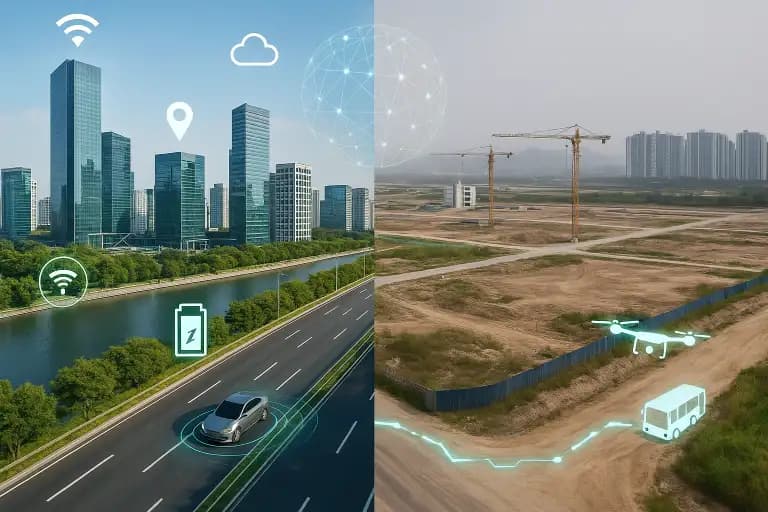
In 2018, South Korea’s Ministry of Land, Infrastructure and Transport (MOLIT) designated two national pilot smart cities: the 5-1 living zone in Sejong and the Eco-Delta City (EDC) project in Busan.
EDC was conceived as an entirely new 11.8-square-kilometer waterfront district combining large-scale urban development with integrated smart-city infrastructure—digital twins, zero-energy buildings, autonomous mobility, robotics, and water-management systems.
Within that much larger project, the “Smart Village” was created in 2022 as a small living-lab enclave of 56 households under a five-year free-lease arrangement, testing more than forty home- and neighborhood-level innovations.
The vision for both pilot cities was ambitious: fully connected urban environments powered by AI, IoT, autonomous mobility, and integrated data platforms. Over the years, government agencies, municipal authorities, public corporations, and large construction firms have reiterated this vision through announcements, promotional videos, and staged demonstrations.
Yet, as of mid-2025, much of that vision remains confined to pilot zones and controlled trials. In Sejong, civil works and platform designs are progressing, but citywide smart services are still in preparation. In Busan, the Smart Village is the most visible citizen-facing example, while the rest of EDC remains under phased construction with most systems yet to be integrated citywide.
This gap between the program’s stated objectives and its citizen-level impact has sparked debate among urban policy experts and technology planners. Some point to the deliberate pace as a safeguard against costly missteps.
Others see in the delays and narrow deployments a deeper set of structural issues: diffuse governance, fragmented data infrastructure, and a procurement model that rewards visible installations over durable outcomes.
The contrast with global leaders—Singapore’s integrated digital backbone, Hangzhou’s real-time “City Brain,” and Amsterdam’s open-standards governance—raises the question of whether Korea’s pilot cities are on a path toward scale, or locked in a perpetual beta.
The Promise, Checked Against Reality
When the national pilot program was launched in 2018, South Korea set out to prove a replicable smart-city model in two locations—Sejong 5-1 and Busan Eco-Delta City—before expanding it nationwide. The design blueprint combined AI-enabled mobility, IoT-rich infrastructure, and a centralized “city operating system” (City OS) managed through public–private special-purpose companies (SPCs). Each SPC would build for five years, operate for ten, and ideally hand over a fully functioning model for replication elsewhere.
Busan’s Eco-Delta City entered a more visible, citizen-facing phase earlier than Sejong. Within the much larger 5.6-trillion-won development zone, the Smart Village opened in 2022 as a 56-household living lab. Residents, selected under a five-year free-lease arrangement (paying only management fees), agreed to participate in testing more than forty smart-home and neighborhood-level features.
These range from AI-enabled kitchen appliances and health-monitoring mirrors to delivery robots and smart farming installations. While these features operate daily inside the village, the project is geographically tiny—occupying a fraction of the EDC footprint—and administratively distinct from the integrated systems planned for the full district.
Sejong’s 5-1 zone followed a different trajectory. Conceived as a “platform city” where transport, energy, water, and civic services would feed into a single data hub, it spent its early years in master-planning, procurement, and SPC formation. Civil works are now under way, and the technical architecture for the City OS is being finalized, but as of mid-2025, large-scale residential occupation and citywide smart services have not yet begun.
Seven years on, the two pilots have yielded tangible hardware and service pockets, but neither has delivered a fully integrated urban model. Busan offers a working micro-scale demonstration without a confirmed transition plan after its initial five-year lease cycle. Sejong retains a strong conceptual framework but remains in the build phase. Together, they highlight the gap between assembling technically impressive components and operating a cohesive, citywide smart environment over time.
Follow the Money
On paper, Korea’s national smart-city program reads like a digital transformation story. In practice, the early spending tells a different tale. The largest outlays in both Sejong and Busan have gone to civil works—land preparation, roads, water systems, and other foundational infrastructure. The “smart layer” of networks, sensors, and software platforms has generally arrived later, in smaller allocations.
From an engineering perspective, this sequencing is logical: without ducts, power supply, and backbone fiber, no digital system can operate. But for residents who were promised a city that behaves differently, years of invisible groundwork feel less like transformation and more like delay. In public perception, new roads and pipes are indistinguishable from any conventional urban development; the smart-city promise only becomes visible when services change daily routines.
Budget records reveal a consistent pattern. Major capital tranches fund the physical site. Smaller, later tranches finance discrete digital components—smart poles, autonomous shuttle loops, environmental sensor clusters, and isolated dashboards. Without sustained, protected funding for the operating core, these components risk remaining stand-alone demonstrations: a shuttle circuit here, a small sensor grid there, a control room viewable only by project staff.
Conversion from allocation to actual citizen-facing service is another friction point. Funds may roll over into the next fiscal year, scopes may shrink mid-project, and commissioning dates often slip. In some cases, a budget line intended for an open-data API ends up delivering a closed, proprietary interface just to meet a milestone. Measured per household or per kilometer, the cost of achieving stable, citywide operations is high—and much of it goes unseen by those meant to benefit.
Transparency is the final test. Mature smart-city programs can show their work: public contract registries, performance obligations, uptime records, API call logs, and adoption rates for resident-facing apps. In both Sejong and Busan, these artifacts are scarce or unpublished, leaving gaps in public oversight and eroding trust.
The budget structure itself adds fragility. Capital expenditure (capex) for construction is relatively secure; operational expenditure (opex) for maintaining and upgrading digital systems is far more vulnerable to cuts. Without guaranteed opex, the smart layer can degrade year by year—sensors uncalibrated, software unpatched, and data streams going dark.
In both pilots, this raises the same question: can the most advanced features survive beyond their pilot phase, or will they quietly expire once the headlines fade?
Pilots Without Scale
For most citizens, Korea’s national smart-city program is tangible only where the technology is densely concentrated. In Busan’s Smart Village, residents can dim lights with a voice command, check vital signs in a mirror, receive packages from delivery robots, and harvest lettuce from an automated indoor farm. In Sejong’s test corridors, autonomous shuttles have quietly plied short loops, while smart poles equipped with cameras and environmental sensors keep watch over carefully chosen blocks.
Inside these zones, the technology works. Devices respond promptly, data flows where it is supposed to, and residents genuinely live in a version of the future. But the edges of these zones mark an abrupt return to the present. Step outside the Smart Village perimeter, and Busan’s transport schedules, lighting systems, and public services operate much as they did before. In Sejong, the smart poles and shuttle routes vanish as soon as you leave the designated demonstration areas.
In the case of Eco-Delta City, this contrast is especially sharp. The Smart Village functions primarily as a compact living lab, showcasing household- and neighborhood-level technologies for a small group of residents.
Beyond this enclave, the broader development resembles a conventional new town—high-rise apartment complexes and supporting infrastructure—largely indistinguishable from other large-scale housing projects in Korea. As a result, the “smart city” label applies far more to the pilot zone than to the wider urban fabric.
This boundedness is not accidental—it is by design. Living labs are meant to be controlled environments, places to test concepts before committing to citywide rollouts. The problem comes in what happens next. Scaling requires more than technical readiness; it needs budget commitments from operating departments, agreements on service rules, and sometimes legislative changes to integrate with existing urban systems. Without these, pilots linger in a perpetual trial phase, impressive but isolated.
Continuity is an equally sharp challenge. The Smart Village’s five-year free-lease agreement—now entering its final stretch—was never meant to be permanent. What happens to its residents and its interconnected devices after that term expires has not been clearly explained. Will the homes be re-leased, sold, or repurposed? Will the smart systems be maintained, upgraded, or dismantled? The lack of a public transition plan makes even the project’s successes feel provisional.
Sejong faces a different but related uncertainty. Many of its intended smart services are still being installed or tested, meaning there is little operational data to guide future replication. Without a clear pathway from demonstration to permanent adoption, the city risks amassing a patchwork of isolated features rather than building an integrated operating model.
Seven years into the program, both Busan and Sejong highlight the same paradox: the technology exists and can work at small scale, but without institutional decisions to scale and sustain it, the “smart city” remains a neighborhood, not a city.
What the Leaders Actually Do
Cities that have moved beyond the pilot phase tend to share a common trait: their smart infrastructure is not an exhibit, but an invisible backbone for daily life. Singapore is perhaps the most cited example.
There, a centralized digital infrastructure connects every layer of public service—from national digital ID to payment systems and secure citizen messaging. New mobility apps, environmental monitoring, and emergency alerts all plug into the same stack, inheriting its security protocols, data formats, and maintenance schedules. The technology itself is not always flashy, but because it is consistent, residents and agencies treat it as essential.
Hangzhou’s “City Brain” demonstrates a different form of integration—real-time urban management. Traffic lights adjust dynamically to relieve congestion; emergency vehicles are given instant priority routing; urban problems are treated as operational bugs to be fixed immediately, not as chronic conditions. The system comes with significant trade-offs in privacy, but it shows what is possible when data from transport, utilities, and public safety flows into a single, active control center.
Amsterdam, meanwhile, offers a governance-first model. Its smart-city projects are built on open standards and open data, with residents involved in deciding which problems technology should address. Living labs there are temporary by design—used to test and refine solutions before codifying them into city policy. This avoids the trap of maintaining “permanent experiments” that never scale.
By comparison, Korea’s national pilots have yet to institutionalize certain foundational habits observed in global leaders.
The first is the presence of a single, empowered operator responsible for the digital layer—an entity with both the mandate and authority to enforce technical standards across all sectors, from transport to utilities to emergency response.
The second is a view of data not as a byproduct of services, but as core civic infrastructure. In such a model, information is made open wherever possible, secured by design, and subject to independent audits that build public trust.
The third is a deliberate pathway for scale: when a pilot project succeeds, it transitions directly into citywide deployment under clear governance, without the delays and renegotiations that so often stall momentum.
In the absence of these elements, even the most functional smart-city systems risk being confined to demonstration zones—effective within their boundaries, but failing to deliver the promised benefits to the broader population.
How to Turn Pilots into a Platform
Transforming Korea’s smart-city pilots from isolated showcases into functioning citywide systems will require more than the installation of new devices; it will demand a fundamental change in the way these projects are governed and financed. At the core of that shift is the creation of a single, accountable body to manage the city’s digital layer.
This operator—whether a government agency, regulated public corporation, or concessionaire structured like a utility—must have the authority to set technical standards, enforce interoperability, manage system updates, and determine when a service is stable enough to roll out across the entire city. Its performance should be measured not by the number of milestones met, but by the reliability and adoption of the services it oversees.
Equally important is the funding model. While construction budgets for physical infrastructure are relatively secure, operational budgets for maintaining and upgrading digital systems are often more vulnerable to cuts.
Without long-term commitments to cover software updates, sensor replacements, and integration work, the “smart” layer can degrade year by year, eroding the benefits residents experience. Contracts should tie payments to tangible outcomes—fewer traffic accidents, faster permit processing, or reduced water losses—rather than to the number of devices deployed.
Procurement processes also need to be treated as a foundation for the city’s future, not as a showcase for one-off features. Open standards, data portability, and verifiable APIs should be mandatory, with clear enforcement mechanisms to prevent vendor lock-in. Public catalogues of modules, uptime records, and API usage can open the door for third-party developers to build services that extend the value of the platform over time.
Finally, scaling must be built into the plan from the outset. Every pilot should have a pre-budgeted, clearly defined path to wider deployment, including which department will operate the service, how it will be governed, and how it will be replicated in the next district. Without this, even well-functioning pilots—like the Smart Village in Busan—risk ending with little more than a set of lessons learned, rather than a permanent improvement to urban life.
The Five-Year Clock
As 2025 progresses, the Smart Village in Busan’s Eco-Delta City approaches the end of its five-year living-lab term. Since opening in 2022, its 56 households have lived in a dense network of connected devices and services—voice-controlled appliances, health-monitoring mirrors, delivery robots, and automated irrigation systems for community smart farms. For residents, these technologies have become part of daily life, illustrating what a fully equipped smart-home environment can offer when backed by active technical support and maintenance.
But the lease arrangement that made this experiment possible is also what makes its future uncertain. Under the original terms, residents occupy their homes rent-free, paying only for utilities and maintenance, in exchange for participating in ongoing testing and data collection. Once the five-year term ends, they may be required to move out, and the continuity of services could depend on whether new tenants are brought in under similar conditions—or whether the project shifts toward a commercial leasing or sales model.
The lack of a publicly detailed transition plan raises questions about sustainability. Will the devices and systems remain operational after the current residents leave? Will incoming households be given the same level of support and integration? And most importantly, will the lessons from this tightly controlled environment be applied to the broader Eco-Delta City, or will they remain locked inside its boundaries?
In practice, the Smart Village is the most visible—and perhaps the most vulnerable—element of Eco-Delta City’s smart identity. Beyond this enclave, most of the district follows the pattern of a conventional new town, with large-scale apartment blocks and standard urban infrastructure. Without a mechanism to extend integrated smart services across the wider development, the city risks losing the very features that set it apart once the initial cycle ends.
The challenge is not unique to Busan. In Sejong, many smart-city features are still in the installation or testing phase, meaning there is little operational data to guide long-term deployment. Without a defined path from pilot to permanent service, both cities risk seeing their most advanced features tied to the lifespan of individual projects rather than becoming part of the everyday urban fabric.
From Perpetual Beta to Operating Reality
Seven years after the launch of South Korea’s national pilot smart-city program, the technology itself is not the limiting factor. Both Sejong and Busan have demonstrated that autonomous shuttles can run safely, that smart poles can gather environmental data in real time, and that homes can be fully integrated with IoT-driven services. The challenge lies elsewhere—in the absence of an operating model that can unify these components, sustain them over time, and deliver measurable improvements to residents’ daily lives.
Global examples make the requirements clear. Mature smart cities assign responsibility for the digital layer to a single operator, secure long-term operational funding, enforce robust data governance, and design every pilot with a clear path to full-scale deployment. Without these elements, even successful features risk becoming static exhibits—working in small pockets but never transforming the city as a whole.
In Sejong, the concept of a “platform city” remains compelling, but the work of knitting together disparate services into a coherent whole is still ahead. In Busan, the Smart Village offers a glimpse of what a connected community could be, but without a post-pilot plan, its lessons may fade as quickly as they appeared.
The strategic choice now facing policymakers is straightforward: continue producing isolated showcases that attract attention but remain temporary, or invest in governance structures and funding models that make smart-city services as reliable and invisible as running water.
If the latter path is chosen, Busan’s Smart Village could evolve into a permanent neighborhood, and Sejong’s platform could move from blueprints to daily operations. In that future, the term “national smart city” would no longer be a promise deferred—it would be a description of reality.
The Weekly Breeze
Keep pace with Busan's deep narratives.
Delivered every Monday morning.