Korea Faces a Spatial Industrial Decision in the AI and Semiconductor Era
Semiconductors, AI and renewables require a second node beyond Seoul. Administrative integration—not subsidies—will determine whether provinces decline or form a new industrial belt.

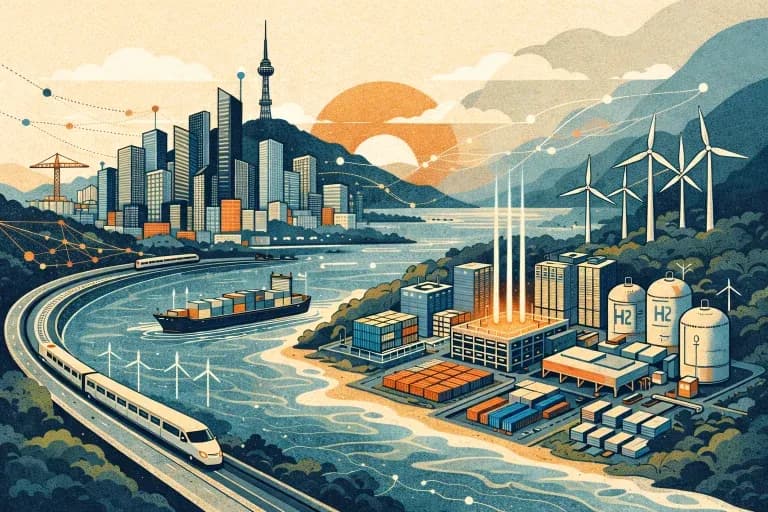
South Korea’s economic map has tilted into a single metropolitan pole. Corporate headquarters, universities, financial services and cultural amenities concentrated in Seoul, while provincial cities aged without successor industries. Manufacturing corridors in the southeast lost automotive and shipbuilding jobs; petrochemical complexes along the southern coast met the carbon transition with no battery or hydrogen clusters to replace them. Population decline followed industrial recession, and welfare spending surged across shrinking tax bases. A provincial belt slid into demographic retreat as the capital region absorbed the country’s remaining growth.
The imbalance has pushed administrative integration from a municipal reform debate to a national question of spatial strategy. Fragmented jurisdictions cannot coordinate ports, rail corridors, water intake, industrial land or transmission networks—components now decisive for semiconductor fabrication, AI compute and hyperscale data centers. These sectors operate as electricity-driven industries, demanding renewable procurement, freshwater, cooling systems and large tracts of contiguous land. Energy geography and industrial geography diverged just as provincial demography weakened, confronting policymakers with a three-layer problem: demographic survival, industrial relocation and administrative scale.
Southern and western provinces hold offshore wind corridors, hydrogen pilots, solar reclamation zones and deep-water ports that match the resource profile of emerging industries. Seoul retains the headquarters, design talent and capital markets, but lacks the renewable capacity and grid space to host gigawatt-scale expansion. Balanced development—long treated as fiscal redistribution—now reads as an industrial relocation agenda under energy transition conditions. Without territorial strategy, administrative integration becomes symbolic; without industrial relocation, balanced development becomes rhetorical.
Seoul’s Dominance and the Provincial Decline
Over two decades, Seoul consolidated the country’s most valuable economic functions—elite education, medical services, venture capital, design and corporate headquarters—creating a metropolitan labor market capable of retaining engineers and young professionals. A dense corridor linking Gangnam, Yeouido and Pangyo concentrated financial decision-making and digital experimentation, reinforcing a feedback loop of wages, amenities and innovation. The capital region became the only scalable environment for high-wage technology and services, drawing talent from every province.
Provincial cities entered the same period with a legacy manufacturing portfolio. Automotive and shipbuilding supply chains in the southeast faced low margins and overseas competition, while petrochemical complexes along the southern coast encountered the carbon transition without successor clusters in hydrogen, batteries or advanced materials. Electronics assembly moved offshore or became automated, eroding employment and hollowing mid-sized labor markets. Universities in the provinces produced graduates who exited to Seoul for professional careers that did not exist locally, accelerating population pyramids toward aging and shrinking cohorts.
Government intervention failed to reverse the capital flow of talent and investment. Balanced development initiatives prioritized infrastructure, tourism and cultural projects but avoided industrial relocation or supply-chain reallocation. Industrial policy treated semiconductor design, components, software and AI services as metropolitan sectors requiring co-location, while provincial jurisdictions absorbed carbon pricing and trade shocks without renewal strategies. The metropolitan economy added high-wage technology and services as provincial economies lost the industries that sustained family formation and tax revenue.
The transition from gradual to structural contraction emerged once birth cohorts collapsed and internal migration intensified toward the capital. Welfare spending expanded to support aging residents while shrinking labor markets reduced tax capacity. Provincial housing markets lost liquidity; universities downsized or closed departments; hospitals confronted specialist shortages. Human capital contraction undermined prospects for industrial renewal, locking the spatial economy into a single growth pole.
National competitiveness became entangled with geographic imbalance. Headquarters functions, research laboratories and cultural industries clustered inside the metropolitan ring, while industrial land, ports and renewable corridors remained underutilized in the south and west. A single metropolitan pole absorbed white-collar labor, while an aging provincial belt carried the burden of legacy industries without successors. The mismatch introduced fiscal and administrative questions—integration, autonomy and industrial relocation—that conventional balanced development rhetoric failed to resolve.
Administrative Scale Becomes Industrial Infrastructure
Balanced development programs relied on fiscal transfers and symbolic decentralization, but next-cycle industries operate at scales that fragmented jurisdictions cannot manage. Semiconductor fabrication, AI compute and hyperscale data centers require electrical transmission upgrades, water intake systems, industrial land assembly, hydrogen corridors and port modernization—assets that demand metropolitan coordination and multi-decade investment schedules. Without larger administrative territories, provincial governments cannot negotiate with central ministries, state utilities or multinational firms.
Administrative integration creates jurisdictions with population, land and fiscal capacity comparable to industrial districts abroad. A consolidated governance structure aligns zoning, transport, ports, research institutions and workforce training without inter-municipal bargaining. Unified budgets finance industrial parks, high-voltage substations and renewable procurement strategies, defining the operating environment in which semiconductor and AI investments are approved and expanded.
Relocation depends on predictable permitting and single decision channels. Fragmented governments issue overlapping requirements on land conversion, environmental reviews and utility contracts, slowing construction and weakening negotiation leverage with the center. Integration consolidates permitting authority, enabling concurrency in reviews, zoning changes and infrastructure approvals. Speed becomes decisive in industries competing on export cycles and capital depreciation measured in months rather than years.
Control over energy and water infrastructure is equally binding. Semiconductor fabs and AI compute require gigawatt-scale electricity, tens of thousands of tons of freshwater per day and renewable procurement compatible with RE100 standards. Transmission corridors, offshore wind ports, hydrogen pipelines and seawater cooling cannot be planned at municipal scale. Integrated jurisdictions can negotiate directly with grid operators, renewable developers and port authorities while adjusting land use and housing to host technical labor.
Talent and urban services impose constraints alongside physical infrastructure. Engineers and researchers require universities, hospitals, international programs and housing that can absorb inbound workers. Fragmented provincial governments cannot build research clusters or medical centers without coordination failures. Integration allows education, research, housing and transport to function as a single urban-industrial ecosystem, lowering relocation costs for firms and workers.
Local autonomy gains material relevance at larger administrative scale. Integrated territories can issue industrial bonds, create development authorities and redesign vocational training around semiconductor packaging, hydrogen, power systems and AI computing. Local governments can negotiate power-purchase agreements, land leases and accelerated construction timelines without referring every decision to central ministries. Greater fiscal and regulatory competence reduces uncertainty for private capital.
Industrial relocation requires more than incentives. It requires administrative structures capable of executing infrastructure, coordinating education and guaranteeing utilities over decades. Without integration, provincial jurisdictions lack the instruments to host semiconductor fabs or hyperscale compute clusters; without industrial relocation, integration degenerates into territorial redrawing without economic consequence. The sequence is linear: integration expands capacity; capacity attracts industry; industry stabilizes population; population sustains services; services retain labor. Balanced development becomes industrial rather than symbolic.
Energy Transition Rewrites Industrial Geography
Semiconductor fabrication, AI compute and hyperscale data centers have converged into a single industrial chain linking silicon supply, computational demand and data storage. Each segment requires gigawatt-scale electricity, renewable contracts, freshwater intake, advanced cooling and large tracts of industrial land while drawing on universities, labor markets and headquarters functions. The spatial demands exceed the metropolitan region’s capacity to supply power, land and renewable energy.
The energy transition altered the cost structure of digital industries. High-performance computing now consumes electricity loads once associated with petrochemicals and metals processing. RE100 targets imposed contractual obligations on global firms, while institutional investors linked capital flows to carbon intensity. Gigawatt-scale data campuses in the United States and Europe clustered around wind, hydro and low-carbon power, signaling that AI had become an energy industry and that computational supply chains obey energy-intensive manufacturing logic.
Seoul lacks the physical resources required by the chain. Transmission bottlenecks limit high-capacity loads; solar and wind remain insufficient for renewable compliance; land scarcity blocks hyperscale campuses; housing markets struggle to absorb sustained inflows of engineers. By contrast, the southern and western provinces hold offshore wind corridors, hydrogen pilots, solar reclamation zones and deep-water ports suitable for seawater cooling. Regional grids carry spare capacity following industrial decline, and water infrastructure remains underutilized.
Reallocation depends on alignment between energy assets and industrial needs. Offshore wind requires ports, hydrogen blending and transmission upgrades; semiconductor fabrication requires freshwater, high-voltage substations and logistics networks; AI compute benefits from cold climates or seawater cooling; data centers require long-term renewable procurement for contractual obligations. Territorial planning becomes decisive once industrial chains depend on energy corridors rather than corporate prestige districts.
Balanced development acquires strategic content under these conditions. Provincial decline originated in industrial stagnation and youth outmigration, not administrative fragmentation alone. Industrial renewal cannot proceed without energy transition, because next-cycle industries anchor around electricity and carbon performance. Administrative integration produces jurisdictions capable of negotiating renewable procurement, transmission construction, port modernization, research institutions and housing districts for technical labor. Without industrial function, integration lacks demographic impact; without energy assets, industrial function lacks feasibility; without territorial strategy, energy assets lack industrial application.
The semiconductor industry cannot expand indefinitely in a single metropolitan pole. AI compute and data centers cannot secure renewable energy without wind, hydro or solar corridors. Housing markets cannot absorb sustained engineer inflows without new districts; universities cannot restructure engineering programs without industrial demand; ports cannot host hydrogen terminals or turbine yards without coordinated permitting. Demographic stabilization follows industrial allocation, not the reverse.
Global competitors fused energy transition with territorial planning. The United States routed AI and data centers to Iowa, Virginia and Texas for wind, solar and natural gas; Japan distributed advanced packaging and hydrogen pilots across Kyushu and Yamaguchi; Taiwan linked Hsinchu, Taichung and Kaohsiung into a tri-polar semiconductor system; Europe placed AI clusters in Scandinavia to exploit hydro and cold climates. Allocation followed industrial logic rather than capital-city dominance.
Korea confronts a choice: reinforce a monocentric industrial model or form a southern and western belt in which fabrication, compute, data infrastructure, materials and renewables align. Administrative integration, fiscal autonomy and energy planning provide instruments for such a strategy. Without industrial reallocation, balanced development remains rhetorical; without energy transition, reallocation remains impractical; without territorial strategy, integration remains symbolic.
Busan Positions as a Port-Centric Compute and Packaging Node
Busan controls Korea’s principal deep-water port and the country’s largest container throughput. Terminal clusters, shipyards and petrochemical complexes built an ecosystem capable of handling heavy logistics, equipment imports and export-oriented supply chains. Semiconductor packaging, testing and equipment manufacturing align with the machinery and petrochemical base already present in Busan and Gyeongnam. Hyperscale compute clusters benefit from seawater cooling and proximity to submarine cable landings, while battery materials and hydrogen terminals can attach to existing chemical storage infrastructure.
Ports create leverage unavailable to inland cities. Lithography equipment, test machinery and advanced substrates move through customs without the transit bottlenecks common in interior districts. Semiconductor packaging firms exporting to global customers benefit from low-friction logistics. Energy-intensive compute nodes sited near the port can negotiate for seawater cooling, desalination or hydrogen co-firing. Offshore wind turbines and electrolyzers enter through the same terminals, positioning Busan at the intersection of industrial load and renewable import infrastructure.
Relocation depends on electricity and renewable procurement. Semiconductor packaging and AI compute require multi-hundred-megawatt to gigawatt loads, forcing negotiation with transmission operators and renewable developers. The southern grid holds latent capacity following the decline of machinery and shipbuilding, but gigawatt-scale additions require substation upgrades. Offshore wind in Jeollanam-do and hydrogen projects in Ulsan form an energy corridor that can supply Busan if interconnections are built. Without transmission, renewable potential remains geographically stranded.
Administrative integration alters the operating scale. The corridor from Busan to Changwon and Gyeongnam forms a territory where ports, industrial land, universities and housing markets can coordinate. Local autonomy over power-purchase agreements, industrial zoning, research incentives and education policy allows the corridor to bid for semiconductor, compute and battery investments without deferring to central ministries. Consolidated governance accelerates permitting for data centers, industrial facilities and transmission.
Population and talent constraints shape feasibility. Busan produces mechanical, electrical and software engineers, but retention depends on wages, research labs, medical services and housing suitable for young professionals. Semiconductor packaging and compute industries generate high-wage employment capable of supporting urban amenities, unlike low-margin manufacturing. Demographic stabilization requires industrial sectors capable of regenerating the labor market rather than relying on logistics or tourism.
Competition within the southern belt defines the stakes. Jeollanam-do and Saemangeum hold renewable energy and land; Pohang retains materials and battery clusters; Ulsan controls hydrogen and petrochemicals; Busan commands ports, engineering labor and cooling. These assets are complementary but uncoordinated. Without integration, jurisdictions compete for limited semiconductor and compute investment, fragmenting supply chains and diluting bargaining power. With coordination, functions divide logically: design and R&D in the central axis, packaging and export in Busan, materials in Pohang, renewable generation in Jeollanam-do and hydrogen in Ulsan.
Global analogues reinforce Busan’s position. Kaohsiung aligns ports, petrochemicals and marine cooling with semiconductor packaging; Singapore builds compute clusters near submarine cables and LNG terminals; Yokohama and Kobe connect ports with hydrogen import terminals and R&D campuses. Busan matches the category of port-centered industrial cities suited for compute-intensive digital and manufacturing infrastructure.
Busan’s strategic opportunity arises from the overlap of port logistics, cooling, energy transition and semiconductor packaging. Seoul cannot provide industrial land or renewable energy at scale; Jeollanam-do lacks headquarters and logistics; Pohang lacks container ports; Ulsan excels in hydrogen and heavy industry but not in terminals. Busan can convert logistics into industrial advantage if transmission upgrades, renewable contracts and administrative integration converge. The choice determines whether Busan remains a logistics city or becomes an industrial city for the next cycle.
Strategic Outlook Under Demographic, Energy and Industrial Constraints
Semiconductor fabrication, AI compute and hyperscale data centers pull Korea toward a second geographic pole beyond Seoul. The capital retains headquarters and the deepest talent pool, but cannot supply renewable energy at the scale demanded by RE100 contracts or absorb gigawatt-scale industrial loads without transmission expansion and new housing districts. Industrial expansion now depends on energy geography rather than metropolitan prestige.
Southern and western provinces hold the assets required for next-cycle industries: offshore wind corridors, hydrogen pilots, solar reclamation zones, deep-water ports and large tracts of contiguous land. Industrial water systems remain underutilized and regional grids carry spare capacity. These assets remain dormant because administrative fragmentation prevents metropolitan-scale planning.
Administrative integration enables industrial relocation by assembling land, negotiating transmission, modernizing ports and restructuring universities. Local autonomy over renewable procurement and permitting accelerates deployment. Industrial relocation stabilizes populations and allows balanced development to operate through taxes rather than subsidies.
Demographics impose urgency. Provincial extinction accelerates as youth cohorts exit, universities close departments and hospitals lose specialists. Balanced development without industrial function cannot reverse attrition; industrial function without energy and administrative capacity cannot form. Semiconductor and AI industries remain among the few chains capable of producing wages, research demand and service employment at population-retaining scale.
Global competitors have already built polycentric maps. The United States distributed fabs and compute across Texas, Arizona, Ohio, Iowa and Virginia; Japan placed advanced packaging and hydrogen pilots in Kyushu; Taiwan linked Hsinchu, Taichung and Kaohsiung; Europe routed compute to Scandinavia. Allocation followed energy, logistics and land rather than capital-city dominance.
Korea’s choice is no longer rhetorical. Reinforcing a single metropolitan pole pushes semiconductor and AI expansion into conflicts with energy scarcity, housing constraints and workforce saturation. Constructing a southern and western industrial belt aligns renewables, ports and land to host the next industrial cycle. Administrative integration and local autonomy determine whether provinces function as industrial cities or administrative districts. The decision defines whether balanced development becomes a national strategy for population and industrial survival or remains a political slogan.
The Weekly Breeze
Keep pace with Busan's deep narratives.
Delivered every Monday morning.


