Inside Korea’s Push for Climate-Resilient Farming
Smart farms promise steady harvests, but without renewable power, shared infrastructure, and sustainable business models, the technology may not withstand the very climate shocks it is meant to defeat.

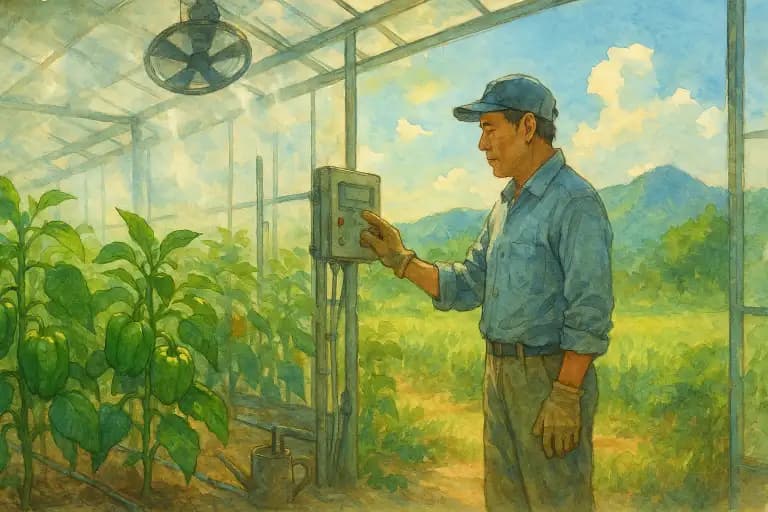
From the highway, the greenhouses look still under the glare of the noon sun. Step through the sliding door and the air changes. It is heavier, warm with the smell of damp soil and the sharp scent of paprika leaves. Fans turn above the rows, pushing slow waves of air that barely lift the heat. A fine mist drifts from the pipes overhead, catching the light in thin silver threads before falling onto the plants.
Outside, the temperature sits at thirty-six degrees. Inside, it is higher. The grower glances at the control panel, where the numbers flicker a fraction above the target. Every degree counts. Too much heat and the fruit will scar or drop before ripening; too little cooling and the season’s work can be lost in a week. The systems run without pause, pulling power by the hour.
South Korea is banking on places like this to steady its food supply. Grain self-sufficiency has slipped to roughly one in five, the lowest in the OECD. The weather is no longer predictable enough to trust open-field harvests alone. In recent summers, heavy monsoon rains have been followed by heatwaves that cut vegetable yields and sent prices surging. Smart farms promise to hold the line, growing through storms and droughts alike. The question is whether they can do it without exhausting the farmers, the finances, or the land itself.
Food Security Under Threat
South Korea’s dinner table depends more on overseas harvests than on its own soil. Wheat from Australia, corn from the United States, soybeans from Brazil — they make up the bulk of the feed and flour that keep the country running. In 2024, only about 21 percent of the nation’s grain came from domestic fields, the lowest share among major OECD economies.
That dependence might feel abstract on a calm market day. It becomes real when weather turns. A heatwave in Europe or drought in the American Midwest can lift import prices within weeks. Add export restrictions — as India imposed on certain rice varieties last year — and the cost shock arrives even faster.
Climate change is tightening the squeeze. The growing season is shifting northward, pushing traditional crops out of their comfort zones. Apple orchards that thrived in Gyeongsangbuk-do are creeping toward Gangwon-do. In rice paddies, erratic rainfall is altering planting schedules and yields. Tropical fruits are appearing in greenhouses once used for temperate vegetables, a visible marker of how the baseline has shifted.
In this landscape, smart farms are not just about modernising agriculture; they are a form of insurance. They promise steady production no matter the season, insulated from the worst swings of weather. But scaling that insurance is another matter.
Most farms in Korea are small — under two hectares — and the cost of building and running a high-spec facility can outstrip annual earnings. Without a plan to spread the benefits beyond a handful of large operations, the country’s food security will remain exposed to forces far beyond its borders.
The State of Smart Farming in South Korea
Over the past decade, smart farming has shifted from pilot projects to a visible part of the rural landscape. New greenhouse complexes have risen in places like Goheung, Nonsan, and Pocheon, many built with government grants and low-interest loans. Inside, climate-control panels, nutrient delivery lines, and sensor arrays are now as common as hoes and watering cans once were.
Even so, adoption remains limited. As of last year, about 6.8 percent of farms used some form of smart technology, according to Ministry of Agriculture figures. Most are in greenhouse horticulture — paprika, strawberries, tomatoes, and leafy greens — where temperature and humidity control can be directly tied to higher yields and better quality. Open-field crops, which still dominate the national diet, are far harder to manage with these systems.
The technology itself varies widely. First-generation setups handle basic irrigation and ventilation on timers. The more advanced systems — integrating AI-driven climate algorithms, real-time nutrient monitoring, and closed-loop hydroponics — are concentrated in large-scale, export-oriented facilities. Smallholders often lack the training to interpret complex data or the capital to maintain high-end systems.
Farm size is another constraint. The average Korean farm is less than two hectares, a fraction of the size found in the Netherlands or the United States. That scale makes it difficult to absorb the fixed costs of construction and equipment. For some growers, the initial outlay can take a decade to repay — longer if energy prices climb.
And in the background is the issue that few like to discuss: keeping these glass and steel structures running means keeping the electricity flowing, whatever the source or cost.
Heatwaves, Monsoons, and Cold Snaps
In theory, a smart farm should hold steady through the seasons. In practice, the extremes are where the limits show.
During last summer’s heatwave, temperatures in parts of South Jeolla and South Gyeongsang rose above 38 °C. Inside many greenhouses, even with fans and misting systems running flat out, gauges crept higher. The leaves on paprika and cucumber plants curled at the edges; flowers dropped before fruit could set. Some growers kept their cooling systems on around the clock, watching the electricity meter spin as quickly as the ceiling fans above their heads.
The monsoon brings a different strain. Weeks of heavy rain swell the humidity inside, feeding fungal diseases and slowing growth. Ventilating to dry the air can let in more warm, wet air from outside, forcing farmers into a constant trade-off between airflow and climate stability. In winter, the problem reverses. Sub-zero nights demand near-constant heating, and fuel bills can rival those from peak summer cooling.
Every season pushes the balance between plant health and financial survival. For larger operations, the extra cost can sometimes be absorbed; for smaller farms, one bad month can wipe out a year’s margin.
The very systems designed to protect against weather volatility can become liabilities when energy use soars.
Global Models in Smart Farming
In the Netherlands, the road west from Rotterdam passes through an expanse of glass and steel that seems to have no end. Greenhouses stretch to the horizon, their roofs reflecting the pale northern sun. Here, growers do not work in isolation. Heat from nearby factories and geothermal wells runs through a shared network, warming crops in winter and storing excess for the colder months. Rainwater is collected from the rooftops, filtered, and returned to the fields through communal reservoirs. Many of these structures are semi-closed, recovering heat from outgoing air to cut cooling costs in summer and reduce fuel use in winter. The result is a system that maintains production year-round while keeping energy costs predictable — a stability that allows farmers to plan with confidence.
A continent away in Japan, a similar logic is at work, but tailored to different pressures. In Chiba and Shizuoka, high-spec greenhouses stand alongside solar panels and biomass plants, drawing a share of their power on-site. Government subsidies here are not handed out for equipment alone; they are tied to results. Less water per kilogram of crop, fewer kilowatt-hours for each unit produced — the gains must be measurable. With farm labour ageing fast, automation is designed to replace human hands where needed, from climate control to harvesting. Even in the face of typhoons and heatwaves, controlled environments paired with on-site renewables keep yields steady.
In the United States, the scale is different again. In the desert valleys of Arizona, massive greenhouses produce tomatoes and lettuce for supermarket chains thousands of kilometres away. Under summer skies that top forty degrees, evaporative cooling walls and efficient ventilation hold the interior climate steady. Many operators have invested in solar generation to offset the surge in demand during peak heat, selling surplus electricity back to the grid once the season turns. Here, the push has come less from government than from private capital, with retailers funding facilities to secure reliable supply.
Across these regions, a pattern emerges. Success comes not from technology alone, but from the way it is embedded in wider systems: shared infrastructure to spread costs, renewable energy to buffer climate extremes, and incentives linked to performance rather than purchase.
For Korea, where most smart farms remain standalone structures tied to the national grid, adopting even part of this approach could mean the difference between seasonal struggle and year-round resilience.
Building the Framework for Resilient Farming
For smart farms to move from scattered showcase projects to a backbone of national food security, Korea will need to think beyond individual facilities. The first step is to make energy part of the farming equation. Large-scale solar fields, small wind installations, or geothermal systems can be tied into clusters of greenhouses, allowing multiple growers to draw from the same renewable source. Shared infrastructure would spread costs and reduce the burden on any one operator, much as the Netherlands has done with its heat networks.
Policy will have to change as well. Current subsidies often focus on the installation of equipment, which encourages one-time purchases but not long-term efficiency. A shift toward performance-based support — rewarding reductions in water use, energy consumption, or emissions — would push operators to keep improving their systems. Japan’s model of tying aid to measurable results shows how this can work in practice.
Cooperative models offer another way forward. Small farms could pool land, capital, and technical expertise to build and operate shared high-spec facilities. These cooperatives could also manage logistics, marketing, and export strategies, lifting the burden of running both farm and business from individual growers.
Finally, a sharper focus on crop strategy could help smart farms move from defensive adaptation to proactive growth. Targeting high-value, climate-resilient crops for export could boost profitability and justify investment in advanced systems. Korea’s premium strawberries, peppers, and leafy greens already have footholds in overseas markets; scaling those exports could help offset the volatility at home.
The shift will not happen overnight. It will require coordination between government, research institutions, and farmers, along with a willingness to treat smart farming not as a novelty, but as part of the country’s core infrastructure. Without that commitment, the technology risks remaining a symbol of potential rather than a pillar of resilience.
Smart Farms as Strategic Infrastructure
Back in Goheung, the afternoon light has shifted, but the heat inside the greenhouse has barely eased. The fans are still running, the misters still hissing at regular intervals. Outside, cicadas hum in the trees, a reminder that summer has weeks yet to go.
For the grower, each day is another calculation — how to keep the plants alive, the bills manageable, and the harvest on schedule.
These decisions, repeated in thousands of greenhouses and fields across the country, add up to something larger than any one farm. They form part of Korea’s quiet struggle to feed itself in an era when weather patterns are unreliable and the global food market can turn overnight.
Smart farms will not solve that challenge alone, but they can be a crucial line of defence — if they are built to last, not just to impress.
Treating them as strategic infrastructure means thinking about more than yield. It means securing affordable, low-carbon power; building systems that recycle water and nutrients; and ensuring that farmers can operate profitably through both heatwaves and cold snaps.
It also means recognising that food security is no longer an abstract policy goal but a daily reality, shaped by the climate outside and the resilience inside.
The question now is not whether Korea can adopt the technology. It is whether the country can build a smart farm system strong enough to keep its people fed, its farmers in business, and its promise of sustainability intact — not just this season, but for the decades ahead.
The Weekly Breeze
Keep pace with Busan's deep narratives.
Delivered every Monday morning.