How South Korea’s Credit-Based High School System Went Off Track
South Korea’s high school credit system promised flexibility and student choice. But staffing gaps, grading flaws, and private consulting are undermining reform.

This was supposed to change everything. In March, South Korea launched a new high school credit system with a simple promise: let students choose their own classes, and they’ll figure out who they are—what they care about, what they’re good at, what kind of future they want. It was the most significant shift in decades away from the country’s famously rigid, test-driven school culture.
On paper, the policy sounded like progress. Students would no longer move through fixed class schedules. Instead, they’d select courses based on their interests, much like college students. Officials spoke of flexibility, autonomy, and individualized learning. It was, they said, time to give kids some control.
But ask around—students, teachers, even school principals—and a different picture emerges. Some schools are still struggling to offer even a handful of elective courses. Teachers say they’re being asked to teach subjects they barely had time to prepare for. In rural towns, students sit through livestreamed classes because their schools couldn’t hire instructors. And the freedom to choose? It often comes down to picking from whatever hasn’t been cancelled.
In one high school in Seoul, 25 first-year students dropped out before summer—more than twice last year’s number. In others, students are steering away from the classes they love because fewer classmates means tougher grading under Korea’s relative evaluation system. “They told us we’d get to choose our path,” one student said. “But every road leads back to the same test.”
South Korea set out to modernize its schools. But somewhere along the way, it forgot to modernize the system beneath them.
What Schools Weren’t Ready For
For the credit system to work, schools would need to function very differently than they had for decades. That meant building a more flexible timetable, offering a broader selection of electives, and staffing subjects that previously weren’t part of the core curriculum. In theory, it was a shift toward personalization. In practice, it required a structural overhaul that most schools had neither the funding nor the personnel to manage.
Across the country, especially outside Seoul and a few metropolitan hubs, secondary schools face severe staffing constraints. Many still operate with just enough full-time teachers to cover national core subjects—Korean, English, math, and a handful of required sciences and humanities. Opening niche electives in law, engineering, or the arts, as envisioned by the new policy, often meant asking one teacher to stretch across unrelated subjects, or not opening the class at all.
The problem isn’t just about course variety. It’s about the logistics of daily scheduling, classroom space, and staffing ratios. The South Korean teacher assignment model, which calculates headcount based on enrollment numbers rather than curricular complexity, has remained largely unchanged. That means a school of 600 students in a rural district receives roughly the same number of teachers regardless of whether it’s trying to offer five electives or twenty. This arithmetic simply doesn’t match the policy's ambitions.
Even in relatively well-resourced schools, course offerings are constrained by the realities of class formation. A subject with too few registrants may be canceled, even if it aligns with national reform goals. Conversely, popular courses may exceed capacity, forcing schools to fall back on traditional batch scheduling. The credit system, in many places, becomes a system of default assignments—a rebranding of old limitations under new labels.
There is also the matter of administrative labor. Adapting to the credit system requires reconfiguring student guidance systems, managing semester-based course rotations, and tracking individualized graduation requirements across three years. This is a heavy lift even for large schools. For smaller institutions with one or two vice principals and a limited counseling staff, it becomes nearly impossible to operate the system as designed.
In short, the policy assumes a level of organizational flexibility that the current school system cannot deliver. It asks schools to behave like universities, while operating under the structure—and staffing model—of a centralized, standardized bureaucracy. The gap between what the reform imagines and what the institutions can do is not marginal. It's fundamental.
How Relative Grading Undermines Curriculum Autonomy
If the promise of South Korea’s high school credit system is that students can shape their education, the practice is something else entirely. At the center of this disconnect is a grading system that punishes risk, discourages specialization, and quietly funnels students toward the same limited set of subjects.
In most subjects, student performance is still assessed using relative grading—students are ranked against each other, and a fixed proportion are assigned each grade. This structure, in place for decades, was originally intended to maintain standardization and resist grade inflation. But in the context of elective-based curricula, it has become a barrier to meaningful choice.
When grades are awarded based on peer comparison, the number of students in a course directly impacts how grades are distributed. A small class of eight students studying an advanced science or niche humanities subject makes it nearly impossible for more than one or two to earn top marks, regardless of absolute performance. In contrast, students who choose more crowded, mainstream classes often enjoy more statistical room to maneuver. The result is predictable: students avoid courses they care about and select ones that maximize their chances of a higher GPA.
In theory, students were encouraged to explore their interests. In practice, they quickly learned to calculate their risk exposure. Subjects like world history, philosophy, advanced physics, and economics—despite aligning with many students’ actual aspirations—have seen declining enrollment in many schools because the grading disadvantage is simply too great.
The Ministry of Education initially planned to transition to absolute, criterion-referenced grading for electives, but that transition was delayed and partially reversed following administrative changes. As of now, most elective subjects are still subject to mixed systems that include both achievement-based and norm-referenced evaluations, creating confusion for schools and inconsistency for students.
This lack of alignment between grading and curriculum has real consequences. Students who hope to apply to competitive universities cannot afford to take academic risks. And while the credit system claims to support individual growth, the GPA-centered logic of Korean higher education forces conformity. In some cases, students map out their entire high school plan not by interest, but by what will generate the most favorable transcript metrics.
This is not a miscommunication. It is a structural contradiction. You cannot reward independent academic choices while penalizing students for making them.
When Choice Becomes a Gamble
It didn’t take long for students to realize that having more options didn’t mean having more freedom. Not when every choice came with a price.
Under Korea’s relative grading system, students are evaluated not on how well they do, but on how well they do compared to everyone else in the room. Top grades are limited by design. Only a fixed percentage of students—usually no more than 4%—can receive the highest mark in any given class. That system might make sense in a standardized, uniform curriculum. But in a model built on electives and individual choice, it begins to punish the very behavior the reform was meant to encourage.
The logic runs quickly through every student’s mind. A smaller class might mean fewer competitors—but also fewer chances to earn top marks. A niche subject, no matter how interesting, carries risk. A popular subject? Safer. More predictable. Easier to read the room.
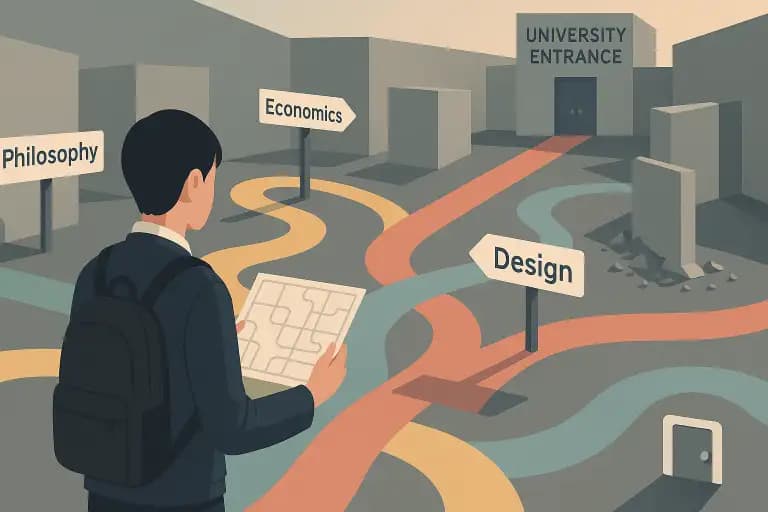
Over time, the message becomes internalized: choose what others are choosing, and you’re less likely to lose. And so, the courses that were supposed to spark academic exploration—philosophy, design, applied economics, even literature—start to empty out. Not because they’re unpopular. Because they’re unforgiving.
Policymakers had once promised a shift toward absolute evaluation, where students would be graded against clear standards, not each other. That plan was quietly shelved. Some schools now apply a mixed model, but confusion remains. What counts as “safe” varies by region, by school, sometimes even by semester. There’s no unified rulebook. Just a growing sense that the system penalizes curiosity.
What was meant to open doors ends up narrowing them. Students don’t build paths anymore—they calculate routes. And the idea of “academic freedom,” once held up as the core of the reform, now feels like a slogan with no room to breathe.
The Private Market Fills the Gap
Where the public system hesitates, the private market doesn’t. As students and parents struggle to interpret what the new credit system actually means—for graduation, for transcripts, for college admissions—a growing number are turning elsewhere for answers. Not to their schools, but to consulting services, cram academies, and independent curriculum coordinators. The message is clear: if the institution can’t guide you, buy someone who will.
These are not traditional tutoring services. Many now resemble academic think tanks for hire. For a fee, consultants analyze student profiles, simulate GPA outcomes under different course combinations, and produce multi-year planning charts tailored to specific university departments. A single program can cost upwards of 20 million won—more than a year’s tuition at some Korean universities.
At the heart of this is uncertainty. With universities offering little clarity on how elective choices will be evaluated—and schools applying the policy with wide variation—families are left to make high-stakes decisions with little guidance. In this vacuum, information becomes currency. And those who can pay for better advice, better simulations, better paperwork, do.
The result is a quiet but growing inequality. In theory, the credit system was supposed to create diverse academic trajectories. In practice, it has created a parallel industry that tells students not only what to take, but when to take it, how to report it, and how to justify it in future interviews or personal statements. Strategy, not curiosity, becomes the central discipline.
Meanwhile, schools—already overwhelmed by scheduling, staffing, and administrative work—are unable to compete. Most offer only general guidance, updated annually. A handful of elite schools have developed internal counseling systems that rival private firms. But most cannot. And so, the system that was meant to reduce pressure has simply relocated it—outside the classroom, and into the market.
If educational freedom depends on how much advice you can afford, it’s no longer freedom at all. It’s leverage. And for many, it feels like the system never really changed—only the instructions got more expensive.
What Happens When Reform Stops at the Surface
The credit system wasn’t just a scheduling tweak. It was a symbolic promise—an attempt to give students some measure of control in a system that has long demanded obedience. But control, as it turns out, requires more than options. It requires structure, trust, and a willingness to rethink not just how schools are managed, but why they work the way they do.
That didn’t happen here. The reform targeted the appearance of flexibility, not the forces that shape student behavior. It left untouched the GPA economy, the ranking obsession, and the opaque college admissions process that holds all of it together. What began as a move toward autonomy quickly collapsed into a new kind of strategic compliance.
And the result isn’t chaos. It’s choreography—students adjusting, families compensating, consultants stepping in, teachers adapting. Everyone is moving, but no one is leading.
It’s tempting to see this as a temporary misstep, a policy rolled out too fast or without enough support. But maybe the problem runs deeper. Maybe the real question isn’t how to fix the credit system. Maybe it’s whether the system, as it stands, is capable of reform at all.
The Weekly Breeze
Keep pace with Busan's deep narratives.
Delivered every Monday morning.