How Coupang’s Crisis Response Undermined Public Trust in Korea
The controversy surrounding Coupang’s data breach highlights how crisis responses designed to limit legal risk can generate broader regulatory and political consequences when public process is sidelined.

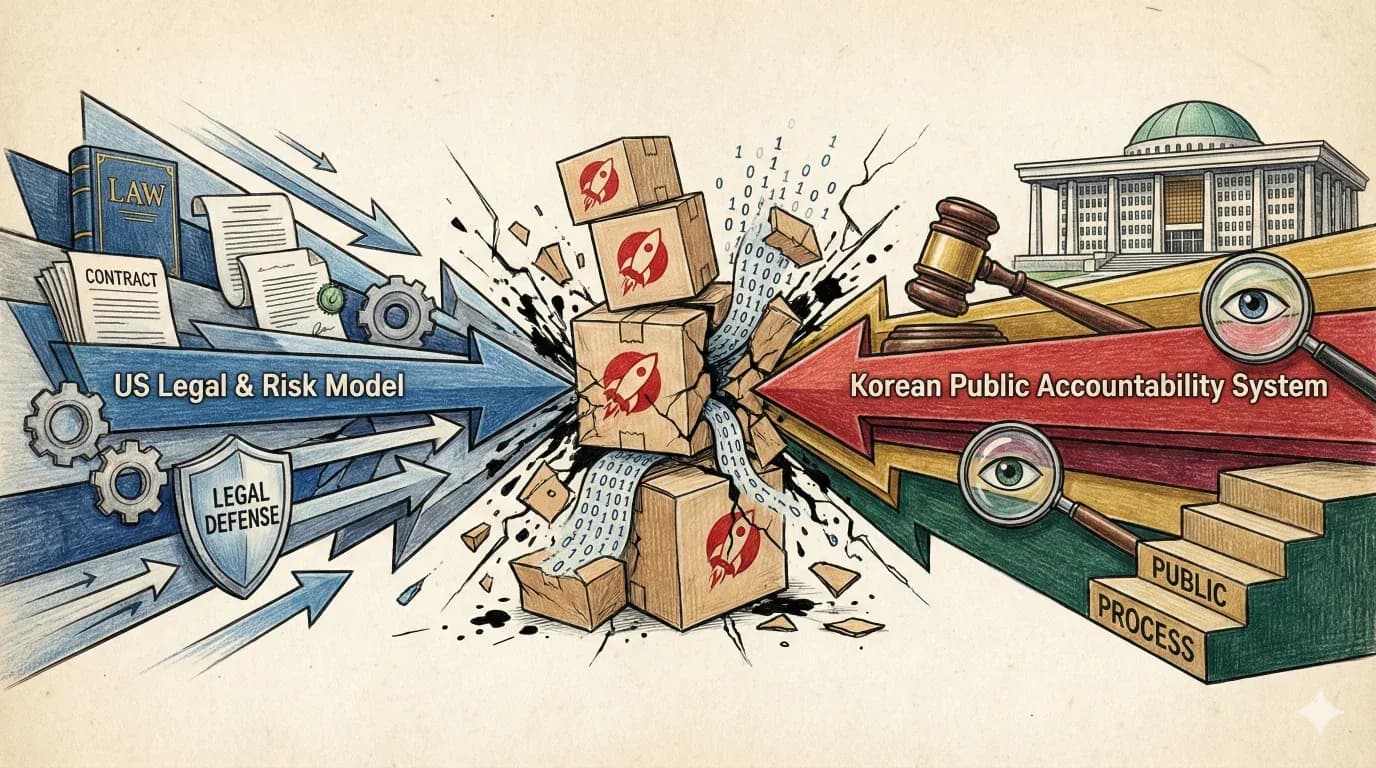
Large-scale data breaches are not new in South Korea, and technical failure alone has rarely been enough to trigger sustained political or regulatory escalation. The intensity of the reaction that followed the Coupang breach stemmed from a different source: how the company responded once the incident entered public view, and the order in which it asserted authority over the facts.
In the early stages, the company moved quickly to define the scope of the incident. Public statements emphasized internal verification, access thresholds, and limited exposure while government investigations were still ongoing. The language was precise and confident, and conclusions were presented before regulators had reached their own. Attention soon shifted away from the mechanics of the breach toward the posture reflected in the response.
In Korea, corporate accountability is evaluated through more than compliance with the law. Legitimacy is established through process. Companies under scrutiny are expected to defer visibly to public institutions, allow investigations to proceed without preemption, and demonstrate restraint before asserting resolution. When conclusions arrive ahead of official verification, speed is rarely read as efficiency. More often, it is taken as an attempt to shape judgment rather than submit to it.
That interpretation gained traction quickly. Criticism spread from consumers to lawmakers and regulators, altering the direction of the case. What began as a data security incident expanded into a broader examination of corporate authority and governance, driven less by disputed facts than by concern over who was positioned to settle them.
The episode exposed a structural tension embedded in Coupang’s business model. The company’s revenue, users, and operational influence are concentrated in Korea, while its legal exposure and disclosure obligations are anchored in the United States. The response reflected a risk framework aligned with U.S. capital markets, where reducing ambiguity and preserving legal optionality take precedence. That framework collided with a domestic accountability system that assigns weight to sequence, restraint, and institutional respect.
The question that follows is narrow but consequential. Did the company underestimate the domestic response, or did it proceed on the assumption that backlash in Korea would remain secondary to legal and investor risk elsewhere? The answer matters because it speaks to the limits of crisis strategies that prioritize legal defense over public legitimacy in environments where process itself defines authority.
Structural Friction in the Sequence of Disclosure
Early signs of backlash did not stem from new disclosures, but from repetition. Each stage of communication reinforced impressions formed earlier, gradually shaping a perception that containment had taken precedence over cooperation. Initial statements focused on narrowing the scope of impact and distinguishing between unauthorized access and confirmed extraction, even as government authorities remained in the early stages of fact-finding. The tension that followed was rooted in timing. Corporate confidence arrived before regulatory inquiry had run its course.
Public attention shifted as that gap widened. Regulators continued to emphasize that investigations were ongoing, while corporate messaging conveyed a sense of closure. The conflict did not revolve around competing evidence. It centered on competing claims over who was entitled to define when the matter had been settled. By presenting internal findings as sufficiently conclusive, the company appeared to assert a private threshold for resolution in a system where conclusions are expected to emerge through public process.
Language amplified the effect. Terminology designed to narrow legal exposure was received as minimization rather than clarification. Subsequent explanations remained framed within the same boundaries, doing little to alter the initial impression. Over time, the focus of scrutiny moved away from the technical dimensions of the breach toward the perceived effort to manage responsibility instead of acknowledge it.
The compensation framework sharpened criticism further. Restitution tied to continued use of the platform was widely interpreted as a measure to stabilize engagement rather than address harm. For users already unsettled by the handling of personal data, the approach suggested that trust was being restored through commercial mechanisms rather than recognition of loss. The contrast between operational efficiency and public expectations of accountability became increasingly visible.
By the time the issue reached legislative hearings, earlier choices shaped how testimony was received. Narrowly framed answers and defensive positioning were interpreted through a lens formed by the preceding sequence of events. At that point, the backlash no longer depended on the breach itself. It had taken on a trajectory of its own, driven by the perception that scale and speed were being used in place of procedural humility. What began as a data security incident had evolved into a broader inquiry into how infrastructural platforms respond to public authority.
Strategic Drivers of the U.S. Public Company Risk Model
The response followed a decision-making framework shaped primarily by legal exposure rather than public reconciliation. As a company listed in the United States, Coupang operates in an environment where imprecise language, premature acknowledgment, or inconsistent disclosure can carry significant legal and financial consequences. Crisis communication under these conditions is designed to narrow uncertainty, control admissions, and preserve flexibility until claims can be defended under formal scrutiny.
Incentives within U.S. capital markets reinforce that approach. Speed and technical precision are valued more than expressions of remorse, particularly in incidents involving data security. Statements are drafted to withstand potential class-action litigation, with definitions limited to what can be verified and defended. Reliance on internal verification reflects established practice in managing investor expectations and mitigating risk. From this vantage point, disclosure functions less as a tool of public explanation than as a form of legal insulation.
That logic governed not only what was communicated, but when it was communicated. Legal defensibility became the organizing principle, shaping the sequence of statements and the confidence with which conclusions were presented. The absence of visible deference to ongoing investigations did not stem from inattention. It followed a framework that treats unresolved uncertainty as a liability to be closed internally rather than a condition to be endured publicly. Within this calculus, public reaction is expected to fluctuate but remain manageable once technical resolution is asserted.
Risk was not weighed evenly across jurisdictions. Market backlash in Korea appeared to be treated as reversible, buffered by scale, infrastructure, and habitual use. Legal exposure in the United States, by contrast, was approached as immediate and potentially enduring, with direct implications for valuation and access to capital. That imbalance shaped the hierarchy of priorities, placing investor-facing safety ahead of domestic legitimacy and applying a model optimized for one accountability system to a market governed by another.
The internal consistency of this risk model explains the persistence of the company’s posture as criticism intensified. Adjustments addressed wording and scope, not orientation. Decisions continued to be measured against legal and investor benchmarks, while the political and social costs of eroding public trust in Korea were discounted as manageable. The limits of that discounting emerged only when the response encountered an accountability environment where authority is established through process, not through the declaration of closure.
Institutional Friction in the Korean Accountability System
Resistance to the company’s response did not arise from doubts about legal coherence. It emerged from a direct collision with an accountability system that assigns authority through sequence and restraint. In Korea, legitimacy during corporate crises is produced procedurally. Public institutions establish the factual baseline, and corporate explanations are expected to follow with visible deference. When that order is reversed, the result is rarely interpreted as efficiency. More often, it is read as an attempt to move ahead of oversight.
Speed became the central point of friction. Assertions of internal certainty, delivered while regulators were still examining evidence, were received as an effort to shape the terms of judgment before public verification had taken place. Attention shifted away from the technical substance of the breach toward a more basic question: who was positioned to decide when the matter had been settled. Lawmakers and officials focused less on the accuracy of internal findings than on whether regulatory authority was being respected.
Political escalation followed a familiar pattern. As public unease grew, the threshold for intervention fell. Legislative hearings expanded the scope of inquiry beyond the incident itself, signaling interest in governance practices, control frameworks, and systemic safeguards. A response designed to narrow exposure instead widened scrutiny, drawing justification not only from the breach but from concern over institutional balance.
Consumer dissatisfaction played a catalytic role without serving as the primary driver. Public anger acquired political force only after the response was perceived as dismissive of established process. From that point, enforcement logic took precedence. Regulatory action was framed as a means of reasserting authority over a platform viewed as operating ahead of oversight.
The breakdown stemmed from applying a legally disciplined strategy within an environment that treats restraint as a core measure of compliance. Tactics effective in managing litigation risk registered as disregard in a system that evaluates accountability through visible submission to public process. The clash transformed a contained operational failure into a broader governance issue, revealing the limits of a response calibrated for one regulatory order when deployed within another.
The Erosion of Authority and the Price of Disconnected Rationality
The aftermath points to continuity rather than collapse. Scale, logistics, and habitual use remain largely intact. What has changed is the basis on which that position is maintained. Regulatory scrutiny has shifted from incident-driven response to standing oversight, attaching weight not to isolated failures but to recurring patterns of judgment. Compliance now operates as a permanent condition, narrowing discretion and raising the cost of every subsequent decision.
Market behavior reflects a similar adjustment. Trust does not vanish at once; it thins. High-frequency users reassess routines, subscriptions become conditional, and alternatives gain relevance. These movements register slowly, more as friction than as flight, but their cumulative effect reshapes retention and growth over time. Convenience endures, yet dependence becomes more fragile once reputational certainty is disturbed.
A legally coherent response proved insufficient in an accountability system where legitimacy is established through process rather than defensibility. Measures that reduced exposure in one jurisdiction expanded vulnerability in another. Legal containment limited one category of risk while elevating political and regulatory attention, demonstrating how strategies optimized for U.S. capital markets can generate countervailing costs elsewhere.
The deeper lesson concerns judgment rather than messaging. Strategic misalignment emerges when firms draw economic power from one society while calibrating crisis decisions to a different legal order. In such cases, operational incidents evolve into questions of authority. Control-oriented tactics, effective against litigation risk, read as disregard in systems that prize restraint and deference to public process.
The episode involving Coupang leaves a durable marker for global platforms. Market dominance does not negate the need for public consent. Legal rationality cannot replace institutional respect. Long-term sustainability across regulatory systems turns on whether legitimacy is treated as a residual cost to be managed or as a core asset to be preserved when risk materializes.
The Weekly Breeze
Keep pace with Busan's deep narratives.
Delivered every Monday morning.