Busan’s Skyline and the Vanishing Horizon
Busan’s skyline grows higher each year, promising beauty and prosperity. But behind the towers lies a quieter truth — a city losing its landscape, its rhythm, and its memory.

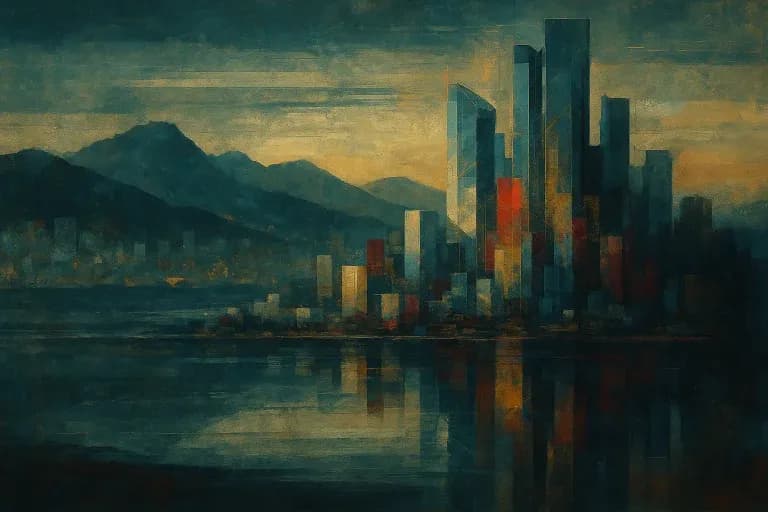
"The City That Forgot to Breathe"
There will come a time when Busan’s parks are no longer visited but surrounded; when the sea can still be seen, but only from above; when every hill has been tamed into a view and every view, priced. In that time, the city will appear flawless — a skyline without memory, a horizon without access.
The irony of progress is that it perfects the image of what it destroys. Once, the city was a landscape that lived with its geography — a conversation between slope and street, between labor and light. Now it is an architecture of distance. Every new tower reflects the sea, but none can hear it.
A city that forgets to breathe does not collapse. It just ceases to be seen.
From the terrace of the United Nations Memorial Cemetery in Busan, the horizon no longer exists in a single sweep. The sea — once a flat, blue certainty — now fractures into reflections of glass and steel. Towers have risen like mirrors, multiplying the city’s image but erasing its line. The silence of the memorial, a space built to honor those who died for peace, is broken by the faint percussion of pile drivers and cranes in the distance. In Busan, even the view of the dead is for sale.
In recent years, South Korea’s second-largest city has embarked on an ambitious campaign of what it calls “urban regeneration.” City officials describe it as a modernization effort, a necessary rebalancing between heritage and progress. But behind that neutral language lies a simpler reality: to regenerate means to redevelop, and to redevelop means to build higher. The city’s Department of Urban Spatial Planning has steadily relaxed height limits in several “scenic zones” — areas once protected for their cultural or historical landscapes — under the banner of landscape improvement. In practice, this has meant granting private developers permission to fill those landscapes with glass towers whose elevation, not design, defines their worth.
The irony is almost architectural. A city once shaped by the accidents of its terrain — mountains folding into narrow valleys, houses clinging to steep ridges, streets tracing the slope of the land — is now being refashioned according to the logic of the render. Busan’s geography made it a city of thresholds: between hill and harbor, tradition and trade, disorder and adaptation. Today, that living irregularity is being recoded as inefficiency. The informal settlements of the past, the tangle of roofs and alleys that once defined its character, are treated not as cultural memory but as urban failure in need of vertical correction.
Nearly 70 percent of Busan’s housing stock predates 1995. Many of those neighborhoods sit on slopes steeper than fifteen degrees, accessible only by narrow stairways and winding roads. For planners, this is the evidence of decline. For developers, it is opportunity. Since 2019, at least five major scenic districts have been deregulated, each producing towers rising between 40 and 70 floors. The city’s skyline, once a side effect of geography, has become its governing ambition — a measurable, photogenic indicator of progress, easily reproduced in campaign brochures.
Officials argue that such development “harmonizes” with the surrounding landscape, that the vertical silhouette of new buildings complements the ridgelines of the city’s mountains. It is a familiar logic: the belief that the skyline itself is the city, that the measure of design lies in its outline. Yet this pursuit of visual unity conceals a deeper fragmentation — social, spatial, and moral. What Busan gains in uniformity, it loses in memory and scale. The neighborhoods that once fostered a human rhythm of streets and courtyards are replaced by towers where the horizon is private property, and the community is verticalized behind access codes.
The result is not modernization but monetization. The rhetoric of “scenic improvement” has turned the landscape into a development currency. In Busan, as in Hong Kong or Singapore, the view has become a financial instrument — traded, securitized, and finally enclosed. The sea, the mountains, even the historical solemnity of the UN Memorial grounds, are being reframed as aesthetic resources to be optimized rather than shared. Each new tower promises “panoramic living,” but what it delivers is exclusion: a city seen from above, not lived from within.
To watch Busan transform is to witness a subtler kind of loss — not of buildings, but of proportion. The balance between land and light, between public space and private ambition, is quietly collapsing. Urban design has become administrative routine, and landscape a marketing adjective. The cranes move with bureaucratic rhythm; progress is defined by the number of floors completed, not the quality of ground preserved.
This is not a uniquely Korean phenomenon. Across Asia’s coastal cities, the politics of elevation has replaced the politics of habitation. But Busan, with its fractured geography and fragile memory, offers an especially clear lens into the problem. Here, “regeneration” has become the polite translation of replacement. The city’s planners speak of harmony, yet what they produce is hierarchy — a skyline of symbols rising above the very communities it claims to renew.
The question, then, is not whether Busan can grow, but what kind of city it chooses to become. Can a place built on the interplay of land and water, mountain and street, survive the flattening effect of its own ambitions? Can a city that sells its view still see itself?
The Topographic Paradox — Disorder as Identity
Seen from the air, Busan is a geography in tension with itself. Mountains surge abruptly from the coast; neighborhoods slide down their flanks like sediment. Streets curve, then vanish; alleys narrow to the width of a single person. It is a city built not on a grid but on improvisation — a choreography of constraint. For decades, this irregularity defined its beauty. The very difficulty of the terrain produced a sense of intimacy: each hill offered its own horizon, each street its own rhythm of ascent and return.
For planners, however, that same landscape now reads as pathology. In the bureaucratic vocabulary of modern urbanism, Busan’s natural irregularity translates into “inefficiency,” its layered neighborhoods into “blight.” The slopes that once offered perspective are treated as obstacles to rational development. A city that survived by adapting to its topography is being redrawn as if the land were flat.
The data tell the story with an almost geological clarity. Roughly forty-two percent of Busan’s residential land lies on gradients steeper than fifteen degrees, according to the city’s own 2023 Urban Survey. More than a third of hillside homes remain beyond formal road access. These are not trivial figures; they describe the lived geometry of the city. Yet in policy documents, they appear as items on a list of problems to be corrected through comprehensive redevelopment. In official maps, the mosaic of small, uneven plots is recolored into tidy rectangles, the terrain simplified into zones of “potential.”
The simplification is aesthetic as much as economic. To render the land manageable, one must first render it abstract. In place of winding stairways and sloping roofs come vertical slabs of uniform height. In the name of efficiency, Busan is losing the spatial texture that made it legible. The old hillside districts — Amnam, Yeongdo, and parts of Dong-gu — once allowed the eye to move naturally between sea and mountain. Now, their replacements create a visual wall: a single gesture of repetition where there used to be gradation and breath.
What the city calls “restructuring” is, in essence, an erasure of complexity. The language of planning favors what can be measured: floor-area ratios, road widths, unit counts. But complexity resists quantification. The way a stairwell catches morning light, the irregular alignment of rooftops, the accidental convergence of sightlines — these are forms of order that emerge only from long habitation. Busan’s topography was never chaos; it was a slow negotiation between human need and natural contour. To treat that negotiation as failure is to misunderstand what a city is.
This misreading has consequences beyond aesthetics. When planners impose vertical order on a horizontal disorder, they also impose a new social geometry. The hillside, once a place where economic lines blurred and neighbors shared the same slope, becomes a frontier of displacement. Redevelopment promises stability but delivers segregation — the poor moved out of sight, the landscape flattened into market value. The result is not harmony but hierarchy.
In truth, Busan’s unevenness was never a flaw to be corrected; it was a memory system. Each incline told a story of adaptation: houses adjusted to rock formations, alleys followed natural drainage, communities evolved along lines of necessity rather than design. To erase that pattern in pursuit of uniform modernity is to strip the city of its narrative depth.
Busan’s paradox, then, is this: the very disorder that once anchored its identity is now being cited as justification for its transformation. A city that learned to coexist with its mountains now seeks to dominate them. In the administrative imagination, the future must be level. But a city that flattens its own geography risks flattening its imagination as well.
How “Scenery” Became a Development Currency
Few words in Korean urban policy have traveled as far from their original meaning as “gyeonggwan gaeseon” — “landscape improvement.” Once used by planners to describe visual preservation and cultural balance, it now functions as a legal synonym for deregulation. The phrase appears benign, even poetic, on official documents. Yet in Busan, it has become the rhetorical key that unlocks private towers along the city’s most fragile horizons.
The transformation began quietly, with the language of efficiency. In the early 2000s, as South Korean cities embraced redevelopment as an economic engine, the vocabulary of planning shifted from protection to optimization. In Busan, “scenic zones” (gyeonggwan jigu) were originally drawn to protect sightlines toward cultural or natural landmarks: the mountains surrounding the port, the curve of the coastline, the solemn geometry of the UN Memorial Park. Over time, however, these zones came to be seen as underused real estate. To “improve” them, in bureaucratic logic, was to make them productive — which meant taller, denser, and more lucrative.
Between 2019 and 2025, five of these scenic districts have been either loosened or fully reclassified. The numbers tell a simple story: in Namcheon’s coastal belt, height limits rose from 60 to 180 meters; around Busan Citizens Park, from 35 to 150. Even the surroundings of the UN Memorial Park — once protected by international agreement — are now subject to “conditional approval” for 80-meter structures. The city frames each adjustment as harmonization, a balancing of new and old. But the harmony exists mostly on paper. On the ground, what emerges is repetition: towers aligned not with terrain, but with profit.
The shift is not merely economic; it is linguistic. The planning documents read like exercises in semantic alchemy, turning public values into administrative permissions. Phrases such as “improving urban scenery,” “enhancing skyline identity,” and “restoring visual coherence” populate the city’s redevelopment guidelines. Each carries an implicit inversion: to “enhance” means to remove, to “restore” means to replace. What begins as landscape policy ends as real estate strategy.
This linguistic laundering performs an essential political function. It allows the state to speak two languages at once — one for citizens, one for investors. To the public, officials promise the refinement of urban beauty; to developers, they promise flexibility. The same document that invokes “heritage preservation” can authorize a 60-story tower beside a war memorial, because the word preservation has been redefined as “integration into the modern skyline.” In Busan’s new lexicon, the city’s visual coherence depends not on continuity, but on vertical punctuation.
The effect is cumulative. Each deregulated site becomes a precedent for the next. Once the logic of “improvement” is accepted, its boundaries dissolve. The skyline expands by contagion. In 2024, when planners justified high-rise approvals near the Suyeong River, they cited earlier exceptions granted for “balanced cityscape management” — exceptions that were themselves products of earlier relaxations. Regulation becomes recursion: the policy feeds on its own breaches.
There is, of course, a visual rationale behind all this. Busan’s leadership argues that a taller skyline projects global modernity — that the city must compete with Seoul’s Gangnam or Singapore’s Marina Bay for attention, investment, and tourists. But the competition is not architectural; it is metaphoric. In a global economy obsessed with image, height becomes shorthand for confidence. To stand out on a postcard is to succeed. And so the city equates visibility with vitality, spectacle with substance.
Yet the cost of this symbolic economy is real. The public view — once shared, unpriced, and continuous — is being enclosed floor by floor. The right to see the sea has become a private amenity, expressed in square meters and sale prices. The aesthetic commons has been commodified. What began as a promise to beautify the city has turned into an industry that sells its reflection.
This is how scenery became currency. The language of policy, bent slightly each year toward convenience, evolved into a marketplace idiom. “Improvement” is no longer an act of care, but of conversion. Busan’s skyline is now a ledger — a visible record of linguistic manipulation, where every new tower stands as both an architectural and a semantic monument to deregulation.
The Political Economy of Height — Bureaucracy Meets Capital
In Busan, altitude is not simply an architectural condition; it is a political currency. Every additional floor represents a compact between public authority and private capital, negotiated in the language of “urban efficiency.” The skyline, once a by-product of the city’s terrain, has become a stage on which power performs its modernity.
Inside City Hall, this performance takes bureaucratic form. Planning committees meet beneath diagrams of future skylines—renderings that show light dancing on facades, green roofs blooming above invisible shadows. What appears as design is, in practice, administration. Each project moves through a sequence of approvals, studies, and exceptions, its trajectory measured not by civic value but by compliance. The planner’s task is no longer to imagine the city; it is to reconcile regulation with ambition, to translate political desire into technical legality.
The alliance is efficient. Developers offer spectacle; politicians offer legitimacy. Both trade in visibility. A tower that breaks the skyline before an election is proof of “progress,” a metric of competence rendered in concrete. Between 2021 and 2024, eleven of Busan’s fourteen major redevelopment approvals coincided with mayoral publicity campaigns or national-holiday ceremonies. The rhythm of construction now mirrors the rhythm of governance: every administration needs its own vertical emblem.
The data confirm the intimacy of this relationship. The average time required for a height-limit relaxation in Busan is just 5.4 months—almost half the national mean. Seventy-eight percent of the city’s official landscape-review members are linked to private consultancy firms, according to the 2024 Transparency Audit. When review boards consist of those who design the very projects they are meant to regulate, oversight becomes ritual. What passes for planning is, effectively, choreography: motions repeated until they resemble deliberation.
The economy beneath this choreography is straightforward. Land in Busan’s coastal wards—Suyeong, Haeundae, Nam-gu—has risen in value by seventeen percent since the first scenic-zone deregulations of 2019. For developers, each meter of additional height yields exponential profit; for the city, it yields a fraction in tax and the illusion of growth. The bureaucratic apparatus converts symbolic capital—“global image,” “modern skyline,” “international competitiveness”—into policy justification. Height becomes both the product and the proof of governance.
Yet the logic is self-defeating. The more the city builds upward, the less it invests outward. Infrastructure budgets strain to service towers whose maintenance costs surpass those of low-rise districts by up to thirty percent per capita. Public-space ratios decline; wind tunnels multiply. But these are deferred problems, invisible in campaign cycles measured in years. In the short term, the skyline photographs well.
What emerges from this convergence of politics and profit is a distinct ideology: altitude as virtue. The city treats elevation as evidence of advancement, as though civic success could be quantified in meters above sea level. It is an ideology of spectacle disguised as urbanism. The skyline becomes a mirror in which government and capital admire each other, both convinced that reflection is substance.
Busan’s planners insist that they are merely following procedure—that every tower has passed environmental reviews, that all designs meet aesthetic criteria. But procedure itself has become the aesthetic. The city’s most ambitious structures are not products of vision but of paperwork. The true architecture of Busan today is the architecture of bureaucracy: forms stamped, boundaries adjusted, exceptions granted, all ascending toward a skyline that glows with administrative certainty.
And yet beneath this vertical choreography lies an older truth: the higher a city climbs, the smaller its ground becomes. When policy treats the skyline as destiny, it forgets that cities live not in elevation but in connection—in the streets where people move, trade, and see each other. Busan’s towers rise quickly, but their shadows lengthen faster.
The High-End Mirage — The Marketization of Scenery
In Busan, the word high-end has achieved a curious omnipresence. It appears on billboards, in planning briefs, in mayoral speeches — a mantra promising transformation through luxury. The adjective has migrated from fashion to real estate, from aspiration to policy. High-end living, high-end skyline, high-end regeneration. The repetition suggests inevitability, as if elevation itself conferred virtue.
The logic is seductively simple: make the city desirable to the affluent, and prosperity will trickle downward. But in practice, Busan’s high-end boom has created a geography of exclusion — a vertical economy built on scarcity, spectacle, and speculation. The city’s natural assets — its sea views, its mountains, its fractured topography — have become the raw materials of a luxury narrative. What was once common scenery is now a financial premium.
According to the Korea Real Estate Board, units marketed as panoramic ocean view apartments in Busan sell at an average 48 percent price premium compared to inland equivalents. Nearly one-third of those units are purchased by non-residents, many holding multiple properties. These are not homes; they are derivatives — instruments of value detached from use. The result is a paradoxical vacancy: the higher the tower, the darker its windows at night.
Developers understand that luxury in Busan is not built; it is positioned. Height substitutes for craftsmanship, view for community. Marketing renders every project as an image of isolation — a penthouse against the horizon, a balcony suspended above the city’s noise. The visuals are aspirational, but the lived reality often is not. Studies by Kwon et al. in Urban Housing Studies (2023) found that residents of high-rise complexes reported significantly lower neighborhood cohesion and higher maintenance stress than those in low- to mid-rise districts. In the name of comfort, the city has produced vertical solitude.
Even the economics are fragile. Maintenance fees in Busan’s luxury towers average 27 percent higher per square meter than in conventional housing, owing to private amenities — gyms, sky lounges, concierge lobbies — that function less as services than as status symbols. The financial burden is passed to residents, whose cost of living quietly erodes the very prestige they bought into. For many, the skyline is both an aspiration and a trap: expensive to enter, costly to remain.
What sustains this illusion is narrative. In official planning documents, “high-end” is conflated with “public value.” A sleek skyline is equated with civic pride; the premium of private comfort becomes evidence of urban vitality. City Hall measures success in promotional images: the reflection of sunset on glass facades, the promise of cosmopolitan life. But beauty, in this equation, is not shared — it is privatized. The city’s aesthetic capital accrues to those who can afford to inhabit its upper stories.
This commodification of scenery has consequences beyond the market. It transforms the very ethics of urban design. When every sea-facing slope becomes a potential luxury enclave, the meaning of “view” itself changes. No longer an experience of place, it becomes a possession — something enclosed, gated, and traded. The horizon turns into collateral. The old social compact — that the best parts of the city belong to everyone — is quietly rewritten.
The irony is that this “high-end urbanism” rarely delivers the quality it promises. The towers are marketed as symbols of progress, but their forms are interchangeable: glass cylinders, stacked balconies, repetitive grids. Their architecture is less designed than templated — optimized for yield, not for grace. They reproduce a global sameness that could belong to any city chasing investment. Busan’s skyline, once a conversation between land and light, now speaks in the monotone of capital.
Still, the illusion persists because it satisfies the short-term desires of all involved. Developers profit, politicians advertise success, and citizens are invited to dream of ascension. Yet beneath that dream lies a quieter exhaustion — the realization that height does not equal dignity, that a city built for the few cannot sustain the many. The high-end boom, for all its glossy surfaces, exposes an older urban truth: when the landscape becomes a product, the city itself becomes expendable.
The Aesthetics of Disappearance — Losing the Line
Every city has a line that defines its soul. In Busan, that line once existed between land and sky — a soft, uneven horizon where mountains descended into the sea, where the rhythm of roofs echoed the contours of the hills. It was not a perfect line; it wavered, folded, adjusted itself to the slope and the wind. Yet that imperfection was the essence of the city’s beauty: a skyline born of coexistence, not conquest.
That line is vanishing. The new towers rising along Busan’s coast — from Namcheon to Haeundae, from Munhyeon to the UN Memorial district — do not follow the terrain; they overwrite it. The mountain’s descent toward the harbor is now intercepted by glass. The view once shared from every hilltop has become a private panorama framed by window mullions and branded as a premium. What once belonged to everyone now belongs to altitude.
The transformation is measurable. City planning data show that between 2020 and 2025, Busan’s average building height in redevelopment zones increased by nearly 45 percent. Shadow analyses from the Namcheon waterfront project reveal that adjacent low-rise areas lose up to 37 percent of winter sunlight. Wind-tunnel tests conducted by Pusan National University record a 20 percent increase in ground-level turbulence in newly developed districts. The physics of height — shadow, reflection, wind — are rewriting the city’s sensory landscape.
But beyond numbers lies a deeper erasure: the disappearance of legibility.
Busan was once a city one could read. From any hill, the eye could trace the line of the coast, the rhythm of the valleys, the sequence of roofs cascading toward the water. That continuity created a sense of belonging — a visible reminder that the city and its inhabitants shared the same geography. The skyline was a form of language, telling the story of adaptation between humans and land. In the new vertical city, that story has been redacted. The horizon no longer speaks; it reflects.
The urban image now depends on spectacle rather than structure. Developers describe their projects as “curtain cities” — a term meant to evoke elegance, but which perfectly captures the problem. The skyline has become a façade drawn against the natural contours of the land, a curtain concealing the disorder and memory behind it. From a distance, Busan’s night view glitters like progress. Up close, it is repetition — a city that blinks instead of breathes.
Architecturally, this flattening of form into surface marks a profound aesthetic loss. Modern Busan’s towers are designed not to harmonize with the landscape, but to dominate its image. They are built to be photographed, not inhabited. The alignment of facades, the choreographed lighting, the branding of “sky villas” and “marine panoramas” — these are gestures to visibility, not to life. The skyline has been aestheticized into abstraction: a continuous silhouette of investment.
Yet in this pursuit of visual modernity, the city has lost the very sense of beauty it sought to project. True urban aesthetics emerge from tension — from the friction between natural form and human adaptation. Busan’s older neighborhoods, with their uneven roofs and zigzagging stairways, embodied that balance. Their irregularity was rhythm. Their asymmetry, grace. The new skyline, in contrast, replaces complexity with coherence. It mistakes uniformity for elegance.
The irony is cruelly geometric. By erasing the irregular, Busan erases the visible evidence of its resilience — the improvisation that allowed life to persist on steep hillsides, the collective intelligence of unplanned form. The new towers, for all their glass and steel, have no memory of the ground they occupy. They stand as symbols of weightless aspiration, indifferent to the soil beneath them.
What disappears, then, is not only the line between mountain and sea, but the line between the city and its conscience. A skyline that once told the story of survival now tells the story of speculation. And beneath its shadow, the city that once looked outward — toward the ocean, toward possibility — now looks only at itself.
Bureaucracy as Design — How Administration Replaced Imagination
Every skyline conceals a filing cabinet.
Behind Busan’s glass towers lies an invisible architecture of forms, stamps, and procedural approvals. Each new building is the end product of a thousand signatures — environmental reviews, height exemptions, land-use adjustments, impact assessments. To the citizen, these appear as evidence of rigor; to those inside the process, they are choreography. The city is being designed through documents rather than ideas.
Busan’s planners no longer draw; they reconcile. Their task is not to imagine new forms of coexistence but to ensure compliance with frameworks that predate imagination itself. The city’s Urban Design Review Committees meet not to debate what kind of space Busan should become, but to verify whether a proposal meets procedural minimums. According to the 2024 Transparency Audit, ninety-two percent of these reviews occur behind closed doors, with no public minutes. Less than five percent of applications are rejected on design grounds. The rest are processed — a term that has quietly replaced approved in the bureaucratic lexicon, as if the city were an administrative machine consuming its own paperwork.
In this machinery, imagination is not forbidden — merely unnecessary.
The design language of Busan’s newest developments, their repetitive geometry and predictable proportions, is not the result of a shared aesthetic vision. It is the product of standardization. Regulations determine the spacing between towers, the setback from the road, the minimum green coverage. What these frameworks do not define — proportion, rhythm, human experience — is left to expedience. The city’s form emerges not from intention, but from compliance.
This bureaucratic mode of urbanism carries its own ideology.
By converting planning into process, it erases accountability. When every decision is procedural, no one is responsible for the result. A tower that blocks sunlight across an entire district is not a failure of policy, but of “unforeseen conditions.” A redevelopment that displaces hundreds of residents is not an act of aggression, but the fulfillment of “legal frameworks.” In this moral geometry, the document absolves the designer.
The aesthetic consequences are visible from any hillside: rows of identical towers rising with mathematical indifference. They are not mistakes; they are the inevitable outcome of a system that confuses repetition with reliability. Busan’s planners defend this order as rational, even democratic — every developer subject to the same code, every design adhering to the same criteria. But democracy in design cannot mean sameness. True equity lies not in uniformity, but in the diversity of form that reflects the diversity of life.
What makes this condition tragic is that it was once otherwise.
In the postwar decades, Busan’s topography forced invention. Hillside houses improvised with available materials and collective labor. Streets adapted to gradients and shadows. It was a messy, resilient city — the product of thousands of small imaginations rather than a single grand plan. Now, in the name of progress, that collective intelligence has been replaced by administrative logic. The old city was irregular because it was alive; the new one is consistent because it is coded.
To watch the planning process today is to witness design reduced to risk management. Every line on a blueprint corresponds to a checkbox on a form. Success is measured not by beauty or coherence, but by the absence of objections. The skyline thus becomes the visual record of bureaucratic comfort: tall, neutral, unambiguous. The city is safe from vision.
What this reveals, finally, is not the incompetence of individual planners, but the exhaustion of the system that governs them.
Busan’s planning bureaucracy was built for control, not creation. It rewards caution, not curiosity. It is a structure that produces verticality because height is easy to quantify, while quality is not. The result is a city of measurable success and invisible failure — a skyline that satisfies every regulation and defies every sense.
In the end, the tragedy of Busan’s urban transformation may not be its glass towers, but the quiet resignation that built them. The city no longer dreams; it administers. And when administration becomes the highest form of design, imagination is the first casualty.
Rethinking the Topographic City
If the city is an organism, Busan has long survived by adapting to its terrain rather than conquering it. The mountains and the sea were not obstacles but coordinates — fixed points in an urban improvisation. To rebuild Busan, therefore, is not to erase its topography but to rediscover it.
The challenge is not technological; it is philosophical. Busan’s crisis is not the lack of expertise, but the absence of imagination that respects the ground. Modern planning has been dominated by an idea of efficiency that flattens everything it touches — the contour of a hill, the complexity of a street, even the memory of place. To rethink the city, we must reverse that vector. The future of Busan lies not in higher towers, but in deeper understanding.
A new urban paradigm begins with a simple shift: build with slope, not against it. Instead of treating mountainsides as defective land, design them as gradients of opportunity — terraced housing that follows the contour, layered public paths that reconnect isolated communities, ecological corridors that double as social infrastructure. In cities such as Yokohama and Barcelona, this approach has produced “topographic urbanism,” where terrain becomes an organizing principle rather than an inconvenience. The result is not only visual harmony, but resilience: a city that breathes with its geography.
Next, the city must replace aesthetic rhetoric with quantitative landscape governance. Busan’s ordinances speak endlessly of “beauty” and “harmony,” yet provide no measurable standards for either. Shadows, wind flow, visibility, accessibility — these are the real metrics of livability. The tools already exist: computational view-shed analysis, solar access indices, pedestrian permeability models. By legislating data instead of adjectives, the city can transform beauty from a political slogan into a civic right. Every citizen should have a measurable share of light, air, and view.
But policy reform alone is not enough. Urban form is also a matter of culture — of who decides what beauty means. The next generation of planning must restore public imagination to the process. A Civic Design Council, composed not only of bureaucrats and consultants but of artists, environmental scientists, and residents, could reintroduce deliberation as a creative act. Busan’s design culture has been privatized; its return to the public sphere would be revolutionary. The city should once again be a place of shared authorship.
Equally vital is memory. Regeneration cannot mean amnesia. Every redevelopment project should begin not with demolition, but with documentation — mapping the patterns of light, slope, and social life that already exist. In the global race for modernization, Busan must learn that preservation is not nostalgia; it is continuity. The irregular city is not the enemy of progress. It is the proof that progress once happened.
Finally, Busan must reclaim the moral dimension of its landscape. The sea, the mountains, the UN Memorial grounds — these are not commodities but collective inheritances. Their value is not aesthetic but ethical: they remind the city of proportion. A truly modern city is one that resists the temptation to consume itself. Busan’s greatness will not be measured by how high it builds, but by how deeply it remembers.
To rethink the topographic city, then, is to rediscover humility — to design not for the skyline but for the slope, not for investors but for those who live within the horizon. A city faithful to its ground is a city that endures. In the shimmer of its towers, Busan has momentarily forgotten that truth. But beneath the concrete, the hills remain, waiting to be reimagined.
The Horizon as Public Memory — Closing Reflection
At sunset, the horizon over Busan still looks the same. From the edge of the UN Memorial Park, the sea burns orange, the mountains turn to silhouettes, and for a brief moment, the city’s towers vanish into the light. The view is pure again — a memory of what the city once was, before height became ambition and the skyline became currency.
That horizon is not just scenery; it is history. It holds the geometry of memory — the line between sacrifice and survival, between the city that endured war and the city that now sells its peace. Every apartment window that frames this view borrows something it did not build: the dignity of a landscape shaped by loss and endurance. To build here, then, is not merely to occupy space; it is to inherit meaning. And inheritance, if it is to be moral, demands restraint.
Busan’s transformation has been defended in the language of progress — regeneration, competitiveness, modernization. But progress without reflection is a form of forgetting. The city’s obsession with the skyline has blinded it to what truly made it visible: the tension between topography and humility, between the built and the natural, between ambition and belonging. When those balances disappear, a city may still grow richer, but it ceases to be recognizable — to itself or to others.
In the logic of contemporary development, the horizon has become a private asset. Yet the horizon was never meant to belong to anyone. It is the city’s collective inheritance — the one thing that no deed, no design approval, can rightfully contain. When that line is fractured, so too is the civic imagination. The erosion of landscape is the erosion of citizenship.
To preserve the horizon, then, is not nostalgia. It is an act of ethics. It means remembering that a city’s beauty is not a photograph but a practice — a way of seeing, of inhabiting, of sharing. It means restoring the idea that the public realm is not what remains after private interest, but what defines it. Busan’s task in the coming decade will not be to build taller, but to see clearer: to recover a vision of modernity that does not destroy the ground it stands on.
If the skyline is the city’s face, the horizon is its conscience. And perhaps that is where Busan’s true future lies — not in the mirror of glass towers, but in the line where the mountain meets the sea, where memory still resists commodification, and where the city, if it listens, might yet learn again how to breathe.
“The Ruins of the Future”
Thirty years from now, the towers of today will stand as monuments to a forgotten optimism — immaculate façades weathered by salt, balconies that never opened to the air they promised. The word “high-end” will sound archaic, a language from a time that mistook luxury for endurance.
In the shadow of these towers, the city’s true legacy will be silence — the absence of street noise where parks once breathed, the disappearance of small lives that gave the skyline meaning. The future will look immaculate from afar, but empty at the ground.
Perhaps that will be Busan’s final lesson to itself: that architecture can imitate eternity, but it cannot replace time.
The Weekly Breeze
Keep pace with Busan's deep narratives.
Delivered every Monday morning.