Climate Change and the City: Why Shade is the New Infrastructure
In August heat, even a short walk can feel punishing. Yet many of Korea’s new towns offer little shade. As climate change stretches summers and intensifies heat, the simple act of walking demands a new vision of urban planning.

By August, the city feels weary from heat that arrived too soon and refuses to leave. Summer now begins in May, lingers past September, and grows more intense with each passing year.
Asphalt radiates like a stove, glass towers shimmer in the haze, and even a short walk can feel punishing. What used to be a brief season of discomfort has stretched into a prolonged ordeal. In Korea, the sticky nights of yeoldaeya—the term for “tropical nights,” when temperatures never fall below 25°C—have become a defining rhythm of urban life. Climate change is no longer a forecast; it is the texture of our daily surroundings.
And yet, in the midst of this relentless heat, entire new towns continue to rise. On the reclaimed flats of Busan’s west coast or at the edges of Seoul, they promise efficiency, modern housing, and green space carefully tallied to meet official standards. The master plans look complete, balanced, almost utopian. But on the ground, one detail is strikingly absent: shade.
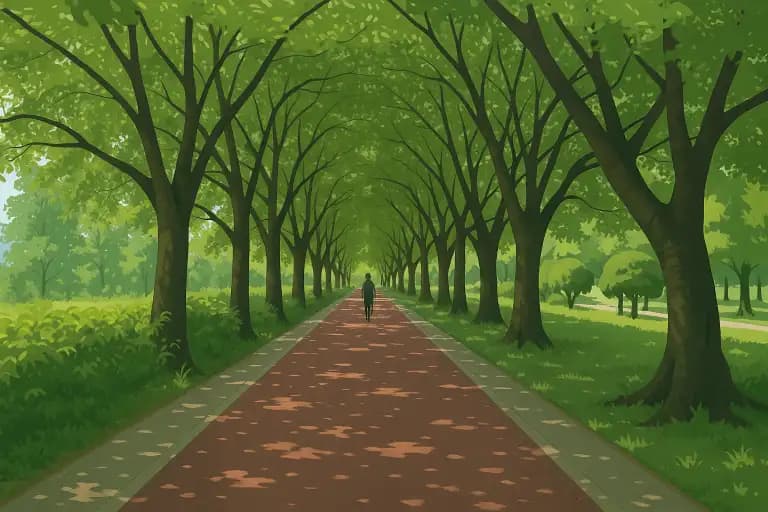
The omission matters. A canopy of trees arching across a sidewalk, or a corridor of continuous shade threading through neighborhoods, is not cosmetic. It is what makes walking possible in a climate that is both hotter and longer than the one cities were originally built for.
Other parts of the world are already responding, reframing shade as infrastructure, as vital as water or power. The challenge for Korea’s new towns is whether they, too, can adapt—whether they can evolve from projects of real estate supply into genuine models of climate resilience.
The Promise and the Reality of New Towns
Korea’s new towns were meant to embody progress. Planned down to the last detail, they rise in orderly grids on reclaimed land or former farmland, with wide boulevards, high-rise apartment clusters, and landscaped parks woven into the blueprint. To policymakers, these projects represent efficiency: a fast answer to housing demand, equipped with transit links, schools, and the minimum quota of green space. On paper, the equation looks solved.
But the lived reality tells another story. Step into these neighborhoods at midday in August, and the geometry of the plan reveals its blind spot. Streets stretch wide and exposed, their trees planted sparsely and more for symmetry than shelter. Parks exist, but often in isolated parcels, separated by sun-bleached blocks of asphalt and concrete. Between apartment complexes, ornamental landscaping provides color but not cover. For residents, the act of walking from home to a bus stop, a shop, or even across the complex itself means braving relentless sun.
This dissonance is rooted in the priorities of development. For decades, new towns have been measured by housing capacity, traffic flow, and market value, while the micro-experiences of daily life—shade, walkability, the comfort of moving through a city on foot—were secondary concerns. The result is that even in districts where utilities have been modernized and power lines buried underground, the opportunity to line boulevards with dense tree corridors has been overlooked.
In effect, the promise of new towns has been delivered in numbers—units built, hectares of parkland secured—but not in the texture of lived comfort. Residents inherit efficiency, but they do not inherit streets they want to walk. And as summers grow hotter and longer, this oversight becomes more than an inconvenience. It becomes a test of whether the very design of these cities is fit for the climate they now face.
Time, Trees, and the Making of Shade
If there is one truth about shade, it is that it cannot be rushed. A city may rise in a matter of years, but a tree needs decades to stretch its canopy wide enough to shelter a street.
In most new towns, cost and logistics dictate the planting of young saplings, slim and fragile, which take ten to fifteen years before they offer meaningful shade. Even when mid-sized trees are transplanted, the effect is partial, requiring another decade of growth before streets begin to resemble green corridors. Large, mature trees can be moved only in exceptional cases—at enormous expense and with no guarantee of survival.
This lag between urban construction and ecological maturity creates a stark gap for residents. A boulevard lined with thin rows of decorative trees may satisfy a green-space requirement on paper, but for the first twenty years of its life, it remains an exposed stretch of heat. In reclaimed flatlands like Busan’s western districts, poor soil compounds the problem, slowing growth and extending the timeline even further.
Other cities, anticipating the same dilemma, have approached it differently. Singapore, for instance, treats canopy planning as infrastructure, investing in advanced transplantation of semi-mature trees and building continuous corridors that link parks, waterways, and sidewalks. In European cities like Barcelona or Freiburg, shading is paired with traffic calming: narrower car lanes and wider pedestrian spaces allow denser planting and faster shade coverage. These are not ornamental choices, but climate strategies, designed to make walking feasible even in peak summer heat.
For Korea’s new towns, the question is whether planning will continue to prioritize rapid housing supply over long-term livability—or whether it can evolve into a vision where shade is designed, staged, and managed as carefully as utilities or transit.
When Shade Becomes Infrastructure
Across the world, cities grappling with hotter summers have begun to treat shade not as a decorative afterthought but as an essential element of urban infrastructure.
In Singapore, for instance, the idea of the “City in a Garden” has matured into a systematic strategy where green connectors—tree-lined pedestrian and cycling routes—are designed with the same level of precision as highways or drainage networks. The aim is not only to beautify but to guarantee that every resident can walk under cover, even in the height of the tropical sun.
Elsewhere, canopy targets have become a new metric of success. Melbourne, long exposed to searing heat waves, has committed to doubling its urban canopy cover within two decades, embedding this goal into citywide policy frameworks with annual audits and long-term maintenance plans.
In Los Angeles, the issue has been reframed through the lens of equity: heat maps revealed that wealthier neighborhoods enjoyed abundant shade while poorer districts were left bare, so tree planting is now prioritized where exposure most threatens public health.
In European cities like Barcelona and Freiburg, the focus has been on redesigning streets themselves, narrowing lanes for cars and widening pedestrian spaces to allow trees to grow densely and quickly into shaded corridors.
Even in Phoenix, where the desert climate tests the limits of vegetation, a hybrid approach has emerged—trees supported by reflective pavements, permeable surfaces, and integrated irrigation—creating “cool corridors” that protect those who have no choice but to walk.
The common thread running through these cases is not one of ornament but of infrastructure. Shade is planned, measured, and budgeted with the same seriousness as transport systems or water supply. It is understood as a determinant of public health, mobility, and livability in an era when summers arrive earlier, last longer, and test the endurance of every city dweller.
The contrast with many of Korea’s new towns is striking. Built rapidly on reclaimed plains and designed to maximize housing supply, they often meet statutory green-space ratios while failing to deliver the one quality that matters most in the heat: continuous, protective canopy along the very routes where people must walk. For these young cities, the opportunity still exists to recalibrate.
If shade is embraced as infrastructure from the outset—planted with long horizons in mind, designed into the geometry of streets, and maintained as rigorously as any other utility—then the new towns of today may yet mature into places where walking is not a burden but a daily comfort, even under the intensifying sun.
Toward a Climate-Ready Urban Vision
The challenge of climate change is no longer abstract.
With summers arriving earlier, lasting longer, and bringing unprecedented levels of heat, urban design must move beyond compliance-based planning and toward climate-readiness as a central principle. This requires shifting the focus from short-term delivery of housing units to the long-term creation of livable environments.
For new towns in Korea, where the landscape often begins as treeless reclaimed plains, this shift is particularly urgent. Designing shaded, walkable corridors cannot be left to chance or ornamental landscaping. It demands coordinated action from the outset: budgeting for semi-mature trees rather than saplings, planning street widths and orientations to accommodate eventual canopy growth, and adopting measurable targets such as canopy coverage rather than relying solely on green-space ratios.
Equally critical is the recognition that shade must form continuous networks—routes to schools, transit stops, and local amenities—rather than scattered patches of greenery that look good on a master plan but fail to protect daily movement.
A climate-ready vision also implies governance that extends beyond initial construction. Maintenance regimes, irrigation planning, and community engagement must be embedded in the model so that trees not only survive but thrive into full shade-giving maturity.
International precedents show that this kind of vision requires 20 to 30 years of commitment. Korea’s new towns, still young enough to redefine their trajectory, have the chance to embed this foresight now.
If the twentieth-century measure of a city was the efficiency of its roads, the twenty-first century will be judged by the comfort and resilience of its public realm.
Shade, once treated as ornament, must now be counted as infrastructure. By reorienting design around walking comfort and climate adaptation, new towns can transform from exposed expanses of concrete into living, breathable environments prepared for the heat that has already become a defining feature of urban life.
In the end, the true measure of a climate-ready city will not be its skyline, but the simple act of being able to walk down a shaded street in the middle of summer—and to feel that the city itself is on our side.
The Weekly Breeze
Keep pace with Busan's deep narratives.
Delivered every Monday morning.