A Nation of Doctors, A Nation of Engineers
In South Korea, the path to prestige increasingly runs through medical school. Despite a national push to lead in artificial intelligence, semiconductors, and advanced robotics, the country’s brightest students are opting for stethoscopes over circuit boards.

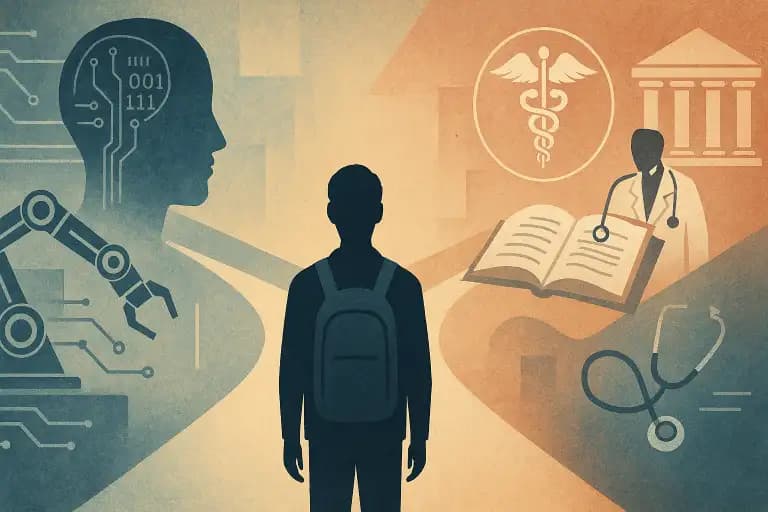
In the competition to shape the future, countries often speak of industries, innovation, and infrastructure. But the real contest starts earlier—in classrooms, in career choices, and in how a society values certain kinds of work. South Korea and China, both nations with deep investments in science and technology, are seeing their brightest students take very different paths. And those choices may matter more than any industrial policy.
In South Korea, students at the top of their class aren’t heading into engineering or computer science. They’re becoming doctors. For years now, medicine has been the dominant destination for high-achieving students. It offers stability, status, and a clear return on years of academic pressure. Engineering, once the pride of the nation’s industrial rise, has slowly fallen out of favor—even in the most competitive science high schools. The result is a growing gap between the country's ambition in technology and the actual flow of talent that will be needed to sustain it.
China, meanwhile, is pushing hard in the other direction. Its top students are being pulled—by policy, money, and a clear sense of national mission—toward engineering, AI, and advanced sciences. From elementary education to elite university labs, the entire system is built to cultivate future technologists. Startups, research centers, and government-backed ventures are absorbing young talent at a scale that reflects not just individual interest, but national intent.
The contrast isn’t subtle. It’s structural. And over time, it could determine which country builds the next generation of global technologies—and which one struggles to staff it.
What Korea’s Top Students Are Choosing
In South Korea, the gravitational pull of medical school is now one of the most powerful forces shaping the academic landscape. High school seniors with near-perfect scores and a deep background in math and science are choosing to study medicine, not physics, not software engineering, and rarely electrical or mechanical engineering. It’s a pattern that has solidified over the past decade, with each admissions cycle reinforcing the same outcome: medicine is where the rewards are, and engineering is where the compromises begin.
Part of the explanation lies in how the professions are structured. Medicine in Korea offers a clear, secure path. Once admitted, the student is virtually guaranteed a stable career with high income, growing demand, and social status. Engineering, by contrast, is a long and uncertain road. New graduates often face intense competition, modest starting salaries, and limited influence within rigid corporate hierarchies. For the most talented students, the calculus is simple. The prestige and compensation that engineering once offered has eroded, while medicine remains a guaranteed ticket to security.
What makes this shift more consequential is that it isn’t just happening at the margins. Even students from Korea’s elite science high schools, institutions built to produce future researchers and innovators, are now applying to medical schools in increasing numbers. Their aptitude for abstract thinking, complex problem solving, and high-pressure performance—traits that once filled the country’s top engineering programs—are now fueling admissions to Seoul’s best medical colleges. And once these students make that choice, they don’t come back. They become clinicians, not coders; surgeons, not scientists.
This realignment has left a visible gap in Korea’s STEM ecosystem. Universities report declining interest in core engineering majors. Government calls for more AI and semiconductor experts rarely align with the actual decisions made by the country’s best students. Efforts to promote coding education and research careers have struggled to compete with the clarity and security that the medical profession offers. The mismatch between what the economy says it needs and what the talent system actually produces has become increasingly difficult to ignore.
How China Is Rewriting Its Talent Map
In China, the pipeline runs differently. Top students are not drifting into medicine or law—they are being drawn, often deliberately, into science, engineering, and deep technology. The system doesn’t rely on student preference alone. It is shaped by design: national policy, school curricula, funding priorities, and the visible rewards of choosing the technical path.
Elite high schools specialize in math and science from early stages, offering fast tracks to top engineering programs at universities like Tsinghua, Peking, and Zhejiang. These institutions are tightly linked to national research agendas and tech entrepreneurship. High-performing students don’t just learn; they are guided—toward robotics labs, AI competitions, and startup accelerators housed on campus. There is a direction to the entire process, and that direction points toward innovation.
The incentives are hard to ignore. Young engineers in China can expect starting salaries that rival or exceed those in the medical field. Tech companies aggressively recruit top graduates, often before they finish their degrees. Many of the country’s wealthiest young entrepreneurs—some still in their 30s—come from engineering backgrounds, not finance or medicine. In cities like Hangzhou and Shenzhen, success stories in AI, autonomous vehicles, and robotics are not rare exceptions; they are becoming part of the culture.
The government has reinforced this trajectory with consistent long-term plans. Industrial policy is not just abstract. Five-year roadmaps, AI development blueprints, and regional tech funding all align to pull talent in the same direction. Thousands of overseas researchers have returned under national talent programs. Venture capital flows freely into technical projects, and failure is tolerated so long as the goals are bold enough. The message, both implicit and explicit, is clear: science and engineering are not secondary options—they are the future of the country.
What results is a talent system that feeds directly into national ambitions. Technical universities produce not only graduates, but founders. Research institutes double as launchpads for commercial products. Government labs collaborate with startups. It is a loop—education, research, application—built to sustain itself. In this ecosystem, becoming an engineer is not a compromise; it is a destination, and increasingly, one of prestige.
When Industrial Goals and Talent Paths Diverge
The contrast between South Korea and China isn’t only about individual choices. It is about the systems that surround those choices—and the signals they send. In Korea, educational policy, labor markets, and public discourse are often misaligned. The government calls for AI engineers and semiconductor experts, yet students see little reason to follow that call. Research careers are underfunded, starting salaries in engineering are low, and long-term advancement is often slow or opaque. Even students who enter STEM programs may drift elsewhere, deterred by poor job prospects or unstable working conditions.
At the institutional level, the fragmentation is clear. Universities, ministries, and industry lack the kind of tight coordination that turns academic learning into national innovation. There are efforts—government scholarships, specialized high schools, industry-academic partnerships—but they often operate in isolation or without long-term continuity. Meanwhile, private tutoring markets and social pressures continue to elevate medical school as the gold standard of academic success, reinforcing a narrow definition of ambition.
In China, the structure is more centralized and directive. Policy frameworks are built with scale in mind. When the government sets a target for AI research or semiconductor independence, funding, curriculum, and career pathways are adjusted in sync. Technical universities act as hubs for both research and entrepreneurship, and students see a clear link between their studies and the sectors the country prioritizes. The result is a more coherent flow—from education to employment to innovation.
Importantly, failure is treated differently. In Korea, a failed startup or research project often closes doors. In China, it may open new ones, especially in regions where local governments and VC funds actively support second and third attempts. This tolerance for risk encourages technical experimentation. It also helps explain why Chinese engineers, even at a young age, are starting companies, leading labs, and building technologies that compete globally.
Over time, these institutional differences compound. Korea is producing more doctors than it needs, while warning of an AI talent shortage.
China is producing more engineers than any other country—and increasingly, they are staying, building, and scaling companies at home. The systems are doing what they are designed to do. The question is whether Korea’s system still matches the future it says it wants.
The Choice That Shapes a Nation
The divergence between South Korea and China is not just academic. It is already shaping the direction of their economies. The industries that will define the next generation—artificial intelligence, quantum computing, robotics, biotechnology—will not grow on policy declarations alone. They will be built by people. And those people are making choices right now.
In China, the system is bending to support those choices. Engineers are rewarded, young scientists are trusted, and technical ambition is backed by coordinated investment. In Korea, the picture is more conflicted. The country wants more AI researchers and chip designers, but its top students are choosing scalpels over code. The message they’re responding to is not in government white papers—it’s in the structure of opportunity, the distribution of risk, and the kinds of futures they believe are realistic.
No single reform will reverse this trend. It will take more than adjusting university quotas or funding a few labs. It requires rebuilding confidence that science and engineering can offer not just purpose, but possibility—and that the country will stand behind those who choose harder, riskier paths. Without that shift, the mismatch between Korea’s ambitions and its talent flows will only grow wider.
In the long run, national competitiveness isn’t won on balance sheets. It’s decided in classrooms, in labs, and in the thousands of decisions students make each year about where their work will matter. That decision—for Korea—has rarely been more urgent.
The Weekly Breeze
Keep pace with Busan's deep narratives.
Delivered every Monday morning.