South Korea’s Farmland Census Tests the Future of Farming
The first nationwide farmland census is designed to expose speculation and misuse. But the harder question begins afterward: who will farm the land, under what terms, and whether it can remain productive in an aging, climate-stressed countryside.

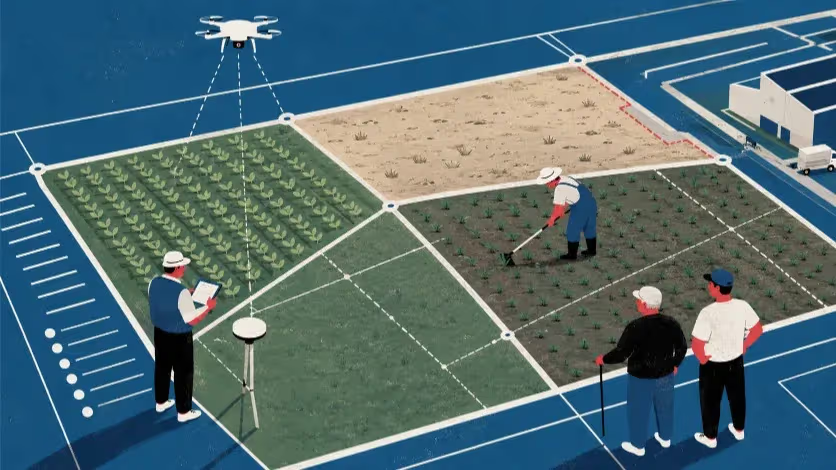
South Korea’s first nationwide farmland census begins with a bureaucratic task: to inspect roughly 1.95 million hectares of land that the state still classifies and protects as farmland. But the work now getting under way is larger than a land-use check. Over two years, the government plans to examine ownership, actual cultivation, idle fields and farmland that may have slipped into non-agricultural use. The first phase focuses on farmland acquired after the Farmland Act took effect in 1996; the second will extend the inquiry to older holdings. Administrative records, aerial imagery, drones and artificial intelligence will be used before deeper field inspections begin.
The government presents the survey as a response to speculation. That description is accurate, but incomplete. Farmland in Korea has become a category under strain. Around metropolitan edges, new towns, roads, logistics sites and industrial projects have changed the price of fields long before their legal status changes. A plot may be valued less for what it can grow than for the chance that it will one day stop being farmland. In older agricultural districts, the pressure looks different. Land remains, but the people who know how to work it are aging out, and successors are not arriving in sufficient numbers.
This is the tension the census will expose. Korea’s farmland law still rests on the principle that agricultural land should be owned and used by those who farm it. Rural reality is less orderly. Fields are inherited by children who live elsewhere, leased through informal arrangements, held as retirement assets, folded into development expectations, or kept in production by tenants whose legal position may be weaker than their practical role. A parcel can be farmland in the registry and something more ambiguous on the ground.
That ambiguity matters because Korea’s agricultural problem is no longer only a question of illegal ownership. The country has made farming more efficient over decades, but the foundations beneath that efficiency are narrowing. The national cultivated area stood at about 1.5 million hectares in 2025, down by roughly 5,000 hectares from the previous year, according to the government’s crop area survey. The census will cover a wider legal and administrative universe than the land currently measured as cultivated, which is precisely why the state is trying to reconcile the record with the field.
Food security has added another pressure. The 2025 agricultural statistics yearbook put Korea’s 2024 food self-sufficiency rate at 47.9 percent and its grain self-sufficiency rate, including feed, at 21.6 percent. Those figures do not mean every field must be frozen in its current use. They do mean that Korea cannot treat remaining farmland as a residual category, defended only until a higher-value use appears.
The Audit Beneath the Census
The mechanics of the census show how far the problem has moved beyond ordinary farmland administration. The government is not sending inspectors into the countryside simply to verify boundary lines or update old records. It is trying to reconcile several versions of the same land: the parcel recorded in the registry, the owner named in the documents, the person actually farming it, the use visible from above, and the economic expectation attached to the site. In many cases, those versions may not match.
The first stage is designed to sort the country’s farmland before inspectors reach the field. Administrative records, farmland ledgers, ownership data, aerial imagery, satellite information, drones and AI will be used to identify parcels that appear inconsistent with their formal status. A field listed as farmland may show no crop activity. A parcel declared for farming may contain a yard, storage site, parking area or building. Land acquired under a plan for self-cultivation may be worked by someone else. A property held by an owner living far from the village may remain productive only because an informal tenant has kept it that way.
That early sorting matters because a full census does not mean every parcel will be treated with equal suspicion. The state is constructing a risk map. Farmland in land transaction permit zones, the Seoul metropolitan region, land acquired through auction, land held by agricultural corporations or foreign owners, parcels acquired through recent farmland qualification certificates, properties owned by people living outside the area, shared ownership plots and sites previously flagged in farmland-use inspections are among the categories expected to receive closer attention. These categories reveal the government’s working assumption: the most sensitive farmland is no longer only the land that has visibly left agriculture, but land where ownership, location and use suggest that farming may have become secondary.
The distinction is important. A field on the edge of a development corridor can remain green and still operate as a financial position. Its value may depend less on the crop standing in it than on road plans, industrial zoning, logistics demand or the expectation that regulation will eventually loosen. A corporation may hold farmland under an agricultural purpose but treat it as part of a broader land strategy. A group of co-owners may divide risk through shared acquisition. An absentee owner may preserve the appearance of cultivation while another person supplies the labor. These cases are harder to see than an illegal warehouse or paved yard. They are also closer to the center of the policy problem.
The stronger legal tools attached to the census give it sharper consequences. A recent Farmland Act amendment created a clearer basis for inspectors to enter land, added illegal farmland leasing to the list of violations eligible for reporting rewards, and tightened disposal orders that had previously depended more heavily on local government discretion. The change means the census is not only a fact-finding project. It is being built to produce administrative action.
That shift will be welcomed by those who see farmland speculation as a long-standing abuse of a protected resource. For years, development expectations have allowed agricultural land to function as a quiet store of future value. The social cost has been difficult to measure because the damage is often dispersed: higher entry costs for real farmers, fragmented ownership, idle land, weakened local production and public distrust after land scandals exposed how easily farmland rules could be used as a screen.
Yet the same enforcement can cut into the working arrangements that have kept some farms alive. Informal leasing is often illegal or poorly documented, but it is also part of how agriculture has survived in an aging countryside. Many owners no longer farm. Many active producers do not own enough land. Many villages function through arrangements that are practical before they are legally tidy. If the census treats every irregular lease as a problem to be terminated rather than a relationship to be regularized, it may remove land from the people most capable of using it.
The more difficult task is to separate speculative control from productive use. An absentee owner holding land for conversion is not the same as an elderly owner leasing to a neighbor who depends on the plot for income. A tenant who lacks a formal contract is not the same as a developer waiting for a zoning change. A corporation using agricultural status to accumulate land is not the same as a farming entity trying to scale production. The census can collect the evidence, but policy must supply the judgment.
Productivity on a Narrowing Base
Korea did not become an agricultural outlier by having abundant land. It became one by learning how to work around scarcity. Small plots were pushed harder. Greenhouses stretched seasons that open fields could not. Machinery took over work that families could no longer supply. Fertilizer, pesticides, improved seeds, irrigation, purchased feed and cold-chain logistics helped lift more value from a limited land base. The achievement was real, but it was never costless. Korean agriculture became efficient by leaning heavily on capital, inputs, family labor and farmers old enough to remember when scarcity was not a policy problem but a daily condition.
That history makes the farmland census more complicated than an anti-speculation campaign. The issue is not whether Korean farms can produce. Many already produce intensely. The issue is whether the system that made that possible still has enough land, labor and time left in it. A greenhouse can raise yields and deepen debt at the same time. A paddy can produce well while the number of paddies falls. A village can keep shipping crops long after its farm households have crossed into old age. Productivity, in that sense, can conceal decline. It can make a weakening system look functional until the people holding it together begin to disappear.
The pressure is most visible at the point of entry. A new farmer does not begin with seed or soil. He begins with land prices, lease terms, machinery costs, water access, credit and the question of whether he can stay on the same plot long enough to make investment sensible. A one-year lease is not a foundation for soil improvement. A fragmented field is not easily worked by machine. A greenhouse built on insecure land is not an asset; it is a risk fixed to someone else’s property. The census may identify land that is idle or unlawfully held, but released land does not automatically become usable land. It has to be affordable, contiguous enough to work, legally secure and connected to a farmer with a reason to invest beyond the next season.
The divide is already visible across the farm economy. Korea’s greenhouse and intensive vegetable sectors show what can be achieved when capital, infrastructure, technical knowledge and market access come together. Other parts of agriculture tell a different story. Open-field crops, pulses, potatoes, older fruit-growing districts and mixed farms still carry the limits of weather exposure, small plots and labor scarcity. In many villages, production continues because elderly farmers keep working, migrant workers fill the seasonal gaps, contractors bring machines when they are available, and tenants cultivate land they do not own. This is not backwardness. It is fragility disguised as continuity.
National figures tend to flatten that fragility. They register yield, output and productivity, but not the exhaustion of the household behind the numbers. They do not show whether the last full-time grower in a village has a successor. They do not show whether a tenant improving the soil can count on farming the same land five years later. They do not show whether a young grower can assemble enough plots to justify a tractor, a greenhouse or a loan. They do not show whether a field near a road project is being farmed as farmland or held as a future claim on development.
The census matters because it can begin to put those hidden conditions back into the picture. Korea’s next gains will not come from asking elderly farmers to work longer or from pouring more inputs into smaller fields. That phase has reached its limits. Productivity now depends less on a single technical leap than on institutional repairs: tenure that lasts, succession that works, local coordination that makes scattered fields usable, and public land programs that move land toward people who will farm it.
Technology will still matter. Drones, robots, sensors and smart greenhouses can reduce labor pressure and improve precision. They cannot repair a broken land market. They cannot turn a short lease into a long-term farm plan. They cannot create a successor for an aging rice farmer or make scattered plots workable without local coordination. Low-carbon farming, strategic crop programs and smart agriculture all depend on something more basic: knowing who controls the land, who works it, and whether that person can remain long enough to manage soil, water and risk.
Farmland Without Successors
The census will examine land, but much of what it finds will be a problem of people. A field does not leave agriculture only when it is paved over, converted or held for development. It can also slip away more quietly, when the person who knows its soil can no longer work it and no one is ready to take his place. In that sense, Korea’s farmland problem is also a succession problem. The registry may still show farmland. The village may still show cultivation. But the human chain that keeps land in production is thinning.
Official data have already made that clear. The 2025 agriculture, forestry and fisheries census found that more than half of Korea’s farm population was aged 65 or older, while farm managers under 40 accounted for only a small fraction of those actually running farms. The imbalance is not a temporary gap waiting to be corrected by another recruitment program. It is the result of decades in which farming became harder to enter, harder to finance and harder to imagine as a stable life. Older farmers stayed because they had land, equipment, habits, local knowledge and no easy way to retire. Younger people stayed away because the same system offered them high land costs, uncertain income, heavy capital needs and a countryside with fewer services than an urban life requires.
That is why the idea of bringing young farmers into agriculture is often simpler in policy than in practice. A new entrant is expected to become a farmer before receiving the conditions that make farming possible. He must find land that is not only available but usable. He must secure credit without yet having a record of production. He must learn a crop, a market, a local network and a regulatory system at the same time. He must compete for land against established farmers, investors, heirs and owners who may prefer to wait rather than lease on terms that give a stranger real security. The difficulty is not enthusiasm. It is the order of entry. Farming asks for commitment before it offers stability.
For older farmers, the choice is no easier. Land is often the only substantial asset they control. It is a pension substitute, a family inheritance and a measure of standing in the village. To sell it can feel final. To lease it formally can feel risky. To hand it to a young farmer outside the family may require a level of trust that policy forms cannot create. Some continue farming because the work is familiar even when the body is not. Others scale down, leave plots idle, or allow neighbors to cultivate under arrangements that remain invisible to the formal system. What appears from the capital as inefficient landholding may look in the village like a cautious attempt to manage old age without losing the last asset that still gives security.
The census will bring these arrangements into view. It will find land whose owner is too old to farm but reluctant to transfer. It will find heirs who inherited fields but not the skills or intention to cultivate them. It will find tenants whose labor keeps land productive while ownership remains elsewhere. It will find plots too small, scattered or poorly connected to attract a new farmer unless they are assembled into something larger. These findings should not be treated as administrative clutter. They are the map of Korea’s failed handover between generations.
A serious land transition system would have to work in that space. It would give older farmers a way to step back without feeling dispossessed. It would make long-term leasing safer and more attractive than informal short arrangements. It would allow heirs who do not farm to place land into public or supervised rental systems rather than leaving it idle or holding it for price gains. It would help new farmers enter through staged access: first a secure lease, then equipment support, then market channels, then the possibility of purchase once the farm has proved itself. Without that sequence, youth farming remains a slogan attached to a land market that still belongs to others.
Succession also cannot be reduced to the image of a young individual taking over an old family farm. In many regions, that model has already become too narrow. The future may depend as much on cooperative production, machinery-sharing groups, contract services, local farming corporations, public lease blocks and mixed careers that combine farming with processing, distribution, tourism or off-farm work. A younger generation may enter agriculture less as solitary owner-operators and more as part of organized production systems. That may offend an older picture of the independent farmer, but it reflects the arithmetic of land, labor and capital now facing the countryside.
The Farmers the Records Do Not Name
The census will also force Korea to confront a quieter fact about its agricultural system: much of farming is carried out through relationships the formal record does not fully capture. The owner named in the registry is not always the person sowing, irrigating, pruning, spraying or harvesting. In many villages, cultivation continues through borrowed land, verbal understandings, seasonal favors, family arrangements and leases shaped less by law than by trust, age and necessity. These arrangements are easy to describe as irregular from a ministry office. They are harder to dismiss from the field.
Tenant farming sits in that uneasy space. It can hide absentee ownership, false self-cultivation and claims made for tax, subsidy or qualification purposes. It can also keep land productive when the owner is elderly, ill, living elsewhere or unable to manage the farm. A neighbor may work a plot because leaving it idle would invite weeds, pests and decline. A younger grower may assemble a livelihood from several small leases because buying land is impossible. A larger operator may rent scattered fields to make machinery use worthwhile. The same legal category can contain abuse, adaptation and survival.
That is why the census cannot treat tenancy as a minor administrative detail. It is one of the places where the old farmland regime meets the present farm economy. Korea’s land law still carries the memory of landlordism and the principle that agricultural land should remain tied to those who work it. The countryside now depends, in many places, on people working land they do not own. The contradiction has been tolerated because it allowed production to continue. The census will make it harder to leave that contradiction unnamed.
The danger is not that irregular leases will be discovered. The danger is that discovery will be mistaken for resolution. If a landowner facing scrutiny decides to cancel a lease and stage direct cultivation, the field may become legally safer and agriculturally weaker. If a tenant who has managed a plot for years loses access because the owner wants to avoid a disposal order, the policy will have punished the wrong point in the chain. The person who knows the drainage pattern, the disease history, the neighbor’s irrigation schedule and the local buyer cannot be replaced by a clean entry in the ledger.
A workable response would separate three cases that the current system too often compresses. The first is speculative or deceptive control: land held for conversion, subsidy advantage or capital gain while farming exists mainly on paper. That demands enforcement. The second is inactive ownership with productive cultivation: land owned by someone who does not farm but used by a real farmer under insecure terms. That calls for legal conversion into protected tenancy or supervised leasing. The third is land with no effective cultivator: idle, inherited, fragmented or abandoned parcels that require public mediation before they can support production. Treating all three as the same offense would be administratively simple and agriculturally careless.
The stakes extend beyond tenancy itself. Low-carbon agriculture, strategic crop programs, soil management and water policy all depend on knowing the actual manager of the field. A subsidy tied to the registered owner may miss the person making daily decisions about irrigation, fertilizer, crop rotation or pesticide use. A climate program cannot work well if the state does not know who controls the practice on the ground. The census can improve that visibility, but only if it looks past title and toward management.
Farmland as Climate Infrastructure
The farmland debate has often been framed through ownership, speculation and legality. Those questions matter, but they do not exhaust the public value of farmland. A field is not only a parcel on a registry or an asset in a household balance sheet. It is a site where water is held or lost, soil is built or exhausted, emissions are reduced or intensified, crops are diversified or narrowed, and local food capacity either survives or disappears. In a warming climate, farmland is no longer just the ground on which agriculture takes place. It is part of the country’s climate infrastructure.
This changes the meaning of the census. A land-use audit can tell the state whether a parcel is still being farmed. A more ambitious reading asks whether that parcel can be farmed in a way that helps Korea adapt to the next phase of climate risk. Flooded paddies, dry fields, orchards, greenhouses and idle plots do not face the same pressures. They store water differently, lose soil differently, require different labor, and carry different possibilities for crop conversion or emissions reduction. A national farmland map that ignores those distinctions will be too thin for the age now arriving.
Climate volatility has already made agriculture harder to manage by habit alone. Heat, heavy rain, drought, disease pressure and unstable growing seasons are not abstract environmental concerns for farmers. They decide planting dates, labor needs, input costs, yields and debt. A grower can absorb one bad season. Several unstable seasons can change whether a farm remains viable. The older the farmer and the thinner the margin, the less room there is for adaptation. This is where land tenure, productivity and climate policy begin to merge. Farmers do not invest in drainage, soil improvement, crop rotation or low-emission practices when they are unsure whether they will control the same field long enough to benefit.
That is why farmland management cannot remain a matter of area alone. The old question was how much farmland should be preserved. The harder question is which farmland can still carry production under stress, and what kind of production it should carry. Some land should be protected because it is among the country’s most reliable food-producing ground. Some may be better suited for strategic crops, feed grains, vegetables or climate-resilient varieties. Some idle land may be recoverable only with public mediation, consolidation or infrastructure investment. Some degraded or poorly located parcels may be less useful as production land than as part of a broader environmental strategy. A serious census should help make those distinctions visible.
Food security adds another layer. Korea does not need every field to produce the same crop, nor can it protect agriculture by freezing the landscape in an older form. But a country heavily exposed to imported food and feed cannot be indifferent to the steady loss or misallocation of its remaining farmland. Global markets can supply calories in ordinary times. They are less reliable when war, export restrictions, shipping disruptions, currency pressure and climate shocks arrive together. Domestic farmland is not a complete shield against those risks. It is a form of insurance, and insurance loses value when it is poorly mapped, poorly managed or priced away from production.
This is why speculative farmland holding carries a climate and food-security cost, not only a legal one. Land kept for future conversion may still appear green, but its agricultural future has already been discounted. Owners waiting for a better non-farm use have little reason to invest in soil, drainage, crop change or low-carbon management. The field remains visible as farmland while its long-term function weakens. A country can lose agricultural capacity before the bulldozer arrives.
The reverse is also true. Land that looks marginal in a market sense may hold public value if it supports local food supply, water management, soil conservation or the entry of new farmers. Market price does not measure those functions well. A field near a city may be worth more as a future warehouse site than as vegetable ground, but the public may still need the vegetables, the open land, the drainage function and the option of keeping food production near consumers. A rural plot may not attract a high buyer price, yet it may become viable if assembled with neighboring land and leased securely to a capable producer.
A National Census, Local Fault Lines
A national census will produce one map, but it will not find one countryside. Farmland in Korea is being pulled out of agriculture by different forces in different places. On the edge of large cities, a field can remain green while its price already reflects a future road, warehouse or industrial site. In older rice-growing areas, the land may be less speculative than stranded: owned by aging households, worked in fragments, and difficult for a younger farmer to assemble into a viable farm. In hill villages, parcels may be too small, steep or isolated to attract successors. Along coastal and industrial corridors, farming competes not with neglect alone, but with ports, logistics, housing and factories. The census will enter all of these places under the same law. It will not meet the same problem.
That difference will shape the politics of enforcement. In high-value districts, a disposal order is unlikely to be read as a neutral correction of land use. It touches the expected price of the land. Owners who bought or held farmland near future infrastructure will see the census as an intervention in a possible windfall, not merely as a check on cultivation. Local governments will face the same tension in institutional form. They are asked to protect farmland in places where tax revenue, industrial demand, housing pressure and landowners’ expectations have already been moving in the opposite direction.
Elsewhere, the census will find quieter forms of loss. A field may be idle because the owner is too old to work it, the heir lives in another city, the irrigation line has deteriorated, or the remaining farmers nearby cannot absorb another scattered plot. There is no scandal in such a case, no obvious profiteer, sometimes not even a clear villain. There is only the slow retreat of farming from land that still carries the legal name of farmland. Enforcement can record the failure. It cannot make the parcel useful again unless someone is willing to mediate ownership, repair access, consolidate fields or create a lease that makes production worth the effort.
These are the cases that will test local administration. A satellite image may show whether a field is cultivated. It will not show why it stopped being cultivated, who last worked it, whether the owner is holding out for development, or whether a tenant has quietly kept the land alive for years. Local officials often know more than the file does, but that knowledge comes with its own risks: family ties, political pressure, village history and the habit of compromise. The census will need local judgment, but it cannot afford local capture. That balance may prove harder than the data work itself.
The investigation will also expose a contradiction Korea has long managed by postponing it. National policy says farmland is a protected resource. Local development often treats it as land waiting for a higher use. Roads, industrial parks, logistics centers, housing districts and tourism projects do not merely consume farmland after approval; they change expectations long before conversion occurs. Once a field is priced for its possible exit from agriculture, farming becomes the weaker claim even before the law changes. The census will show where that has happened. It will not be able to avoid the question of which farmland the country is still prepared to defend.
The better measure of the census will come after the inspection. Not how many violations were found, but how much land was kept in production. Not how many owners were punished, but how many fields moved into secure leases, public land programs, tenant protection, youth farmer access or workable consolidation. A district that issues many orders but leaves land idle has not strengthened agriculture. A district that regularizes real cultivation, blocks speculative holding and moves usable land toward farmers may matter more, even if its enforcement numbers look less dramatic.
The Test Is What Happens to the Land
The census will begin with inspection, but it will be remembered for what follows. Korea can count idle fields, identify false self-cultivation, expose speculative holding and correct farmland records more thoroughly than it has ever done before. That would matter. A country that gives farmland legal protection has to know whether the land is still being used for farming. But a better map will not, by itself, rebuild the agricultural system beneath it.
The harder work begins after the state finds the mismatch between the registry and the field. A plot held for development can be ordered into compliance. An absentee owner can be challenged. An illegal conversion can be reversed or punished. Yet each action leaves a second question behind: who will farm the land next, on what terms, and for how long? Korea does not lack rules declaring farmland important. It lacks a reliable pathway by which farmland moves from inactive ownership, informal tenancy, inheritance or speculation into stable production.
That pathway is now the central test of the census. If released land returns only to the open market, the result may favor buyers with capital rather than farmers with capacity. If irregular leases are exposed without protection for actual cultivators, the policy may weaken production while cleaning the paperwork. If older owners are pushed to dispose of land without a safe retirement or leasing mechanism, resistance will harden. If young farmers are offered land that is fragmented, short-term or unsuitable for investment, the language of renewal will remain detached from the conditions of farming.
A serious response would treat the census as the beginning of a land transition, not the end of a disciplinary campaign. Farmland bank programs would have to become more active. Long-term leasing would have to be treated as production infrastructure. Tenant farmers who have kept land in use would need legal recognition rather than exposure alone. Inherited and idle land would need a route into supervised rental or consolidation before it drifts further from agriculture. Strategic farmland would have to be defended not because every field is sacred, but because some land is too important to food security, water management, regional supply and climate adaptation to be left to speculative timing.
This requires a more difficult politics than enforcement. Punishment offers visible results. Transition demands judgment. It asks the state to distinguish a development bet from an elderly owner’s survival strategy, a paper farmer from a productive tenant, a recoverable idle field from land that will need costly public intervention before it can be farmed again. It also asks local governments to enforce national rules in places where land has become tax base, family wealth, industrial reserve and political pressure at once.
The census therefore arrives as a test of administrative capacity, but it points toward a larger question of national priority. Korea has spent decades producing more from limited land. It has not secured the next foundation of that productivity: younger or newer farmers with access to land, older farmers with a credible path out, tenants with enough stability to invest, and fields managed for soil, water and climate risk rather than short-term extraction or future conversion. Without those conditions, even a successful audit may reveal only how fragile the system has become.
The first nationwide farmland census can still become a turning point. It can show where farmland has remained productive, where it has been hidden inside informal arrangements, where it has been priced away from agriculture, and where the next generation of farming could still be built. But that will happen only if the data are used to move land toward use, not merely to correct ownership after the fact.
Korea’s farmland problem is no longer only about who should be allowed to own agricultural land. It is about whether land that still bears the name of farmland can remain part of a working food system. The census will answer the first question with records, inspections and orders. The second will be answered more slowly, field by field, by whether the country can turn enforcement into access, access into production, and production into a durable agricultural future.
Continue this reporting
Reporting on the same issue
Related coverage selected from the article's desk, topics and newsroom relationships.
 NewsSep 30, 2026
Gyeongnam’s Pine-Wilt Surge Is Forcing a Shift From Tree Removal to Forest Management
Gyeongnam’s pine-wilt outbreak has grown beyond a tree-removal problem. As re...
 NewsSep 22, 2026
Busan Is Growing Westward as Its Waste Infrastructure Stays Put
Busan’s proposed Saenggok incinerator has moved from 800 to 500 tons a day. T...
 NewsAug 17, 2026
What South Korea’s 87% Drop in Aquaculture Heat Losses Really Measures
South Korea reported an 87 percent drop in aquaculture losses from high water...
More from the author
More from this byline
Stay with the same line of reporting through more work from this byline.
 NewsSep 18, 2026
The Other AI Race Is for the Freedom to Change Course
 NewsSep 5, 2026
How a Political Appointment Becomes a Judgment of Character
Reader Signal
Community readWhat did this report leave you with?
Choose the signal that best reflects your reading. Select it again to remove it.
One response per article
No response selected
A moderated conversation about the reporting.
One-level replies and newsroom moderation keep the conversation anchored to this article.
Discussion Status
Open
Please sign in to join the discussion.
Newsletter
Weekly reporting and context from Busan and Korea.