Creating a unique 15-minute city: Busan announces preliminary candidate sites for the "Happy Challenge" project
Busan City has selected four residential areas as preliminary candidates for the second year of the "Happy Challenge" project. The selected areas are Dong-gu (Jwacheon-dong and Bumil-dong), Buk-gu (Mandeok-dong), Saha-gu (Sinpyeong-dong and Jangnim-dong), and Sasang-gu (Gwaebeop-dong and Gamjeon-dong). The Happy Challenge project is a city revitalization initiative launched by the Busan Metropolitan City government. The project aims to create a unique 15-minute city in Busan, where citizens can


Busan City has selected four residential areas as preliminary candidates for the second year of the "Happy Challenge" project. The selected areas are Dong-gu (Jwacheon-dong and Bumil-dong), Buk-gu (Mandeok-dong), Saha-gu (Sinpyeong-dong and Jangnim-dong), and Sasang-gu (Gwaebeop-dong and Gamjeon-dong).
The Happy Challenge project is a city revitalization initiative launched by the Busan Metropolitan City government. The project aims to create a unique 15-minute city in Busan, where citizens can access all their daily needs, such as work, education, healthcare, and leisure, within a 15-minute walk or bike ride. The project strives to achieve the universal values and philosophy of 15-minute cities through various community recovery and revitalization projects. By creating spaces for interaction and communication between citizens, such as pedestrian-oriented living facilities, the project aims to promote sustainable urban development and improve the quality of life for Busan residents.
The concept of a 15-minute city has gained popularity in recent years as a way to create more livable, sustainable, and community-oriented urban areas. Some other examples of cities or regions with 15-minute city projects or initiatives include:
- Paris, France: In 2020, Paris Mayor Anne Hidalgo unveiled a plan to turn the French capital into a 15-minute city by 2030. The plan aims to transform Paris into a more walkable, bikeable, and pedestrian-friendly city with a focus on local commerce, community amenities, and public spaces.
- Barcelona, Spain: The city of Barcelona has been implementing a 15-minute city strategy since 2015, with the aim of promoting sustainable mobility and improving residents' quality of life. The strategy involves creating a network of public spaces and amenities within a 15-minute walk or bike ride from any point in the city.
- Portland, Oregon: The city of Portland has been working on a 20-minute neighborhood strategy since the 1970s, which aims to create self-sufficient and self-contained neighborhoods with a mix of land uses, housing types, and transportation options. The strategy emphasizes walkability, transit accessibility, and community engagement.
- Melbourne, Australia: The state government of Victoria, which includes the city of Melbourne, has launched a 20-minute neighborhood pilot program in several suburbs. The program aims to create neighborhoods where residents can access essential services and amenities within a 20-minute walk or bike ride.
- Montreal, Canada: The city of Montreal has launched a pilot project to create 15-minute neighborhoods in several boroughs. The project involves working with local residents and community groups to identify needs and opportunities for improvements in public spaces, transportation, and community amenities.
Last year, Busan City designated "Danggam-dong and Gaekgeum-dong, Busanjin-gu" as a representative residential areas and allocated a budget of 15 billion won (about $12.5 million USD) this year. The budget is primarily focused on improving roads, parks, and public spaces, with various policy initiatives being implemented gradually. In addition, two pilot project living areas, "Sinseon-South Port area, Yeongdo-gu" and "Mangmi-dong area, Suyeong-gu," were chosen to establish public-private partnerships and create a novel model of autonomous local management with the involvement of the local community.
Busan City has selected four preliminary sites for the upcoming "Happy Challenge" project, following a public offering that ran from November 2021 to January 2022. These sites were evaluated based on 13 criteria across three categories, including the level of volunteer engagement, the state of public facilities and infrastructure, the availability of usable land, the degree of community involvement, the presence of a supportive network of organizations and cooperation, the city's commitment to the project, and the specific needs of each residential area.
To promote balanced development in the region, the preliminary candidate sites are diverse in their target areas, including not only residential centers but also mixed residential-commercial and residential-industrial areas. The areas selected for the project include Jwacheon-dong and Beomil-dong in Jung-gu, Mandeok-dong in Buk-gu, Sinepyeong-dong and Jangnim-dong in Saha-gu, as well as Gwaebeop-dong and Gamjeon-dong in Sasang-gu.
From March onwards, the city will collaborate with local autonomous entities, councils, and service companies to establish a strategic plan. The two residential areas selected as representatives will receive 30 billion won each (about $25 million USD), while the two pilot projects will receive funding of 50 billion won (about $41.5 million USD). The "15 Minute City Advisory Committee" will conduct on-site inspections and evaluations to make the final selection in August.
Continue this reporting
Reporting on the same issue
Related coverage selected from the article's desk, topics and newsroom relationships.
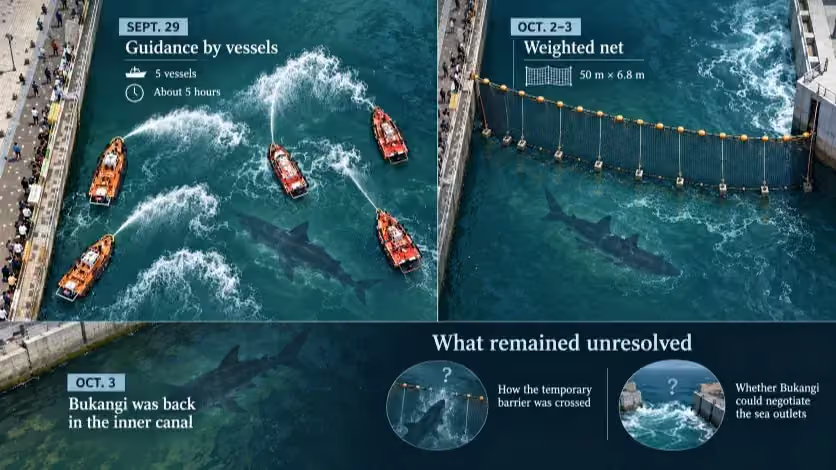 NewsOct 12, 2026
Bukangi, the Shark That Stayed in Busan’s North Port
A rescue net guided Bukangi toward the sea, but the dusky shark returned to B...
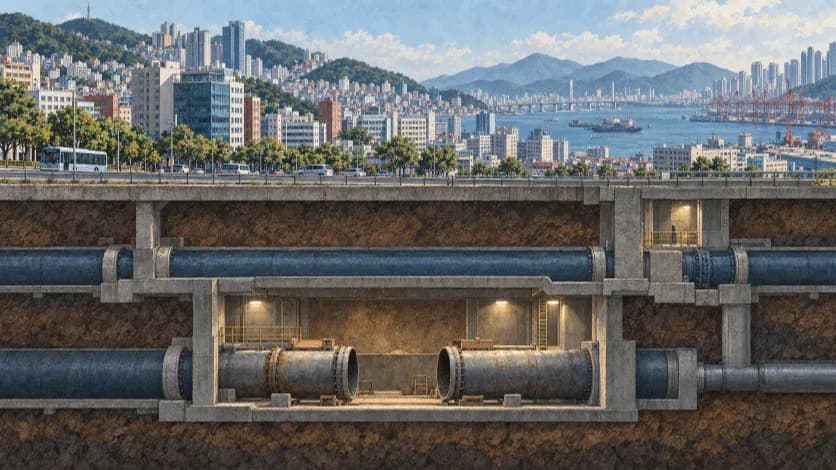 NewsOct 6, 2026
Busan’s Water System Is Entering a Harder Era of Renewal
Busan spent decades building a water system that can absorb major failures. N...
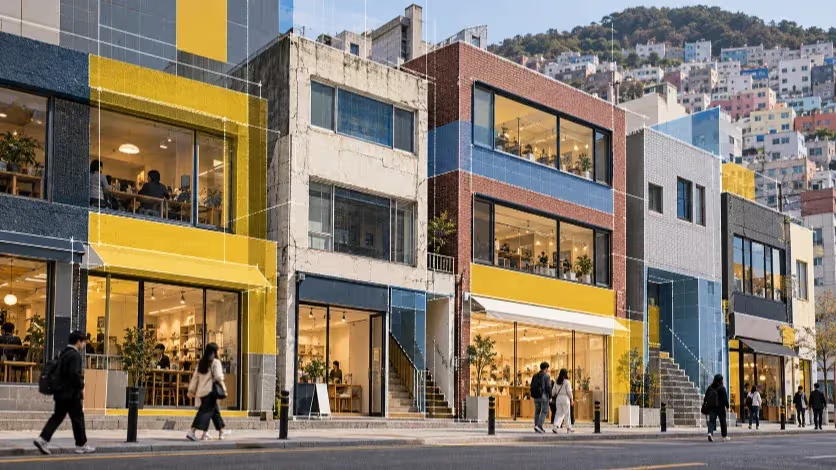 NewsSep 28, 2026
Why Some Commercial Space in Busan Is Hard to Reuse
Two empty commercial spaces exposed to the same broader economy can have very...
More from the author
More from this byline
Stay with the same line of reporting through more work from this byline.
 NewsOct 9, 2026
Why “Busan Is Good” Falls Short as a City Brand
 NewsSep 18, 2026
The Other AI Race Is for the Freedom to Change Course
Reader Signal
Community readWhat did this report leave you with?
Choose the signal that best reflects your reading. Select it again to remove it.
One response per article
No response selected
A moderated conversation about the reporting.
One-level replies and newsroom moderation keep the conversation anchored to this article.
Discussion Status
Open
Please sign in to join the discussion.
Newsletter
Weekly reporting and context from Busan and Korea.