The 2024 Electoral Showdown in the Nakdonggang River Belt
The Nakdonggang River Belt, with its blend of urban development, industrial hubs, and rich historical context, has long been a focal point for political analysts and strategists. In the past, this area has tended to support conservative political parties, particularly the People Power Party (PPP). This is in line with the overall political climate of the Yeongnam region, which consists of the present-day provinces of North and South Gyeongsang, as well as the self-governing cities of Busan, Daeg


The Nakdonggang River Belt, with its blend of urban development, industrial hubs, and rich historical context, has long been a focal point for political analysts and strategists. In the past, this area has tended to support conservative political parties, particularly the People Power Party (PPP). This is in line with the overall political climate of the Yeongnam region, which consists of the present-day provinces of North and South Gyeongsang, as well as the self-governing cities of Busan, Daegu, and Ulsan. However, recent electoral cycles have demonstrated a remarkable openness to progressive candidates from the Democratic Party of Korea (DPK), challenging long-held political affiliations and introducing a new layer of unpredictability into the electoral landscape.
This evolving political landscape is not just about shifting party loyalties but also reflects deeper social, economic, and generational changes. Urbanization, demographic shifts, and changing economic fortunes have all contributed to a more fluid political identity within the region. Moreover, issues such as labor rights, industrial policy, and regional development have become increasingly significant to the electorate, further complicating traditional voting patterns.
In preparation for the 2024 general elections, both the PPP and DPK are intensively analyzing these shifts, aiming to align their strategies and candidate selections to capitalize on the evolving sentiments of the electorate. The PPP, seeking to consolidate its traditional base while making inroads into areas with growing progressive sympathies, is likely to focus on economic development and security issues. Meanwhile, the DPK, aiming to build on its recent successes, will likely emphasize social justice, democratic reforms, and regional equity, appealing to younger voters and those disillusioned with the status quo.
The strategic importance of the Nakdonggang River Belt extends beyond mere electoral victories. It serves as a bellwether for national political trends, offering insights into the changing contours of South Korean politics. As such, the positioning of candidates and the outcomes of elections in this region will not only determine local representation but also significantly impact the national political balance, influencing policy direction and governance strategies for years to come.
Given the stakes, the electoral maneuvering in the Nakdonggang River Belt ahead of the 2024 elections is more than just a local contest; it is a critical battleground that could shape the future of South Korean politics, highlighting the complex interplay between regional dynamics and national outcomes.
The Nakdonggang River Belt, characterized by its significant urban development and evolving demographics, showcases a landscape where political sentiments are in flux. This region, highlighted by industrial zones (Noksan, Sasang, Saha, Gimhae, Yangsan) and burgeoning new cities such as Yangsan New City, Jangyu New City, Hwamyeong New City, Myeongji Ocean City, and Myeongji International New City, has seen a surge in younger populations and external residents. This shift is gradually altering the political dynamics, challenging the historical conservative dominance with a growing openness to progressive ideologies.
Contrastingly, while areas like Haeundae-gu in eastern Busan are known for their affluence, the Nakdonggang River Belt — comprising Buk-gu, Gangseo-gu, Sasang-gu, Saha-gu districts in western Busan, alongside Yangsan and Gimhae cities — does not share this wealth concentration. This discrepancy has cultivated a sense of neglect among the residents of the western districts, exacerbated by perceived development policies favoring the east. The administration under former conservative Busan Mayor Heo Nam-sik was criticized for allegedly prioritizing development in eastern Busan, which is speculated to have driven some constituents in the west toward supporting the Democratic Party.
With a critical mass of around 1.83 million people across its significant areas, including the aforementioned districts of western Busan plus Yangsan and Gimhae, the Nakdonggang River Belt wields considerable electoral influence, accounting for nine National Assembly seats. The demographic and political shifts within this belt spotlight its growing significance as a contested electoral battleground, where traditional political loyalties are tested, and new opportunities for political engagement and representation emerge.
Candidate Profiles and Election Strategies
Buk-gangseo District A (Buk-gu and Gangseo-gu) is witnessing a notable contest where incumbent Jeon Jae-soo of the Democratic Party faces a strategic nomination from the People Power Party (PPP). Jeon, aiming for his third term, has solidified his position through consistent engagement with local issues and a strong legislative record. The PPP has strategically nominated Seo Byung-soo, a seasoned politician with extensive experience, emphasizing his commitment to regional development and policy reforms aimed at revitalizing the local economy and enhancing public welfare.
Buk-gangseo District B sees Kim Do-eup, a veteran from the PPP, grappling with challenges from the Democratic Party's Byeon Sung-wan, a newcomer with a background in city administration. This match highlights the shifting political dynamics in the district, with both candidates prioritizing urban development, job creation, and improving local infrastructure as key campaign pillars.
The Sasang District in the Nakdonggang River Belt is poised for a strategic electoral contest, mirroring the broader political dynamics of the region. Here, Kim Dae-sik, a figure with a background in academia as the former president of Kyungnam College of Information & Technology, has been singularly nominated by the People Power Party (PPP) as their candidate, reflecting a targeted effort to consolidate conservative support in an area witnessing a progressive tilt. On the other side, the Democratic Party of Korea (DPK) is carefully navigating its selection process for a candidate to represent Sasang District, indicating the high stakes involved in securing this key constituency.
The Saha District A is witnessing an interesting battle between Choi In-ho of the Democratic Party and a new candidate, Lee Seong-kweun from the PPP. Choi has a strong background in public service and policy advocacy and is highlighting his achievements in local development projects and social welfare programs. Meanwhile, Lee is focusing on economic revitalization and educational reforms, to appeal to the district's changing demographics.
In Saha B District, the Democratic Party of Korea (DPK) has nominated Lee Jae-sung, a former NCSoft executive, indicating a fresh approach to connect with voters through technology and innovation. Meanwhile, the People Power Party (PPP) is setting up a primary election for the incumbent, Cho Kyoung-tae, a seasoned five-term lawmaker, to compete against other party candidates.
Gimhae City, a pivotal region within the 'Nakdong River Belt', is currently a Democratic Party of Korea (DPK) stronghold, with both Gimhae A and B districts under its control. In Gimhae A, DPK's Min Hong-chul is pursuing his fourth term, facing opposition from multiple People Power Party (PPP) candidates and a Progressive Party candidate. Gimhae B district is notable for its extensive list of PPP contenders, alongside a single-nominated DPK incumbent, Kim Jung-ho, aiming for a third term. This district also witnesses a high number of PPP candidates entering the fray, alongside a Progressive Party challenger.
Recent shifts in voter sentiment have been observed, with the PPP making gains in both presidential and local elections, challenging the DPK's dominance in the area. Gimhae City, with its significant population and strategic location, is seen as a key logistical hub in the region, enhancing its importance in the upcoming elections. The city's aspirations to become a Northeast Asian logistics platform, tied to developments like the Busan New Port and Gadeok Island New Airport, underscore its economic and strategic significance.
In Yangsan City, the political landscape is intensifying as the People Power Party (PPP) strategically positions itself for a 'Nakdonggang River Belt' comeback, nominating three-term lawmakers Yoon Young-seok for Yangsan A and Kim Tae-ho for Yangsan B, the latter being a strategic move as Kim shifts his electoral district from Sancheong, Hamyang, Geochang, and Hapcheon. The Democratic Party of Korea (DPK) has announced its candidates for the upcoming elections in the Yangsan district. Lee Jae-young, former president of the Korea Institute for International Economic Policy, has been nominated as the candidate for Yangsan A, while incumbent Kim Doo-kwan will be running for Yangsan B. This nomination indicates a high-stakes competition between experienced politicians.
The Nakdonggang River Belt, encapsulating the essence of urban evolution, industrial progression, and a rich historical narrative, continues to captivate political analysts and strategists alike. The electoral landscape here, once a bastion for conservative leanings, particularly toward the People Power Party (PPP), is now witnessing an unprecedented openness toward the Democratic Party of Korea (DPK), signaling a significant shift in political affiliations and ideologies.
This shift is emblematic of deeper societal transformations, driven by urbanization, demographic changes, and evolving economic scenarios, which collectively foster a more fluid political identity within the region. The emphasis on labor rights, industrial policy, and regional development has further nuanced the traditional voting patterns, indicating a populace in transition, seeking answers and actions that resonate with their immediate and future aspirations.
Continue this reporting
Reporting on the same issue
Related coverage selected from the article's desk, topics and newsroom relationships.
 NewsOct 4, 2026
Zelensky, South Korea and the Limits of Wartime Pressure
South Korea says Kyiv broke a confidentiality understanding when Zelensky rev...
 NewsSep 1, 2026
What Lee Jae Myung Thinks a Minister Can Fix
President Lee Jae Myung says reform should be judged by results rather than c...
 NewsAug 21, 2026
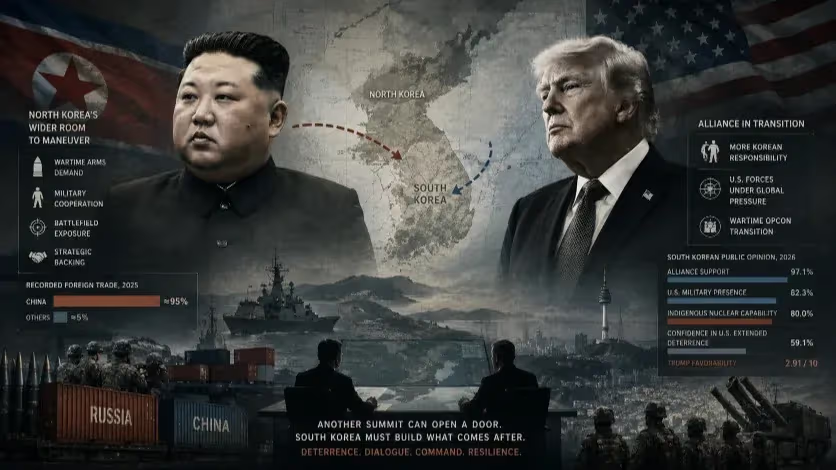
The Korean Peninsula Trump Is Returning To
Another Trump-Kim summit would unfold on a peninsula where North Korea is har...
More from the author
More from this byline
Stay with the same line of reporting through more work from this byline.
 NewsOct 9, 2026
Why “Busan Is Good” Falls Short as a City Brand
 NewsSep 18, 2026
The Other AI Race Is for the Freedom to Change Course
Reader Signal
Community readWhat did this report leave you with?
Choose the signal that best reflects your reading. Select it again to remove it.
One response per article
No response selected
A moderated conversation about the reporting.
One-level replies and newsroom moderation keep the conversation anchored to this article.
Discussion Status
Open
Please sign in to join the discussion.
Newsletter
Weekly reporting and context from Busan and Korea.