Busan’s Merger Debate Starts in the West
For decades, West Busan has carried Busan’s largest development promises. A merger or mega-region would matter only if it gave the city’s western districts and neighboring Gyeongnam cities the authority, money and accountability to function as one urban region.

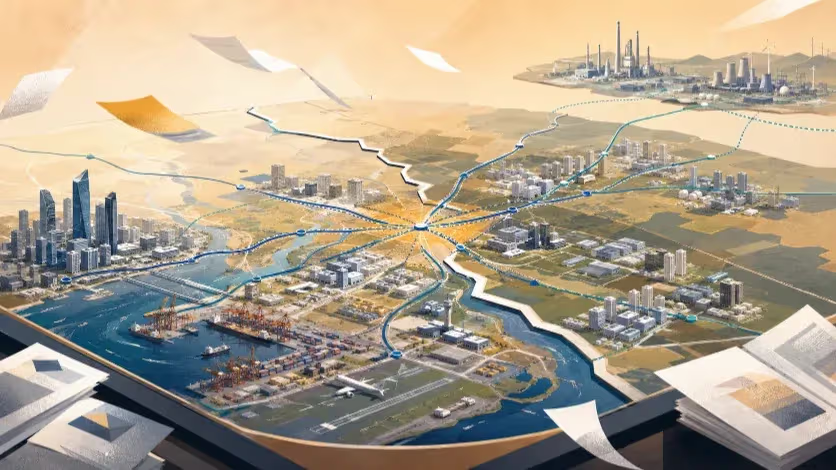
For decades, West Busan has carried the language of things still to come.
It has been described as the place where Busan would correct its east-west imbalance, renew its aging industrial base, connect a major port to a new airport, open new housing districts and build the logistics platform for the city’s next economy.
Successive plans have given the area different names and functions: airport city, port hinterland, industrial renewal zone, smart logistics corridor, western growth axis. Each label has had its own rationale. Together, they have left a more difficult question unresolved: whether the western side of Busan is being built as a complete urban region, or whether it remains the place where the city deposits the infrastructure of its future.
The question has returned through a larger political debate. Ahead of the June local elections, Busan’s regional future is being framed around two competing designs: a Busan-Gyeongnam administrative merger and a revived Busan-Ulsan-Gyeongnam mega-region. The first promises a stronger governing unit with more fiscal and planning authority. The second offers a broader industrial map, adding Ulsan’s manufacturing and energy base to Busan’s port ambitions and Gyeongnam’s machinery, shipbuilding and aerospace sectors.
Neither proposal can be judged by the size of its map. West Busan is where the test becomes concrete.
Gangseo, Sasang, Saha and Buk-gu do not function as isolated districts at the edge of a metropolitan city. They sit in a wider daily region shaped by Gimhae, Yangsan, Changwon, Jinhae, Busan New Port, Gadeokdo New Airport, the Nakdong River estuary, industrial estates, housing corridors and cross-border commutes. The line between Busan and Gyeongnam still controls budgets, transit systems, land-use decisions and environmental authority. Daily life has already made that line less decisive.
The map of daily movement has moved faster than the map of government.
The unfinished promise of West Busan
West Busan has not been ignored. That is part of the problem.
The region has appeared repeatedly in Busan’s development agenda, from industrial renewal and transport expansion to airport access, logistics infrastructure and new residential districts. Busan’s own 2040 metropolitan planning framework already looks beyond the city’s legal boundary, presenting a 4.6 million-person Busan-Gimhae-Yangsan metropolitan area under the vision of a “green smart hub” built around balanced growth, cooperation, logistics and sustainable living.
That official planning frame matters because it recognizes what the city’s daily geography has long suggested. West Busan cannot be understood only as Busan’s western side. Gangseo faces Gimhae, Jinhae, the airport site, the New Port and the Nakdonggang River estuary. Sasang and Saha sit near older industrial corridors tied to the region’s manufacturing and port economy. Buk-gu and northern Busan merge into Yangsan through housing, commuting and routine services.
The west has not lacked attention. What it has lacked is a settled answer to whether these projects create a complete urban region.
Busan’s east-west divide has never been only a matter of distance. It is also a difference in the kind of growth assigned to each side of the city.
East Busan has been associated with the visible rewards of urban development: Haeundae, Centum, coastal amenities, tourism, convention facilities, high-end housing and the city’s outward-facing image.
West Busan has more often been asked to carry growth before its benefits are visible: factories, freight routes, logistics yards, industrial traffic, airport roads, port expansion and residential districts still waiting for civic life to mature around them.
The difference is not absolute. East Busan has its own pressures, and West Busan has seen real investment. The pattern is nevertheless clear enough to shape public perception. The east is often understood through places people visit, buy into or display. The west is often understood through functions the city requires.
That distinction changes how the merger debate should be read. A new airport can strengthen Busan’s national and international position while increasing local pressure on land, roads, housing and environmental management. A port corridor can expand regional capacity without improving daily mobility for nearby residents. An industrial estate can be renewed on paper while the surrounding labor market remains tied to lower-margin work. A new town can add housing before schools, healthcare, culture, local commerce and employment make it feel fully urban.
West Busan’s difficulty has often been found in that gap between project delivery and urban life.
A working region beyond the city line
The commuting data gives that geography a harder edge.
Recent figures based on the 2025 Busan-Ulsan-Gyeongnam social survey show that 3.78 million people aged 15 and older in the three-region area commute, with cross-city and cross-province commuting rising. The share of residents commuting to a city or province different from where they live rose to 8.7 percent, up 0.8 percentage points from 2023, while the share commuting within the same city, county or district declined.
The strongest cross-border movements around Busan run through the cities pressed against its western and northern sides. About 117,000 people travel from Gyeongnam into Busan for work, while 108,000 move from Busan into Gyeongnam. Gimhae, Yangsan and Changwon account for the largest inflows to Busan; the same three cities also dominate the outward commute from Busan. Ulsan’s links are strongest with Yangsan, Gijang and Haeundae, reflecting a separate northeastern corridor.
Those figures do not describe a tidy metropolitan ring. They describe overlapping corridors. Gimhae and Yangsan are tied to Busan through housing, commuting and daily services. Changwon enters through manufacturing, logistics and industrial supply chains. Jinhae and the New Port pull West Busan into a port economy that has never fit cleanly inside municipal boundaries. The region is not one compact city. It is a set of connected but uneven urban fields.
That makes Busan’s old east-west imbalance harder to treat as an internal city problem. West Busan is not only the underdeveloped side of Busan. It is where Busan’s internal imbalance meets eastern Gyeongnam’s urban and industrial growth. Gangseo, Sasang, Saha and Buk-gu sit inside a field of movement that includes Gimhae, Yangsan, Changwon and Jinhae. The old question of how to rebalance Busan has become inseparable from the question of how to govern the region beyond Busan.
The administrative map still treats these places as separate territories. The working map does not. A road project, housing district, industrial estate or port corridor can shift demand on both sides of the Busan-Gyeongnam line, while responsibility remains divided among governments with separate budgets, councils and political incentives. The border has not disappeared. It has become misaligned with the region’s daily movements.
That distinction is important. The commuting data does not prove that an administrative merger is the only answer. It could also support a stronger metropolitan transport authority, a shared fare system, a cross-border land-use framework or a more limited regional planning body. What it shows is narrower and harder to dismiss: West Busan already belongs to a functional urban area that Busan alone does not govern.
The merger model: power closer to the first ring
If the case for regional restructuring begins with the gap between daily movement and public authority, the Busan-Gyeongnam merger offers the most direct answer on the map.
The proposed merger would place Busan and the surrounding Gyeongnam cities most closely tied to it — Gimhae, Yangsan, Changwon and Jinhae — inside a larger administrative framework. Its relevance lies less in creating a bigger local government than in the possibility of joining decisions now split across multiple jurisdictions. Transport, land use, housing corridors, industrial zones, port logistics, greenbelt decisions and environmental management could be planned across the same territory where people already live, work and move.
That is the strongest version of the case. A merger could make the first-ring urban region easier to govern because it would reduce the distance between places that share problems and institutions that divide responsibility for them. It could also strengthen bargaining power with Seoul, especially over fiscal decentralization, infrastructure approvals and the transfer of planning authority.
The merger push has also been tied to explicit institutional demands. A Busan-Gyeongnam special city proposal discussed this year seeks more autonomous fiscal resources, a shift in the national-to-local tax ratio, stronger local legislative and organizational authority, and special treatment for large regional projects such as exemptions from preliminary feasibility or investment reviews. Busan City Council discussions have also framed central government support as essential, with references to a 2026 referendum and a 2027 special act pathway.
The promise depends on what moves with the boundary. A merger without durable fiscal authority would not solve West Busan’s problem. It would enlarge the administrative unit while leaving the same dependence on central government approvals and funding. A merger without real power over transit, land use, industrial upgrading and environmental regulation would struggle to change daily life in the places used to justify it.
The political risk is just as important. What looks from Busan like a rational metropolitan adjustment can look from parts of Gyeongnam like absorption. Gimhae and Yangsan may sit inside Busan’s daily orbit, but Gyeongnam is not only its eastern cities. Western and inland parts of the province have different histories, economies and transport needs. A merger framed too narrowly around Busan’s growth would weaken its own case, because the legitimacy of a larger government would depend on whether it protects places that do not naturally fall into Busan’s immediate urban field.
West Busan exposes both sides of the argument. It shows why the current boundary is increasingly awkward. It also shows why administrative merger cannot be treated as an answer in itself. The west has lived with too many development promises to accept scale as proof. A larger government would matter only if it made the region easier to move through, easier to plan and fairer in the distribution of costs and gains.
The merger model is strongest when it is described not as Busan becoming larger, but as the first-ring region becoming governable.
The mega-region model: a wider industrial map
The Busan-Ulsan-Gyeongnam mega-region begins where the merger model becomes narrow.
A Busan-Gyeongnam government could bring West Busan and the adjacent cities of eastern Gyeongnam into a stronger administrative structure, but it would not capture the full industrial geography of Korea’s southeast. Ulsan sits outside that merger map, and Ulsan is not a marginal addition. It is one of the main reasons the mega-region argument exists.
The Democratic Party’s revived Busan-Ulsan-Gyeongnam proposal draws strength from that wider geography. Busan brings the port, logistics base and ambition to connect a new airport to a larger maritime economy. Gyeongnam brings machinery, shipbuilding, aerospace and the manufacturing depth of Changwon, Geoje, Sacheon and other industrial centers. Ulsan adds one of Korea’s most concentrated bases of automotive production, shipbuilding, petrochemicals, energy and hydrogen-related industry. Democratic candidates in Busan, Ulsan and Gyeongnam have framed the revived mega-region as a way to restore a southern growth bloc, with pledges around a 30-minute living zone and expanded rail connections.
The wider map also aligns with ongoing institutional activity. Busan, Ulsan and Gyeongnam held a policy council meeting in April to select cooperation projects and prepare for national funding under a planned 2027 special account for mega-regional cooperation. Busan’s own release described a strategic response system at the level of a Busan-Ulsan-Gyeongnam mega-regional economic alliance, targeting the 2027 national budget.
That is the strongest version of the mega-region argument. It speaks less to the first-ring commuting zone around West Busan and more to the scale of the southeast as a production system. The model is not mainly about whether a resident of Gangseo can reach Gimhae or Yangsan more easily. It is about whether Busan’s port and airport plans, Ulsan’s manufacturing base and Gyeongnam’s industrial corridors can be organized into a regional strategy strong enough to compete with the capital area and attract national investment.
But scale creates its own weakness. A wider region is harder to govern, especially when the proposal stops short of administrative merger. Busan, Ulsan and Gyeongnam do not have identical priorities. Busan’s immediate concern often lies in the port-airport-logistics system and the uneven development of its own urban space. Ulsan is a highly industrial city with strong links northward as well as southward. Gyeongnam contains both eastern cities close to Busan and western or inland areas whose relationship with Busan is more distant.
A map that includes all three can look complete on paper while becoming difficult in execution.
The previous failure of the Bu-Ul-Gyeong special union still shadows the proposal. The idea did not collapse because the region lacked an economic argument. It collapsed because political alignment, institutional authority and fiscal commitment were not strong enough to keep the structure alive through a change in power. Any revived mega-region must therefore answer a harder question than whether the three places belong together economically. It must explain how decisions would be made, how money would be allocated and how responsibilities would survive beyond the electoral moment that revived the language.
West Busan gives that question a practical edge. A mega-region that includes Ulsan may describe the southeast more fully, but West Busan’s unfinished problems remain local and metropolitan before they are macro-regional. Residents do not experience regional scale as an industrial diagram. They experience it through bus transfers, freight traffic, housing pressure, school access, job quality, road congestion and the environmental burden of logistics expansion.
A mega-region that cannot reach those issues would leave West Busan in a familiar position: central to the rhetoric of regional growth, but not necessarily central to its benefits.
Ulsan’s second geography
Ulsan strengthens the mega-region argument, but it also makes the argument less tidy.
The city is linked to Busan and Yangsan through commuting, transport corridors and shared industrial interests. It also looks north along the east coast, toward Gyeongju and Pohang. That northern relationship is not a minor cultural or historical attachment. It reflects another industrial geography: steel, automotive supply chains, shipbuilding, petrochemicals, energy, hydrogen, batteries and materials moving through an east-coast production belt that does not depend on Busan as its center.
This is where the Haeoreum Alliance matters. Ulsan, Pohang and Gyeongju have built a separate cooperation framework since 2016, and this year the three cities reviewed 45 joint projects across five areas, including economy, industry, maritime affairs, urban infrastructure, culture, tourism, disaster prevention, safety and institutions. The alliance has also discussed projects around secondary batteries, hydrogen, maritime tourism and east-coast connectivity.
The existence of that east-coast axis does not make the Busan-Ulsan-Gyeongnam idea irrelevant. It makes any serious version of it more demanding. A mega-region that treats Ulsan only as Busan’s northeastern partner would misunderstand the city it is trying to include. Ulsan’s manufacturing base strengthens any southern regional strategy, but the same base gives Ulsan reasons to look beyond that frame.
The political effect is clear. By including Ulsan, the Democratic Party’s mega-region proposal can challenge the Busan-Gyeongnam merger as too narrow. A merger without Ulsan may fit West Busan’s first-ring geography, but it leaves outside one of Korea’s most important industrial cities. The counterargument is just as important. A plan that includes Ulsan without explaining how its east-coast ties will be handled risks turning the city into an industrial credential rather than a full partner with its own regional logic.
Ulsan’s position cuts in two directions. It strengthens the case for a broader southeast strategy and weakens any easy claim that Busan-Ulsan-Gyeongnam can be governed as a single, coherent metropolitan field. Busan’s western problem is tied most closely to Gimhae, Yangsan, Changwon and Jinhae. Ulsan’s industrial future is tied to Busan and Gyeongnam, but also to Gyeongju, Pohang and the wider east-coast economy. The two geographies overlap, but they do not collapse into one another.
A more persuasive mega-region would not ask Ulsan to choose between Busan and the east coast. It would recognize Ulsan as a hinge of its own: southward to Busan and Gyeongnam, northward to Gyeongju and Pohang. That would make the Busan-Ulsan-Gyeongnam proposal less tidy, but more honest.
Regional policy in southeastern Korea is not a single circle drawn around Busan. It is a set of overlapping industrial and living systems, with Ulsan sitting across more than one of them.
The West Busan test
Ulsan widens the regional argument. West Busan brings it back to ground level.
The competing proposals describe different futures for southeastern Korea: one through a stronger Busan-Gyeongnam government, the other through a broader Busan-Ulsan-Gyeongnam industrial region. Neither should be judged first by the elegance of its map. The more difficult test is whether either model can change the conditions that have made West Busan central to Busan’s development plans but uncertain in their benefits.
That test begins with movement. A regional government or mega-region framework would have little meaning if residents continued to encounter the same broken sequence of buses, rail gaps, fare systems and long transfers between western Busan, Gimhae, Yangsan, Changwon and Jinhae. Busan has already moved toward practical integration in one area: the city announced the elimination of metropolitan transfer fares for Busan-Gimhae-Yangsan public transit users, estimating annual transport cost savings of 5.5 billion won and monthly savings of more than 10,000 won for daily cross-region commuters. That kind of measure is modest compared with administrative merger, but it shows what regional integration looks like when it reaches daily life.
The same standard applies to industrial policy. West Busan has carried the language of logistics and industrial renewal for years, but logistics alone does not guarantee better local employment. A port, an airport and an expanded freight network can raise land values and regional capacity while leaving nearby workers in lower-margin jobs and nearby neighborhoods with heavier traffic. Industrial upgrading would have to mean more than new labels for old estates. It would have to connect Sasang, Saha, Gangseo, Gimhae, Changwon and Jinhae to higher-value production, technical training, research capacity and firms that do more than move goods through the region.
Housing presents another test because regional growth can shift pressure without resolving imbalance. New residential districts in West Busan, Gimhae and Yangsan may absorb population, but housing supply without employment, schools, healthcare, local commerce and reliable transit can reproduce dependence on long-distance movement. A larger administrative unit could coordinate housing and infrastructure more carefully. A looser mega-region could identify growth corridors. Neither would matter much if residential expansion continued to precede the civic facilities that make districts livable.
Environmental governance may be the most neglected part of the debate. West Busan sits near the Nakdong River estuary, industrial estates, port traffic, airport plans and logistics roads. The burdens of regional growth are not abstract there. They arrive as noise, congestion, air pollution, land-use conflict, flood risk and pressure on ecologically sensitive areas. A merger that concentrates development authority without stronger environmental accountability would deepen local suspicion. A mega-region that speaks of industrial scale without assigning responsibility for the costs of that scale would leave the same problem under a larger name.
The fiscal question cuts through all of these areas. Regional restructuring becomes meaningful only when money and authority move with it. Without durable revenue, a Busan-Gyeongnam merger would remain dependent on central government decisions for the same large projects that already shape the region. Without enforceable budget commitments, a Busan-Ulsan-Gyeongnam mega-region could become a coordination table where governments agree on priorities but retreat when costs arrive. West Busan’s history makes that distinction important. Announced projects have never been scarce. The harder problem has been turning them into settled improvements in daily life.
Representation is the final test. A larger government can make planning more coherent, but it can also make local voices harder to hear. If the merger model is to be more than a Busan-centered expansion, residents in Gyeongnam’s cities and counties would need credible guarantees over budgets, councils, administrative offices and development priorities. If the mega-region model is to survive beyond campaign language, Busan, Ulsan and Gyeongnam would need institutions strong enough to make decisions without erasing local interests.
Scale without accountability would only move the imbalance to a higher level.
A region already taking shape
The debate over Busan’s regional future is often framed as a choice between two political designs. That framing is useful only up to a point. The deeper question is not which map looks more ambitious, but whether either design can govern the region that has already emerged around West Busan.
That region is not waiting for a law or campaign pledge to exist. It is visible in the commute from Gimhae and Yangsan, in industrial links toward Changwon and Jinhae, in the pressure around the New Port and in the future claims that Gadeokdo New Airport will place on land, roads, housing and environmental management. The border between Busan and Gyeongnam remains powerful in budgets and institutions, but less convincing as a description of how the western side of the city actually works.
A Busan-Gyeongnam merger could answer that mismatch if it brought real fiscal authority, planning power and democratic safeguards into the first-ring region where West Busan and eastern Gyeongnam already overlap. Without those powers, it would risk becoming a larger administrative shell around familiar problems.
A Busan-Ulsan-Gyeongnam mega-region could answer the mismatch differently, by linking Busan’s port and airport ambitions to Ulsan’s manufacturing base and Gyeongnam’s industrial depth. Without harder institutions, it would risk becoming another language of scale without the authority to govern at scale.
West Busan leaves little room for easy claims. It has heard the language of future growth for decades. Airports, ports, logistics corridors, industrial renewal and new towns have all been placed in its future. The measure now is not whether another regional plan can describe that future more grandly. The measure is whether it can change the distribution of authority, costs and value in the places asked to carry that future.
A serious regional settlement would begin by treating West Busan not as a support zone for the rest of the city, but as the hinge of a wider urban region. That would require transport systems designed around actual movement rather than administrative convenience, industrial policy that raises the quality of work rather than only the volume of freight, housing plans tied to services and employment, and environmental governance strong enough to match the scale of port and airport development.
The question is no longer whether West Busan will be included in another regional plan. It has been included for decades. The question is whether the next plan will give the region the authority, money and accountability that previous promises lacked.
West Busan is not the edge of Busan. It is where the next version of the Busan metropolitan region is already being made. Politics now has to catch up with that geography.
Continue this reporting
Reporting on the same issue
Related coverage selected from the article's desk, topics and newsroom relationships.
 NewsOct 4, 2026
Zelensky, South Korea and the Limits of Wartime Pressure
South Korea says Kyiv broke a confidentiality understanding when Zelensky rev...
 NewsSep 1, 2026
What Lee Jae Myung Thinks a Minister Can Fix
President Lee Jae Myung says reform should be judged by results rather than c...
 NewsAug 21, 2026
The Korean Peninsula Trump Is Returning To
Another Trump-Kim summit would unfold on a peninsula where North Korea is har...
More from the author
More from this byline
Stay with the same line of reporting through more work from this byline.
 NewsSep 18, 2026
The Other AI Race Is for the Freedom to Change Course
 NewsSep 5, 2026
How a Political Appointment Becomes a Judgment of Character
Reader Signal
Community readWhat did this report leave you with?
Choose the signal that best reflects your reading. Select it again to remove it.
One response per article
No response selected
A moderated conversation about the reporting.
One-level replies and newsroom moderation keep the conversation anchored to this article.
Discussion Status
Open
Please sign in to join the discussion.
Newsletter
Weekly reporting and context from Busan and Korea.