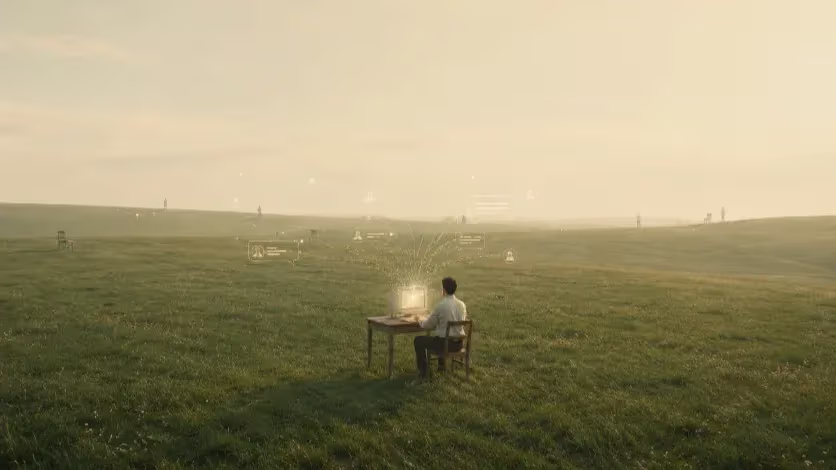
The Sinpyeong-Jangnim Industrial Complex Transformation
Korea's Sinpyeong-Jangnim Industrial Complex, located in the Saha-gu district in western Busan, has been a pillar of the country's manufacturing industry for over four decades. With over 600 companies employing more than 15,000 people, the complex has played a vital role in the local economy. However, with the changing demands of the modern workforce and the rise of knowledge-based industries, the complex has faced challenges adapting to the times. In response, the Ministry of Trade, Industry,


Korea's Sinpyeong-Jangnim Industrial Complex, located in the Saha-gu district in western Busan, has been a pillar of the country's manufacturing industry for over four decades. With over 600 companies employing more than 15,000 people, the complex has played a vital role in the local economy. However, with the changing demands of the modern workforce and the rise of knowledge-based industries, the complex has faced challenges adapting to the times.
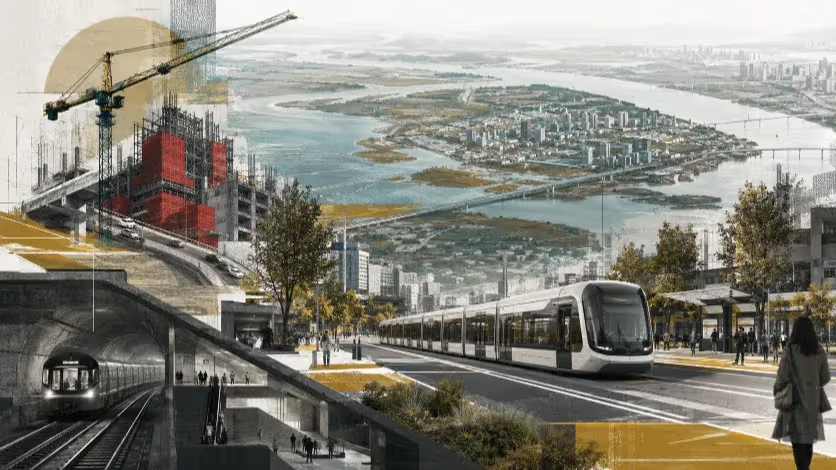
In response, the Ministry of Trade, Industry, and Energy has designated the Sinpyeong-Jangnim Industrial Complex as an information and communication technology (ICT) convergence urban high-tech industrial complex. The aim is to transform the old industrial complex into a hub for high-tech industries and create a more pleasant environment for workers. The plan includes constructing twelve Knowledge Industry Centers(KICs) in the old industrial complex.
The concept of repurposing abandoned spaces into creative spaces is not new. The trend first appeared in Brooklyn, USA, and Berlin, Germany, and has since caught on in Busan, with visitors from the Z-generation drawn to the charm of old and shabby abandoned buildings. Uniqlo's successful fashion store in the Sinpyeong-Jangnim Industrial Complex in Saha-gu, Busan, is a testament to the appeal of repurposed spaces.
However, the industrial complex still faces challenges. It is the oldest among Busan's 28 industrial complexes, with the highest proportion of industrial facility land among medium and large industrial complexes over 1 million square meters, and the highest number of tenant companies per unit area. Additionally, approximately 35% of the tenants in the old industrial complex, or 229 companies, are pollution-producing industries such as textile manufacturing and metalworking.
The Ministry of Environment designates the chemicals used in these facilities as Hazardous Air Pollutants, which require strict management. Data has shown that Saha-gu and Sasang-gu have the highest mortality rate from cardiovascular and respiratory diseases among the 16 districts and counties. As a result, the Ministry of Trade, Industry, and Energy has requested that Busan City take action to relocate chemical-using industries, improve environmental management among companies, and upgrade the physical condition of the industrial complex through structural improvement projects.
The transformation of the Sinpyeong-Jangnim Industrial Complex is a significant undertaking, but the potential benefits are enormous. With the right investments and partnerships, the complex could become a leading hub for high-tech industries in Busan, while also providing a sustainable environment for workers. The success of Uniqlo's fashion store and the trend of repurposing abandoned spaces for creative uses demonstrate the potential of the complex to adapt to changing times and meet the demands of the modern economy.
Editorial Context
"Independent journalism relies on radical transparency. View our full log of editorial notes, corrections, and project dispatches in the Newsroom Transparency Log."
Reader Pulse
The report's impact signal
Be the first to provide a reading pulse. These collective signals help our newsroom understand the impact of our reporting.
Join the discussion
A more thoughtful conversation, anchored to the story
Atlantic-style discussion for this article. One-level replies, editor prompts, and moderation-first participation are now powered directly by Prisma.
Discussion Status
Open
Please sign in to join the discussion.
The Weekly Breeze
Independent reporting and analysis on Busan,
Korea, and the broader regional economy.