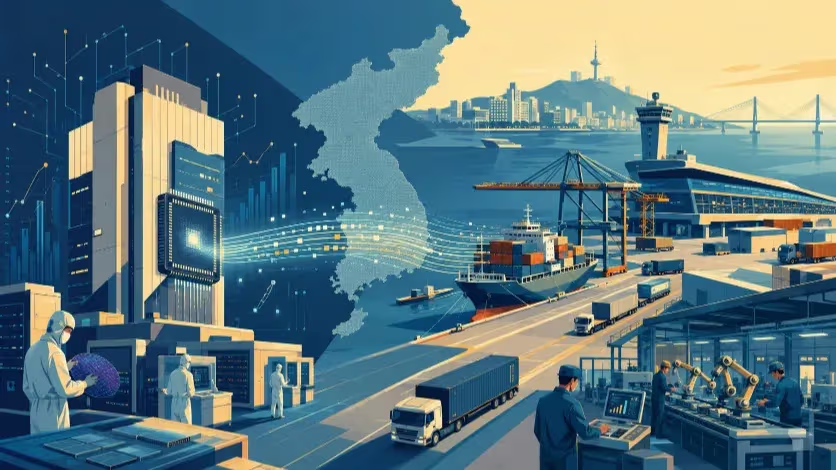
South Korea's Economy on the Edge: Challenges and the Need for a New Approach
South Korea's central bank, the Bank of Korea, has decided to maintain its benchmark interest rate at 3.50% during a recent monetary policy meeting. This marks the second consecutive freeze since February, as consumer price inflation has dropped to the low 4% range. The decision to hold the interest rate was made to monitor the economic situation and support growth. The market has reacted positively to the interest rate freeze, but concerns remain over the widening interest rate gap with the Un


South Korea's central bank, the Bank of Korea, has decided to maintain its benchmark interest rate at 3.50% during a recent monetary policy meeting. This marks the second consecutive freeze since February, as consumer price inflation has dropped to the low 4% range. The decision to hold the interest rate was made to monitor the economic situation and support growth.
The market has reacted positively to the interest rate freeze, but concerns remain over the widening interest rate gap with the United States, which is expected to increase its benchmark interest rate by 0.25 percentage points next month. If the geopolitical risks on the Korean Peninsula escalate, the won-dollar exchange rate could rise even higher, causing foreign investment to leave the stock market like a receding tide.
Despite the increasing exchange rate, which should boost exports, South Korea has experienced a decline in exports for six consecutive months since last October. The trade deficit this year has already reached $25 billion. For the past 30 years, trade between South Korea and China has consistently yielded a surplus. However, during the months of January and February, the trade deficit exceeded $5 billion. Many observers believe that the reopening of China's economy will not have a significant impact.
Inflation remains a concern as 86.2% of the total 458 goods and services items included in the consumer price index have seen price increases compared to a year ago. As a result, the price of a chicken, including delivery fees, has reached KRW 30,000. Additionally, public utility fees such as electricity and gas are expected to rise, and global oil prices are fluctuating due to OPEC production cuts. The South Korean government is considering abolishing fuel tax cuts to secure revenue, which could increase gasoline prices by KRW 200 per liter.
Both exports and domestic demand are experiencing a prolonged freeze, causing negative economic growth since the fourth quarter of last year. Fiscal and trade deficits are snowballing each month, and the financial market is on thin ice due to fears of a sharp rise in exchange rates. The livelihoods of the 1.73 million self-employed individuals in South Korea are in disarray, and a breakthrough is needed to escape this multifaceted crisis. The government must reconsider its approach to economic policy, focusing on fiscal restraint and tax reductions.
The International Monetary Fund (IMF) has lowered South Korea's growth forecast for this year from 1.7% to 1.5%. In contrast, most developed countries, including the United States, the United Kingdom, and Italy, have raised their growth forecasts. The pessimistic outlook on the Korean economy is not limited to the IMF. The average growth forecast for South Korea among eight foreign investment banks, including Goldman Sachs and J.P. Morgan, is only 1.1%. Some foreign banks even predict zero or negative growth.
South Korea's economy is indeed on the brink. Both exports and domestic demand are on a downward trajectory. The trade deficit has increased by 3.5 times compared to last year, reaching $26 billion. The decline in semiconductor exports, which account for 20% of total exports, and decreased exports to China are the main factors behind this trend. After the relaxation of social distancing measures, the domestic economy briefly improved but has since stagnated due to high inflation, interest rates, and exchange rates.
The real issue is the lack of measures to stimulate the economy and escape low growth. Although the Bank of Korea has frozen its benchmark interest rate to counter the economic downturn, this alone is insufficient. The government is unable to increase fiscal spending due to high inflation and dwindling fiscal capacity. While the government is making efforts to inject vitality into the economy through tax support for strategic industries, expanding trade finance, and boosting domestic demand, these measures have so far proven inadequate.
The struggling job market is another cause for concern. Manufacturing employment has decreased for three consecutive months, and the overall employment situation remains bleak. In this context, the need for a comprehensive and effective economic strategy has become even more urgent.
To address these challenges and turn the economy around, the South Korean government must adopt a multifaceted approach. This may involve prioritizing investments in key industries, providing targeted support to small and medium-sized enterprises, and reevaluating regulations that hinder innovation and economic growth. Additionally, enhancing social safety nets and implementing policies that boost household income and consumer spending could stimulate domestic demand.
Furthermore, the government should explore ways to strengthen global trade partnerships and diversify export markets to reduce reliance on a few key trading partners, such as China. This diversification strategy would help mitigate the risks associated with geopolitical tensions and trade disputes.
South Korea's economy is at a critical juncture, facing both external and internal challenges. To overcome these obstacles and put the economy back on the path of sustainable growth, the government must adopt a new, comprehensive approach that addresses the root causes of the current economic stagnation. By taking bold and innovative measures, South Korea can regain its position as a leading global economic powerhouse.
Editorial Context
"Independent journalism relies on radical transparency. View our full log of editorial notes, corrections, and project dispatches in the Newsroom Transparency Log."
Reader Pulse
The report's impact signal
Be the first to provide a reading pulse. These collective signals help our newsroom understand the impact of our reporting.
Join the discussion
A more thoughtful conversation, anchored to the story
Atlantic-style discussion for this article. One-level replies, editor prompts, and moderation-first participation are now powered directly by Prisma.
Discussion Status
Open
Please sign in to join the discussion.
The Weekly Breeze
Independent reporting and analysis on Busan,
Korea, and the broader regional economy.