What Are Koreans Paying Real-Estate Brokers For?
he backlash over broker commissions has become something larger than a price dispute: a crisis of trust in a market where consumers expect risk protection, but still struggle to see what expertise licensed brokers are actually providing.

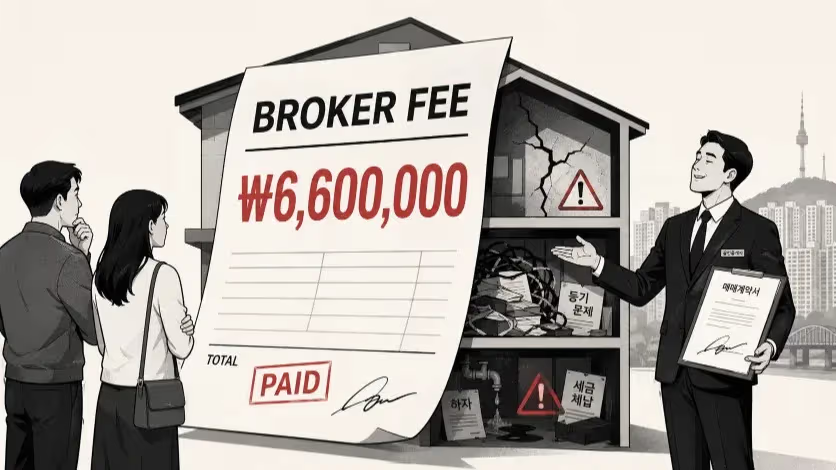
Public anger over broker commissions in South Korea no longer flares only when housing prices rise. It now returns whenever a transaction forces consumers to confront a more destabilizing question: what, exactly, was purchased when the fee was paid. The older dispute over whether brokerage costs are too high has been overtaken by a harder one. A commission can be calculated down to the won. The value of the service behind it often cannot. That mismatch has survived the 2021 revision of brokerage fee ceilings, which lowered the ceiling on a 1 billion won home sale from the old level still often cited in online anger. The rate changed. Distrust did not.
Price alone does not explain the force of the resentment. A more consequential change has taken place in the social meaning of brokerage itself. In a market shaped by jeonse fraud, hidden claims, tax arrears, trust structures, layered liens and widening information asymmetry between counterparties, brokers are no longer judged simply by whether they introduced a property and helped close a deal. They are judged by whether danger was visible before a contract was signed, whether legal and financial exposure was recognized before money moved, and whether the person who took a fee did more than transmit access to a listing. Officially recognized counts of jeonse fraud victims kept rising through late 2025, while the government also publicized thousands of suspicious cases uncovered through special crackdowns. The crisis did not merely expose criminal conduct. It changed what consumers believe brokerage is supposed to do.
That is why the backlash has become more durable than a routine cost complaint. South Korea now asks a great deal of its licensed real-estate brokers. Law and policy have moved toward stronger explanation duties and broader disclosure expectations in response to fraud risk and opacity in housing transactions, and courts have shown a willingness in some lease disputes to interpret brokerage obligations more expansively. Yet the industry continues to be publicly encountered, and publicly measured, less as a profession of documented housing-risk advice than as a dense field of offices, agents, assistants and transactions. Official statistics track business counts, staffing, penalties and sanctions with precision. Much less can be seen about valuation rigor, advisory depth, written risk analysis, service differentiation or consumer outcomes once a deal has gone wrong.
A Market of Hidden Risk Changed What Brokerage Is Expected to Be
The resulting problem is one of legibility before it is one of pricing. The invoice is visible. The labor is not. Consumers know what they paid because the fee appears at the most concrete moment in the transaction, when money changes hands and the purchase becomes irreversible. What remains far less clear is what, in practical and documentary terms, stood behind that payment. A market saturated with listing access, standardized paperwork and familiar brokerage rituals makes it difficult to distinguish clerical passage from professional judgment. The more routine the transaction appears from the outside, the harder it becomes for consumers to identify where expertise began, what risks were independently recognized, and which part of the broker’s role exceeded simple coordination.
That opacity would matter less in a low-risk market. It becomes corrosive in one shaped by hidden liabilities and asymmetric information. The contemporary Korean housing transaction rarely presents itself as a clean bilateral exchange between informed parties. The social rationale for paying an intermediary therefore no longer lies mainly in access. Access has become cheap. The rationale lies in the promise that someone inside the transaction saw what the consumer could not. Where that promise is not visible in form, the fee begins to look less like compensation for expertise than like a toll imposed on movement through the market.
This is where commission anger becomes more revealing than it first appears. Public outrage often sounds numerically crude because it collapses different grievances into one number. Yet the number acts as a container for more specific disappointments. Which documents were checked with real scrutiny rather than perfunctory review. Which material risks were actively raised rather than passively acknowledged. Which questions were pursued because the broker recognized the possibility of danger before the client did. Which judgments, if any, were made that changed the consumer’s understanding of the deal. Without visible answers to those questions, the fee remains precise only in one direction: as cost.
The structure of payment intensifies the problem. Compensation is realized at the close of a successful transaction, while protection is experienced, if at all, through a different institutional sequence later: liability rules, guarantee systems, administrative sanctions, complaints and sometimes litigation. From the consumer’s perspective, payment belongs to the present tense while accountability is deferred into procedure. Korea does impose duties and maintains liability-related mechanisms, but that does not erase the asymmetry in how the transaction is experienced. The law expanded obligations. The service still did not become equally visible.
Jeonse Fraud Turned Brokers Into Expected Risk Filters
No development exposed that asymmetry more harshly than the jeonse fraud crisis. Before it, many tenants likely understood the broker’s contribution in practical terms: showing properties, connecting parties, relaying conditions, assisting paperwork, answering routine questions. After it, those acts no longer appeared sufficient even when competently performed. Consumers began reading transactions backward from the moment of collapse. Once a deposit was trapped, once a priority claim surfaced, once a trust structure or layered lien appeared too late, the broker’s earlier conduct was reinterpreted through a single devastating question: what did this person see, and when should it have been obvious that the deal was dangerous?
That question transformed the emotional economy of brokerage. In a lower-risk market, a broker can still be judged mainly on convenience. In a fraud-shaped market, convenience loses moral weight. What matters is pre-contract interpretation: whether warning signs were identified, whether the consumer was made to understand the hierarchy of claims, whether the legal and financial structure of the property was treated as a source of independent danger rather than background detail. The broker ceased to be judged merely by the success of the matching function. The role acquired a quasi-forensic expectation. Consumers no longer wanted the market translated into opportunity alone. They wanted hidden danger translated into plain language before their money moved.
The difficulty is that the sector was not designed, at least not in any fully visible or standardized way, to present itself as a profession of explicit risk filtration. Duties of confirmation and explanation exist, and those duties have been strengthened in response to crisis. Courts have pushed them further in some contexts. Yet none of that automatically produces a transaction culture in which every consumer receives a clear, structured, client-facing account of what was checked, what remained uncertain and where danger might still reside. Legal duty and professional legibility are not the same thing. A system can expand obligation without building a form in which that obligation becomes consistently visible as service.
The legacy of the fraud crisis therefore reaches beyond the rental market itself. It changed what consumers think a broker is for. The issue is no longer confined to fraudulent deals. It now shadows ordinary transactions as well. A buyer or tenant may not know whether a property is dangerous, but the social assumption increasingly holds that the broker ought to know more than the client and ought to say so in ways that can later be named, recalled and defended. That expectation is far more demanding than the older model of brokerage as facilitated exchange. It pushes the occupation toward something closer to a first-line interpreter of hidden risk, whether the sector itself is institutionally ready for that role or not.
A Shrinking Sector Has Not Yet Become a More Credible Profession
Recent data show the sector under heavy pressure. Brokerage-service establishments fell 5.8 percent in 2024, and employment in the segment also declined. Reporting based on official counts has described a prolonged period in which closures and suspensions outpaced new openings, with new office openings falling to unusually low levels in 2025. The point is not hard to grasp: a sector built around small offices, uneven deal flow and weak public trust is now shrinking.
But contraction alone does not amount to professional renewal. A shrinking sector can still remain professionally shallow. That distinction matters because the public record does not substantiate any strong claim that the remaining market has become more rigorous, more specialized or more advisory as weaker actors exit. It tells a story about fewer offices. It does not tell, at least not clearly, a story about better advice. If the sector were genuinely moving toward professional maturation, some trace of that shift should appear in the public form of the market: stronger specialization, clearer service differentiation, more visible risk-review practice, more explicit evidence that the surviving field had become less dependent on undifferentiated transaction intermediation. That is not what the data architecture shows.
The State Sees Offices, Staff and Sanctions — Not Professional Value
What the current data structure does show, with considerable clarity, is how the state sees the field. District-level public files can show how many brokerage offices operate, how many affiliated licensed brokers and assistants they report, how many sanctions were imposed and how many penalties were levied. Qualification systems track entry into the occupation. Housing authorities publish transaction, price, completion, start and permit data. In narrow bureaucratic terms, the field is highly visible. It can be counted, mapped, supervised and periodically disciplined.
Yet what is most visible in those records is not professional substance but administrative surface. The state knows where the offices are, how many people work in them and how often authorities intervene. It does not publicly show with equal force which offices produce serious valuation work, which brokers provide structured written risk assessments, which transactions involved meaningful explanation beyond formal compliance, or how often service failure leads to compensation, settlement or unremedied loss. No standardized public measure captures advisory depth, documentation quality, client-facing warning standards or the degree to which brokers distinguish between routine coordination and genuine professional judgment. The field appears, through public categories, as a regulated array of storefronts and personnel rather than as a differentiated professional service whose value can be tested in terms of analytical rigor, risk recognition or client protection.
That asymmetry matters because measurement is never neutral. A state that counts offices, staff and penalties more easily than expertise is not simply publishing too little information. It is reproducing a conception of brokerage as a field of presence and compliance rather than a field of documented judgment. The effect is subtle but powerful. Administrative visibility can coexist with professional obscurity. An occupation can be extensively supervised and still remain difficult to trust if the public has no credible way to see what its expertise consists of.
The Market Still Rewards Deal Closure More Than Visible Judgment
The same problem appears inside the sector’s economic logic. Professional form is shaped not only by duties assigned in law, but by the way work is paid for, packaged and recognized in the market. South Korean brokerage still carries the internal grammar of a transaction business because its most visible economic event remains the closing itself. Compensation crystallizes when the deal is completed. However much labor, explanation or document review may precede that moment, the fee still appears to the consumer as the price of a successful transfer. That does not eliminate professional effort. It does subordinate professional judgment to the choreography of completion. In such a system, the transaction is what consumers believe they are buying, even when the occupation would prefer to describe its value in broader advisory terms.
That commercial grammar shapes how brokerage presents itself. Services tend to be bundled rather than differentiated. The client encounters one fee attached to one event. Little in the public structure of the market clearly separates listing access, transaction coordination, document explanation, risk recognition, valuation judgment, post-contract support or higher-order advisory interpretation. Without visible service tiers, consumers cannot identify where ordinary brokerage ends and specialized work begins. A market that does not strongly distinguish between clerical facilitation and professional analysis will repeatedly struggle to defend the price of the latter, especially when both appear inside the same undivided fee.
The weakness becomes sharper in the interpretation of value. Korean brokerage participates in price talk constantly, but the public form of that price talk remains thin. Asking prices, comparable transactions, neighborhood sentiment, construction novelty and location advantages all circulate through brokerage practice, yet little of this is translated into a durable public language of valuation rigor. Consumers hear price opinions, but rarely encounter a standardized demonstration of how those opinions were derived, how uncertainty was weighed, or where the broker’s view ends and market custom begins. A profession does not earn authority by mentioning value. It earns authority by making valuation judgment traceable enough to withstand scrutiny.
Risk analysis remains similarly submerged. The post-fraud market has raised the premium on identifying hidden liabilities, but brokerage still offers too little visible evidence of structured risk work as a distinct professional layer. Duties of explanation exist. Yet a duty on paper does not create a recognizable service form in which clients can see a written statement of unresolved exposure or a disciplined distinction between what was verified and what remained uncertain. Risk analysis, when it occurs, is too often absorbed into the fog of the transaction rather than surfaced as a visible product of expertise. Consumers are left expected to believe that judgment was exercised, but rarely shown its contours in a form that survives the closing.
Oversupply makes the problem harder to solve. In an occupation crowded with small offices and uneven transaction volumes, pressure to secure deals intensifies. That density does not prove bad service by itself, but it does create conditions in which visibility, speed and access become easier competitive tools than slow, documentable analysis. Where too many actors chase too little distinguishable advisory value, competition tends to reward responsiveness and deal flow before it rewards legible expertise. The result is a flatter market in which genuine judgment is hard to price separately and therefore hard to build into a stable professional identity.
Other Systems Make Responsibility Easier to Locate
International comparison makes South Korea’s structural ambiguity easier to see. The point is not that foreign markets are cleaner or fairer in every respect. It is that they make responsibility easier to locate.
In the United States, recent reform emphasis has centered on written buyer agreements that make service scope and compensation more explicit before the transaction advances. The significance lies not in any fantasy of perfect protection, but in the refusal to leave service scope entirely implicit. Compensation and representation are pushed into clearer contractual form. The system does not assume that the client automatically understands what the broker will do, how the broker will be paid, or whose interests the broker represents.
Britain resolves the problem differently. Estate agency does not carry the entire symbolic burden of transactional safety because legal transfer is more clearly separated through conveyancing, and complaint handling is not left to private frustration alone. Mandatory redress participation makes visible the principle that brokerage service failure belongs inside a recognizable remedial structure.
Germany makes the contrast even starker. The legal completion of a property transfer is not left in the broker’s shadow. The notary occupies a central place in the transaction’s legal finalization. That architecture reduces the temptation to imagine that brokerage itself embodies the whole chain of trust.
Japan is closer in surface form because it retains regulated fee structures in residential brokerage, yet even there the transaction gives greater procedural visibility to pre-contract explanation. Japan’s stronger emphasis on formal explanation and disclosure does not abolish asymmetry or risk, but it gives the transaction a more explicit architecture of warning. South Korea has moved in that direction through strengthened explanation duties, especially after fraud-related failures. Yet the public experience of the Korean market still lacks an equally durable habit of presenting risk interpretation as a structured service rather than as a byproduct of general brokerage.
The comparative lesson is institutional. In each case, some part of what the client is paying for, or who stands responsible for what, is easier to locate. South Korea’s difficulty lies in the inverse condition: a market in which a growing volume of expectation rests on brokerage while the boundaries of that expectation remain too weakly specified, too poorly differentiated and too lightly externalized to command stable trust.
South Korea Still Has a Licensed Intermediary Field, Not a Trusted Risk Profession
What remains, then, is not a simple complaint about Korean brokerage being expensive, crowded or unpopular. The deeper problem is categorical. South Korea has built and supervised a field of licensed intermediaries. It has not yet made that field convincingly legible as a profession of housing-risk interpretation. Licensing, supervision and disciplinary rules create the outer architecture of a profession. Consumers do not encounter professions through statute alone. They encounter them through what is documented, explained, priced and remembered at the point of service.
In Korea’s housing market, that encounter remains too ambiguous. The broker is no longer treated merely as a market introducer; fraud, complexity and rising exposure have pushed the role toward something closer to a first-line interpreter of hidden danger. At the same time, the service still reaches the client through a commercial format dominated by one closing-linked fee and an undifferentiated bundle of acts whose professional content is difficult to isolate. The market asks for advisory judgment but still presents brokerage largely as assisted completion.
That is why the present legitimacy crisis cannot be reduced either to greed on one side or ignorance on the other. Brokers are not wrong to say that much of their labor is invisible. Consumers are not wrong to say that the fee often appears detached from any clearly demonstrable layer of protection. The system itself produces that mutual incomprehension. It rewards completion more visibly than judgment, measures administrative presence more systematically than analytical quality, and expands expectations faster than it clarifies professional boundaries. Under those conditions, price becomes overloaded. The commission is forced to bear every unresolved dispute about value because too little else in the transaction has been made durable enough to defend that value in public.
Fee Reform Alone Cannot Repair a Professional Form That Remains Weak
A serious reform agenda therefore cannot begin with the fee table alone. A market shaped by fraud memory, legal opacity and rising consumer suspicion cannot be stabilized simply by trimming the visible cost of intermediation. The more urgent problem lies in the gap between what brokerage is assumed to do and what it can show, in durable form, that it has done. Any reform that leaves that gap intact will reproduce the same cycle in a cheaper register: public anger will return, trust will remain weak, and commissions will continue to function as a stand-in for unresolved doubts about professional value.
The first requirement is contractual clarity over service scope. Clients should know, before a transaction hardens, what was within the broker’s review, what was outside it, what documents were examined, what risks were flagged, and where the broker’s responsibility stops. The second is the standardization of risk documentation. Liens, tax arrears, trust arrangements, lease hierarchy, building status and unresolved ownership questions should not remain submerged within general transaction conversation. They need to be surfaced in structured, client-facing form. The third is a more visible architecture of redress. Consumers do not encounter protection as a clear companion to brokerage; they encounter it later through separated channels. A fourth requirement is clearer functional layering in transactions whose stakes or complexity exceed what bundled brokerage can plausibly absorb. Some higher-risk deals need more explicit separation between brokerage, legal review, valuation and risk verification. The fifth is public measurement. South Korea cannot continue evaluating the field mainly by counting offices, staffing patterns, penalties and sanctions if the market increasingly needs something closer to professional assurance. It needs public indicators of service failure, dispute outcomes, explanation deficiencies, specialization patterns and documented risk practices.
None of that would remove conflict from the housing market. The real standard is whether the profession can become more intelligible at the point where consumers are most vulnerable. Brokerage in South Korea does not primarily suffer from a lack of legal existence. It suffers from a lack of visible professional form proportionate to the expectations now imposed upon it.
The Fee Backlash Is Really a Verdict on What the Profession Failed to Become
South Korea did not merely stumble into another cyclical argument over brokerage fees. A more destabilizing break has opened between the kind of housing market the country now has and the kind of brokerage profession it still publicly recognizes. Prices rose, risks multiplied, fraud rewrote consumer expectations, and legal duties expanded in response. Yet the industry remained structurally closest to what it had long been: a licensed intermediary field organized around access, coordination and completion, not a fully legible profession of risk interpretation whose expertise could be seen before a deal closed and judged after it failed.
That is why the controversy no longer behaves like a conventional pricing dispute. Consumers are not simply objecting to the size of the fee. They are objecting to the weakness of the professional form behind it. The issue is no longer whether brokers should exist. The issue is whether the profession has become what the market now needs it to be.
Continue this reporting
Reporting on the same issue
Related coverage selected from the article's desk, topics and newsroom relationships.
 NewsSep 26, 2026
South Korea’s 490 Regional Doctor Seats Begin a Longer Route to Care
South Korea’s first 490 regional-doctor seats tie medical-school admission to...
 NewsAug 30, 2026
The Hidden Economics of South Korea’s Public Transport
Busan’s latest transport review exposes a wider national problem: South Korea...
 NewsAug 11, 2026
Korea’s Innovation Cities Did Not Grow the Same Way
Nearly two decades after South Korea began relocating public institutions, th...
More from the author
More from this byline
Stay with the same line of reporting through more work from this byline.
 NewsSep 16, 2026
Busan’s Young-Adult Migration Turns Sharply at 25–29

Reader Signal
Community readWhat did this report leave you with?
Choose the signal that best reflects your reading. Select it again to remove it.
One response per article
No response selected
A moderated conversation about the reporting.
One-level replies and newsroom moderation keep the conversation anchored to this article.
Discussion Status
Open
Please sign in to join the discussion.
Newsletter
Weekly reporting and context from Busan and Korea.