South Korea’s Job Market Hits 27-Year Low in May as Hiring Slows
South Korea's labor market weakened sharply in May 2025, with the job openings-to-seekers ratio falling to 0.37—the lowest for May since 1998.

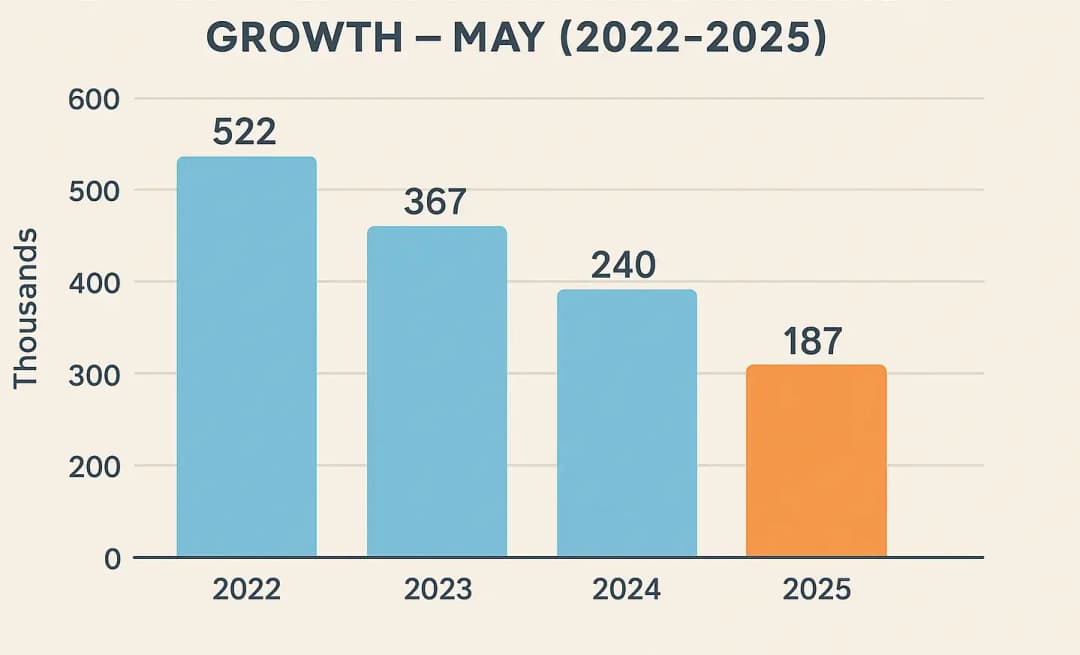
South Korea’s job market showed fresh signs of strain in May as the number of job openings per job seeker fell to its lowest level in 27 years, reminiscent of the labor market conditions during the 1998 Asian Financial Crisis. According to data released by the Ministry of Employment and Labor on June 9, the job openings-to-seekers ratio dropped to 0.37 in May, the lowest for the month since 1998 when the figure stood at 0.32. The significant decline reflects a deepening imbalance between labor supply and demand, with fewer companies actively hiring while the number of job seekers continues to rise.
The number of newly registered job openings through the government’s WorkNet platform amounted to 141,000, marking a sharp 24.8 percent decrease from the same month last year. In contrast, the number of new job seekers increased by 2.6 percent to 376,000. The combined effect of these trends led to the dramatic drop in the hiring ratio, highlighting mounting difficulties in job creation across major sectors of the economy.
Employment insurance data further underscored the slowdown. The total number of insured employees stood at 15.58 million at the end of May, an increase of 187,000 from a year earlier. However, this marked the smallest year-on-year increase in May since 2020, when hiring slowed significantly due to the COVID-19 pandemic. Analysts noted that although hiring showed slight signs of recovery from earlier in the year, overall momentum remains subdued.
By sector, employment trends revealed a divergence. Manufacturing employment saw a modest overall increase, particularly in subfields such as food processing, transportation equipment, and chemicals. However, when excluding the increase in foreign workers under the employment permit system, domestic employment in manufacturing actually declined by 16,000, continuing a 20-month streak of contraction. Textiles, fabricated metals, and rubber and plastics all reported declines in insured employment. Construction sector employment also continued to shrink, with the number of insured workers falling to 754,000—a 22-month consecutive decline, largely driven by ongoing reductions in general construction activities.
In contrast, the service sector continued to expand, led by gains in health and social welfare, professional and scientific services, hospitality, and transportation. Nevertheless, employment in retail and information and communications remained on a downward trajectory, reflecting broader shifts in consumer behavior and digital transformation.
The data also pointed to growing demographic disparities. Female insured workers increased by 148,000 over the past year, far outpacing the 39,000 increase among male workers. Employment rose in the 30s, 50s, and 60-and-above age groups, but continued to decline among those under 30 and in their 40s. Specifically, the under-30 group recorded a drop of 93,000, marking 35 consecutive months of decline, while those in their 40s fell by 37,000 for the 21st month in a row. The Ministry attributed this to both structural demographic shifts and difficulties in labor market entry and retention for younger workers.
Meanwhile, unemployment benefit figures continued to rise. In May, 85,000 new applications for job-seeking benefits were filed, a slight decrease of 3.1 percent year-on-year. However, the number of recipients climbed to 670,000, up 3.7 percent, and total disbursements reached 1.11 trillion won—marking the fourth consecutive month above the one-trillion-won level. As of the end of May, the government had already spent 5.37 trillion won out of its 10.9 trillion won annual budget for unemployment benefits. Officials cited the continued effects of a 2019 policy change that extended the maximum benefit period to 270 days as one reason for the sustained increase in recipients and overall spending.
Director of the Ministry’s labor market analysis division, commented that unemployment benefit claims tend to spike following the end of fiscal quarters and usually recede by mid-year. He added that the Ministry anticipates monthly payouts to fall below one trillion won starting in June. However, he also acknowledged that underlying structural challenges remain. “While hiring in the service sector has provided some support, conditions in manufacturing and construction remain difficult,” he said. “According to forecasts by research institutions, employment may show signs of recovery in the first half of the year but is likely to weaken in the second half.”
As South Korea continues to navigate a changing industrial and demographic landscape, the government faces mounting pressure to address labor market imbalances. With hiring stagnating, unemployment spending accelerating, and key age groups facing prolonged employment difficulties, targeted policy responses will be essential to ensure labor market stability in the months ahead.
Continue this reporting
Reporting on the same issue
Related coverage selected from the article's desk, topics and newsroom relationships.
 NewsSep 26, 2026
South Korea’s 490 Regional Doctor Seats Begin a Longer Route to Care
South Korea’s first 490 regional-doctor seats tie medical-school admission to...
 NewsAug 30, 2026
The Hidden Economics of South Korea’s Public Transport
Busan’s latest transport review exposes a wider national problem: South Korea...
 NewsAug 11, 2026
Korea’s Innovation Cities Did Not Grow the Same Way
Nearly two decades after South Korea began relocating public institutions, th...
More from the author
More from this byline
Stay with the same line of reporting through more work from this byline.
 NewsOct 14, 2026
What Became of Busan’s University Streets?
 NewsSep 28, 2026
Why Some Commercial Space in Busan Is Hard to Reuse
Reader Signal
Community readWhat did this report leave you with?
Choose the signal that best reflects your reading. Select it again to remove it.
One response per article
No response selected
A moderated conversation about the reporting.
One-level replies and newsroom moderation keep the conversation anchored to this article.
Discussion Status
Open
Please sign in to join the discussion.
Newsletter
Weekly reporting and context from Busan and Korea.