Busan Trading Degrees for Institutional Survival
A structural audit into how Busan’s new visa incentives prioritize university solvency over industrial competency, transforming regional campuses into residency brokers.

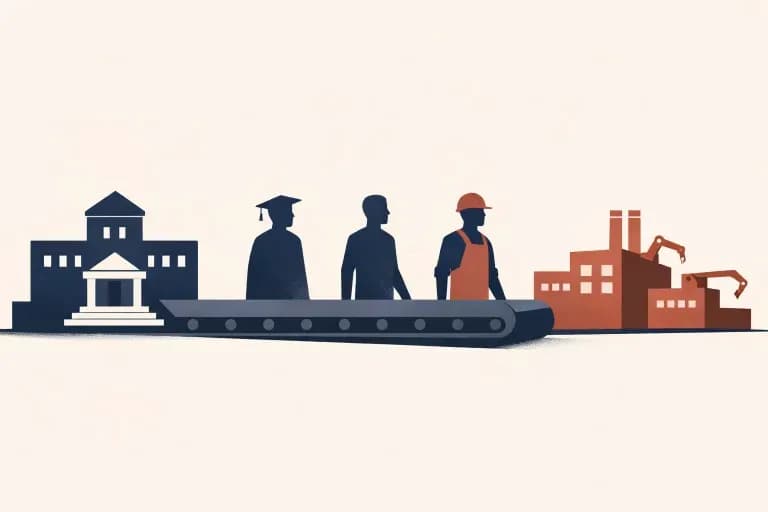
BUSAN — Busan is formalizing a demographic trade-off to sustain its failing regional education system. On Friday, the city designated three vocational colleges—KIT, DIT, and BIST—as hubs for a pilot program that effectively tethers academic enrollment to permanent residency. The administrative architecture of this "Skilled Technical Major" track reveals a strategy centered on institutional solvency rather than industrial innovation.
For universities facing a terminal decline in domestic enrollment, international tuition has become a critical subsidy. By waiving financial requirements and extending work hours to 35 per week, the city has reclassified the student visa as a de facto labor permit. The university now functions as a residency broker, providing legal status in exchange for the capital necessary to keep regional campuses operational.
This model creates a functional disconnect on the factory floor. The reliance on TOPIK Level 3—a proficiency level insufficient for technical environments—ensures a persistent gap between classroom output and industrial demand. Industry-specific Korean remains the primary barrier to employment in Busan’s manufacturing zones, yet the current incentives prioritize rapid recruitment over linguistic or technical mastery.
The stagnant 7.4% domestic employment rate for international graduates serves as a sober indicator of this systemic failure. When academic rigor is secondary to visa processing, the "technical degree" loses its market value. The result is a cycle of low-wage labor and eventual migration to the capital, leaving Busan’s industrial heart with a transient workforce rather than a settled class of skilled technicians.
The Industrial Disconnect: Literacy as a Barrier to Entry
The 7.4% domestic employment rate for international graduates functions as a definitive audit of current regional education policies. This figure indicates a fundamental failure to convert academic enrollment into industrial integration. The primary friction point is the linguistic threshold: TOPIK Level 3 provides the vocabulary for basic social existence but leaves the holder functionally illiterate in a technical environment.
In the manufacturing sectors of Sasang and Gangseo, operational safety and precision depend on a mastery of industry-specific Korean. A student who enters a mechanical engineering program with Level 3 proficiency rarely achieves the advanced technical literacy required by employers during a two-year vocational course. Consequently, the "skilled technician" designation becomes an administrative label rather than a reflection of technical competency.
The expansion of time-limited labor to 35 hours per week further erodes the quality of the technical output. Under this framework, the university operates as a legal facilitator for a low-wage workforce. When the majority of a student’s energy is diverted to labor to service tuition debt, the "degree" is relegated to a byproduct of a residency transaction. This creates a workforce that is legally present but technically stagnant, unable to meet the high-reliability standards of local automotive and machinery firms.
Financial data from regional colleges underscores this dependency. As domestic tuition revenue plateaus, the survival of these institutions hinges on maintaining high quotas of international recruits. This fiscal reality incentivizes colleges to prioritize "visa processing efficiency" over "educational quality." The result is a commodified credential—a degree that satisfies administrative requirements for a visa but fails to provide the professional mobility necessary to anchor talent in Busan.
Without a pivot toward mandatory technical Korean mastery and a decoupling of university survival from recruitment volume, these graduates remain transient. The 26 million KRW salary floor stipulated by the K-CORE visa often fails to compete with the higher wage scales and better infrastructure of the Seoul Metropolitan Area. Busan is effectively subsidizing the initial entry of a workforce that will inevitably migrate to the capital, leaving the city’s industrial core in a state of permanent vacancy.
The Policy Dead-End: Subsidizing Institutional Stagnation
The current fiscal framework for regional university support, including the Glocal 30 initiative, functions more as a buffer for failing institutions than a catalyst for structural reform. By linking government subsidies to enrollment figures, the state incentivizes a volume-based recruitment strategy. This fiscal pressure forces Busan’s universities to prioritize the quantity of international students over the rigorous academic standards required to produce viable technical talent.
This path dependency prevents the necessary downsizing of the regional education system. Instead of merging or closing insolvent institutions, the "Visa Fast-Track" allows these colleges to maintain a veneer of functionality. The resulting environment is an academic-industrial ghetto where low-entry requirements lead to a degradation of the degree's market value. Local firms, recognizing this decline in quality, continue to favor graduates from the capital or specialized industrial high schools, further isolating the international student body from meaningful career paths.
The 26 million KRW salary threshold for the K-CORE visa acts as a temporary anchor, but it lacks the weight to counter the regional economic disparity. Without a fundamental shift toward wage parity with the Seoul Metropolitan Area and a radical overhaul of technical Korean instruction, Busan’s industrial complexes will remain a revolving door for transient labor. The "One-Stop" settlement plan remains an administrative fix for a problem that is fundamentally economic and educational.
Ultimately, the survival of Busan’s industrial core depends on decoupling university solvency from international recruitment quotas. A merit-based integration model—one that mandates high-level technical literacy and rigorous vocational testing—would likely result in fewer graduates but higher retention within the local industry. Persisting with the current model suggests a city that has prioritized the short-term preservation of its university buildings over the long-term health of its manufacturing base.
The Weekly Breeze
Keep pace with Busan's deep narratives.
Delivered every Monday morning.


