South Korea's Digital Nomad Visa: A Leap Forward or a Missed Opportunity?
South Korea's recent introduction of the digital nomad visa, effective from January 1, 2024, marks a shift in its approach to remote work and tourism. However, the visa's stringent income requirements and other criteria have sparked debate about its actual effectiveness and appeal. High Income Threshold: A Barrier to Broader Appeal A pivotal aspect of the digital nomad visa is its high income requirement, set at twice the national GNI per capita, translating to an annual income of about 84.96


South Korea's recent introduction of the digital nomad visa, effective from January 1, 2024, marks a shift in its approach to remote work and tourism. However, the visa's stringent income requirements and other criteria have sparked debate about its actual effectiveness and appeal.
High Income Threshold: A Barrier to Broader Appeal
A pivotal aspect of the digital nomad visa is its high income requirement, set at twice the national GNI per capita, translating to an annual income of about 84.96 million won ($33,000). This condition positions the visa to attract high-income professionals rather than traditional digital nomads, known for their flexible, lower-cost lifestyle. Critics argue that this approach might limit the diversity of remote workers coming to Korea, favoring only those in the higher income bracket. Critics argue, "This high bar might limit the diversity of remote workers coming to Korea, skewing it toward a narrower, wealthier demographic."
The decline in remote work trends post-pandemic, especially in the tech sector, poses another challenge. With countries gradually moving away from remote work models, the target demographic for Korea's digital nomad visa might shrink. Moreover, the global cooling of the workcation trend raises questions about the timing and relevance of this new visa policy.
When compared with similar digital nomad visas from other countries, South Korea's version stands out for its stringent financial requirements. Many nations with digital nomad visas have lower income thresholds or more relaxed criteria, aimed at attracting a broader range of remote workers. Countries like Portugal and Estonia offer digital nomad visas with more attainable requirements, potentially making them more attractive destinations for a wider range of remote workers. This difference could make Korea less competitive as a destination for digital nomads.
The Korean government anticipates the visa will boost local economies by attracting high-spending foreigners. The Korea Tourism Organization estimates a potential economic benefit of 4.5 trillion won. However, this optimistic projection hinges on the assumption that high-income digital nomads will significantly contribute to local spending.
Experts suggest that instead of focusing narrowly on high-income professionals, South Korea should consider more inclusive tourism strategies. The recent decline in Chinese tourists, a previously significant revenue source, underscores the need for diversification in the tourism sector. Adapting to the changing global tourism landscape may require policies that cater to a broader spectrum of visitors.
While South Korea's digital nomad visa represents a forward-looking approach to the changing work environment, its success and broader impact are not guaranteed. The high income requirement may limit its appeal, and global trends in remote work could further challenge its effectiveness. As the world adapts to the post-pandemic reality, South Korea's ability to refine and possibly recalibrate its digital nomad visa could be crucial in realizing its potential benefits for both the local economy and the global remote working community.
Continue this reporting
Reporting on the same issue
Related coverage selected from the article's desk, topics and newsroom relationships.
 NewsSep 21, 2026
Europe’s Electrical-Steel Safeguard Now Reaches Inside the Transformer
A new EU safeguard follows electrical steel into certain finished transformer...
 NewsSep 14, 2026
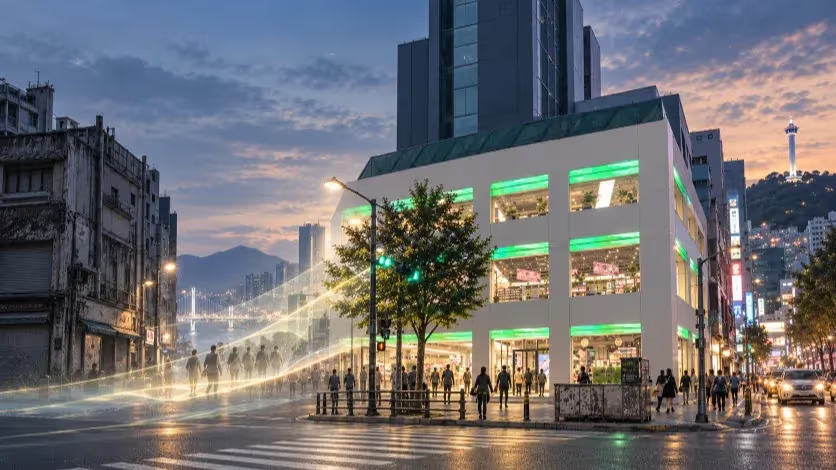
Foreign Tourist Spending Is Reshaping Busan’s Nampo District
Foreign spending is making long-empty commercial space valuable again in Namp...
 NewsSep 11, 2026
Busan-Jinhae’s New Industrial Strategy Meets a Jobs Divide
As BJFEZ prepares to add AI, data and advanced energy to its industrial prior...
More from the author
More from this byline
Stay with the same line of reporting through more work from this byline.
 NewsSep 18, 2026
The Other AI Race Is for the Freedom to Change Course
 NewsSep 5, 2026
How a Political Appointment Becomes a Judgment of Character
Reader Signal
Community readWhat did this report leave you with?
Choose the signal that best reflects your reading. Select it again to remove it.
One response per article
No response selected
A moderated conversation about the reporting.
One-level replies and newsroom moderation keep the conversation anchored to this article.
Discussion Status
Open
Please sign in to join the discussion.
Newsletter
Weekly reporting and context from Busan and Korea.