Singapore edges out Hong Kong in regional financial competition
Hong Kong has been facing a major challenge in recent times, as it tries to regain its position as Asia's premier financial center after years of pandemic controls. However, a Financial Times analysis of real estate prices, air traffic, and other indicators shows that Singapore has taken the lead in the region, leaving Hong Kong to play catch-up. While Hong Kong's chief executive, John Lee, has launched a campaign to convince the world that the Chinese territory is not only open for business bu


Hong Kong has been facing a major challenge in recent times, as it tries to regain its position as Asia's premier financial center after years of pandemic controls. However, a Financial Times analysis of real estate prices, air traffic, and other indicators shows that Singapore has taken the lead in the region, leaving Hong Kong to play catch-up.
While Hong Kong's chief executive, John Lee, has launched a campaign to convince the world that the Chinese territory is not only open for business but also remains a leading financial center, Singapore has been making significant gains. The data shows that Hong Kong paid a price for its tough pandemic restrictions and quarantines, while Singapore made gains by being one of the first countries in Asia to reopen its borders during the pandemic.
Hong Kong's regional importance has been entrenched by its location on mainland China's doorstep, but it has only just reopened to tourists after three years in which many international airlines stopped their services. In contrast, Singapore has been attracting foreign investment and promoting sustainable economic growth. More aircraft have arrived in Singapore than in Hong Kong every month since January 2022, according to flight statistics. Arrivals in Singapore have now reached 70 per cent of pre-pandemic levels, while those in Hong Kong are just over half of what they were before the pandemic.
One of the reasons for Singapore's growing appeal to wealthy elites and their funds is Chinese leader Xi Jinping's clampdown on technology entrepreneurs. Since mid-2021, Singapore's foreign currency deposits have increased by more than $100bn, while deposits in Hong Kong banks have dwindled since early 2022. The number of family offices in Singapore has grown from a handful in 2018 to an estimated 1,500 by the end of last year, according to Singaporean data analysis firm Handshakes. On the other hand, Hong Kong has been experiencing a severe labour shortage that is preventing the full return of routes, and Qantas has delayed the start of its Hong Kong to Melbourne service to the middle of the year.
It is difficult to quantify how many people have moved from Hong Kong to Singapore, and banks remain reluctant to say how many staff they moved there during the height of the pandemic. Some had been expanding in Singapore even before the pandemic, especially after the introduction of a tough new security law in Hong Kong in 2020 following protests and unrest. All of this has contributed to rental prices in Singapore surging 40 per cent in the fourth quarter of last year from the same period two years earlier.
Hong Kong's proximity to China remains a huge draw for investors. In terms of capital market activity, Hong Kong is still far ahead of Singapore, with stock market turnover and market capitalisation more than seven times larger than its rival. However, Singapore is fast closing the gap with Hong Kong in the asset management and advisory service industry. In 2021, Singapore's assets under management grew 16 per cent to $4tn, while Hong Kong's grew by only 2 per cent to $4.6tn.
Despite the challenges, Hong Kong is expected to grow 3.9 per cent in 2023, faster than Singapore's 2.3 per cent, as the city is open and China has abandoned its zero-Covid policy. Nevertheless, some Hongkongers are expected to return to the city, particularly if the political situation improves or if economic conditions in the UK or US are not as good as expected.
Continue this reporting
Reporting on the same issue
Related coverage selected from the article's desk, topics and newsroom relationships.
 NewsOct 21, 2026
What a Small Mackerel Is Worth
Busan’s catch is dominated by small mackerel even as some buyers need larger...
 NewsSep 21, 2026
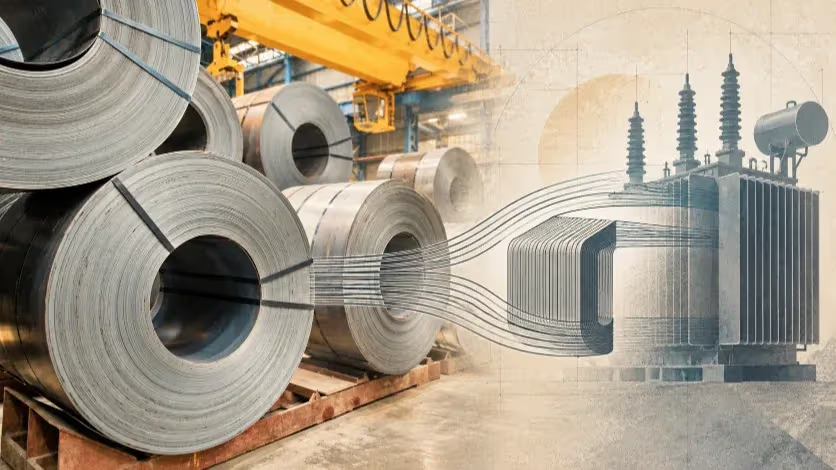
Europe’s Electrical-Steel Safeguard Now Reaches Inside the Transformer
A new EU safeguard follows electrical steel into certain finished transformer...
 NewsSep 14, 2026
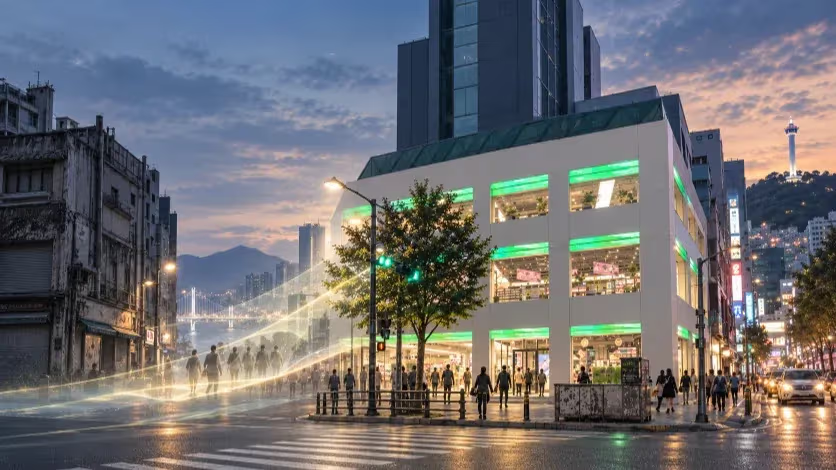
Foreign Tourist Spending Is Reshaping Busan’s Nampo District
Foreign spending is making long-empty commercial space valuable again in Namp...
More from the author
More from this byline
Stay with the same line of reporting through more work from this byline.
 NewsOct 9, 2026
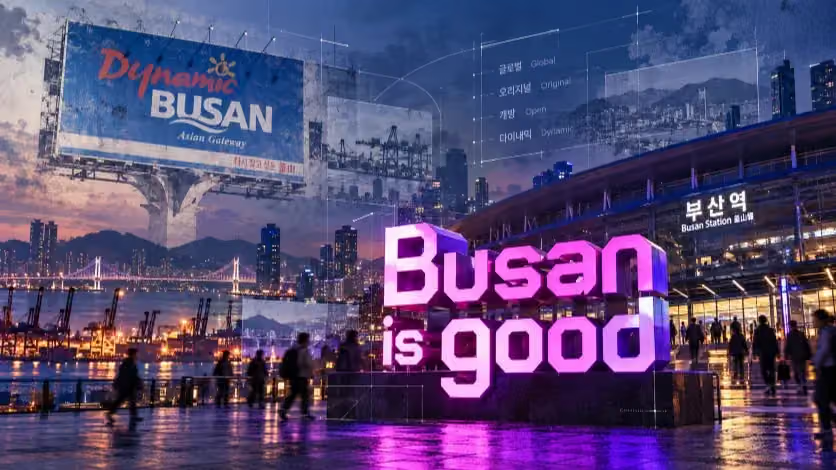
Why “Busan Is Good” Falls Short as a City Brand
 NewsSep 18, 2026
The Other AI Race Is for the Freedom to Change Course
Reader Signal
Community readWhat did this report leave you with?
Choose the signal that best reflects your reading. Select it again to remove it.
One response per article
No response selected
A moderated conversation about the reporting.
One-level replies and newsroom moderation keep the conversation anchored to this article.
Discussion Status
Open
Please sign in to join the discussion.
Newsletter
Weekly reporting and context from Busan and Korea.