Netflix's South Korea Expansion Faces Tax Evasion and Network Fee Controversy
In a significant announcement, Netflix has committed to invest $2.5 billion in South Korea over the next four years, marking an unprecedented investment in a specific country by the streaming giant. The South Korean Presidential Office actively promoted the decision, highlighting the investment as a breakthrough achievement. Discussions regarding the investment commenced in January, with President Yoon Suk-yeol engaging in direct correspondence with Netflix executives. The Presidential Office n


In a significant announcement, Netflix has committed to invest $2.5 billion in South Korea over the next four years, marking an unprecedented investment in a specific country by the streaming giant. The South Korean Presidential Office actively promoted the decision, highlighting the investment as a breakthrough achievement.
Discussions regarding the investment commenced in January, with President Yoon Suk-yeol engaging in direct correspondence with Netflix executives. The Presidential Office noted that this public announcement was exceptional since Netflix has not previously disclosed investment plans or amounts for specific countries.
The investment is expected to elevate South Korea's national image while generating substantial economic benefits, as the content industry has a significant impact on domestic industries and product exports. However, controversies quickly arose over the announced investment amount.
Jeong Cheong-rae, Chairman of The National Assembly's Science, ICT, Broadcasting, and Communications Committee, questioned the investment's significance. Jeong claimed that according to Netflix Korea's "Economic Impact Report," the company was already investing approximately KRW 800 billion ($667 million) in 2022. When multiplied by four years, this amounts to KRW 3.2 trillion ($2.67 billion), suggesting that the investment plan merely reaffirms an existing commitment.
In response, Netflix defended the $2.5 billion investment, stating that it indeed doubled the company's cumulative investment in South Korea since its entry into the market. The streaming giant also explained that the 2022 content investment estimate does not accurately reflect the actual production costs of various projects and that the company had never officially disclosed investment amounts before.
Despite Netflix's clarification regarding the investment amount's value, the company still faces ongoing issues. In 2021, the National Tax Service levied KRW 80 billion ($67 million) in taxes against Netflix on suspicion of tax evasion. Netflix contested the decision and requested a review from the National Tax Tribunal.
Netflix's domestic sales have been steadily increasing, while its corporate tax payments have seen relatively small growth. It has been suggested that the company is avoiding corporate tax by transferring a significant portion of its domestic revenue overseas.
In addition to the tax evasion controversy, the dispute over network usage fees remains unresolved. SK Broadband has been involved in a legal battle with Netflix since 2020, arguing that the streaming giant is avoiding paying fees for its massive data traffic. SK Broadband cites the unfairness of Netflix not paying fees in South Korea when it does so in the United States and Europe.
Netflix maintains that consumers are already paying for network development costs through subscription fees and that requiring additional payment from Netflix would be equivalent to double-charging for the same infrastructure.
While a lower court ruled in favor of SK Broadband in June 2021, Netflix appealed the decision, and the case is currently in its second trial. The Presidential Office confirmed that the network usage fee issue was not discussed during investment negotiations with Netflix.
Continue this reporting
Reporting on the same issue
Related coverage selected from the article's desk, topics and newsroom relationships.
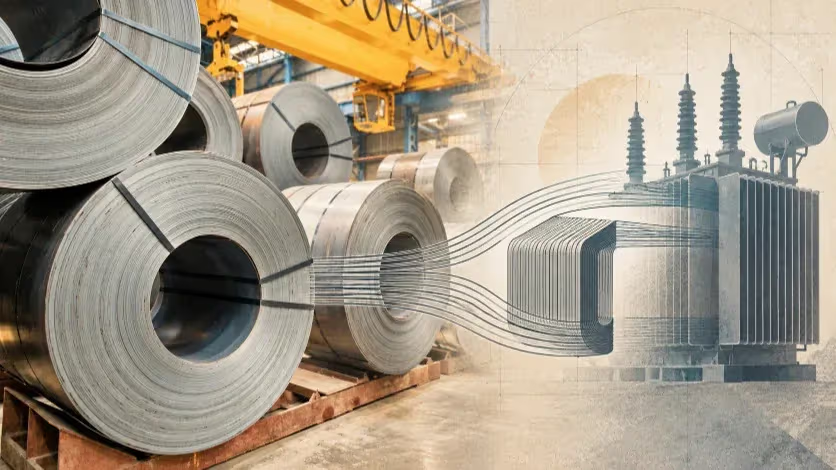 NewsSep 21, 2026
Europe’s Electrical-Steel Safeguard Now Reaches Inside the Transformer
A new EU safeguard follows electrical steel into certain finished transformer...
 NewsSep 14, 2026
Foreign Tourist Spending Is Reshaping Busan’s Nampo District
Foreign spending is making long-empty commercial space valuable again in Namp...
 NewsSep 11, 2026
Busan-Jinhae’s New Industrial Strategy Meets a Jobs Divide
As BJFEZ prepares to add AI, data and advanced energy to its industrial prior...
More from the author
More from this byline
Stay with the same line of reporting through more work from this byline.
 NewsOct 9, 2026
Why “Busan Is Good” Falls Short as a City Brand
 NewsSep 18, 2026
The Other AI Race Is for the Freedom to Change Course
Reader Signal
Community readWhat did this report leave you with?
Choose the signal that best reflects your reading. Select it again to remove it.
One response per article
No response selected
A moderated conversation about the reporting.
One-level replies and newsroom moderation keep the conversation anchored to this article.
Discussion Status
Open
Please sign in to join the discussion.
Newsletter
Weekly reporting and context from Busan and Korea.