BNK Kyongnam Bank Embezzlement Scandal: The Largest in Korean Financial History
In a startling revelation, the Financial Supervisory Service (FSS) announced that the recent real estate project financing (PF) scandal involving BNK Kyongnam Bank has reached a staggering 298.8 billion won ($224 million). This marks the most substantial embezzlement in the annals of the Korean financial market, surpassing the previous record involving Woori Bank's scandal last year. The wrongdoer, an employee surnamed Lee, orchestrated this elaborate scheme over thirteen years, from 2009 to Ju


In a startling revelation, the Financial Supervisory Service (FSS) announced that the recent real estate project financing (PF) scandal involving BNK Kyongnam Bank has reached a staggering 298.8 billion won ($224 million). This marks the most substantial embezzlement in the annals of the Korean financial market, surpassing the previous record involving Woori Bank's scandal last year.
The wrongdoer, an employee surnamed Lee, orchestrated this elaborate scheme over thirteen years, from 2009 to July 2022. Serving in the bank's PF department, Lee cleverly manufactured fake loan documents for real estate developers, ones who had never sought loans, adding up to a staggering 102.3 billion won. Furthermore, Lee illicitly diverted loan repayments from bona fide developers to the tune of 196.5 billion won.
To conceal his deceit, funds were funneled into unauthorized accounts, those under family members, acquaintances, and even accounts Lee had set up covertly. These ill-gotten gains went into buying real estate, gold bars, supporting his children's international education, and speculative stock investments.
BNK Kyongnam Bank, as a direct result of Lee's actions, incurred a net loss of 59.5 billion won.
The FSS pointed to systemic lapses in the internal control systems of both the BNK Financial Group and BNK Kyongnam Bank, attributing the embezzlement's enormity to these oversights. Shockingly, since its acquisition by the BNK Financial Group in 2014, the bank has not undertaken a single internal investigation into its PF departments, despite their inherently high-risk nature.
Adding to the bank's woes, their internal audits appeared to have been conducted either without due cause or were done so negligently, amplifying the severity of the embezzlement. The bank and the financial group further landed in hot water for intentionally stalling their report to the financial regulator, even after discerning the embezzlement in April. Disturbingly, Lee remained in his position, continuing his usual duties, with no mandatory leave enforced.
The FSS expressed its intention to rigorously investigate further into the allocation of the embezzled funds. They've also pledged stern action against those found in violation of regulations and any related employees found complicit in the misconduct.
The BNK Kyongnam Bank scandal unveils more than just the devious actions of a single individual; it exposes a glaring vulnerability in the very framework of financial institutions. This case, marked by its sheer magnitude and duration, highlights the dire need for rigorous internal controls, consistent oversight, and a culture that prioritizes ethical conduct.
The lack of regular and comprehensive audits, especially in high-risk sectors such as project financing, has evidently exacerbated the situation. It underscores the pivotal role that banks and financial groups should play in not just serving their customers, but also in diligently safeguarding their assets.
Furthermore, this incident serves as a stark reminder of the importance of regulatory bodies in the financial realm. Their task is not just to respond to malfeasances but to proactively set, monitor, and enforce standards that ensure the financial stability and integrity of the sector.
As the dust settles on this unparalleled embezzlement case, there's hope that it propels the entire financial industry in South Korea and beyond to introspect, reform, and fortify its operations. The trust of millions lies in the balance.
Continue this reporting
Reporting on the same issue
Related coverage selected from the article's desk, topics and newsroom relationships.
 NewsSep 21, 2026
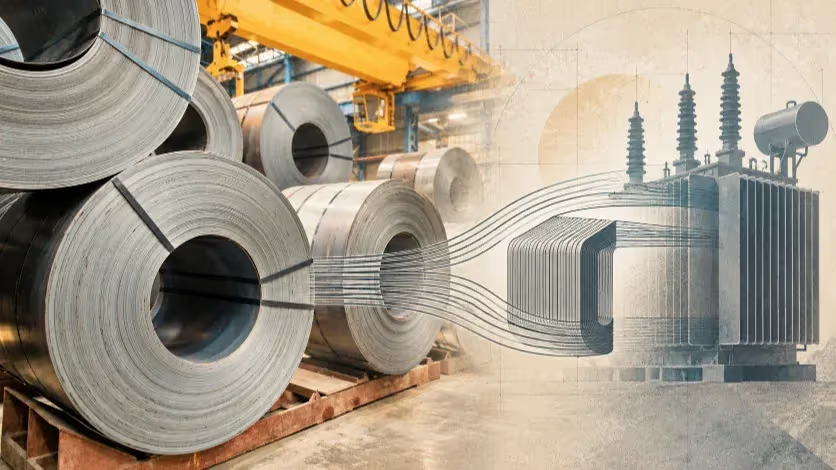
Europe’s Electrical-Steel Safeguard Now Reaches Inside the Transformer
A new EU safeguard follows electrical steel into certain finished transformer...
 NewsSep 14, 2026
Foreign Tourist Spending Is Reshaping Busan’s Nampo District
Foreign spending is making long-empty commercial space valuable again in Namp...
 NewsSep 11, 2026
Busan-Jinhae’s New Industrial Strategy Meets a Jobs Divide
As BJFEZ prepares to add AI, data and advanced energy to its industrial prior...
More from the author
More from this byline
Stay with the same line of reporting through more work from this byline.
 NewsOct 9, 2026
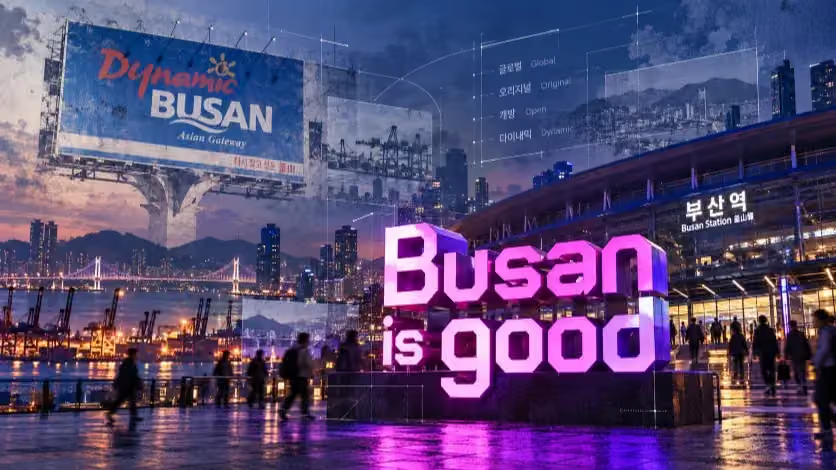
Why “Busan Is Good” Falls Short as a City Brand
 NewsSep 18, 2026
The Other AI Race Is for the Freedom to Change Course
Reader Signal
Community readWhat did this report leave you with?
Choose the signal that best reflects your reading. Select it again to remove it.
One response per article
No response selected
A moderated conversation about the reporting.
One-level replies and newsroom moderation keep the conversation anchored to this article.
Discussion Status
Open
Please sign in to join the discussion.
Newsletter
Weekly reporting and context from Busan and Korea.