World Ocean Forum 2025 Opens in Busan Amid Maritime Uncertainty
The 19th World Ocean Forum begins today in Busan, bringing together global experts to rethink shipbuilding, finance, and climate strategy in an era where volatility has become the new tide.

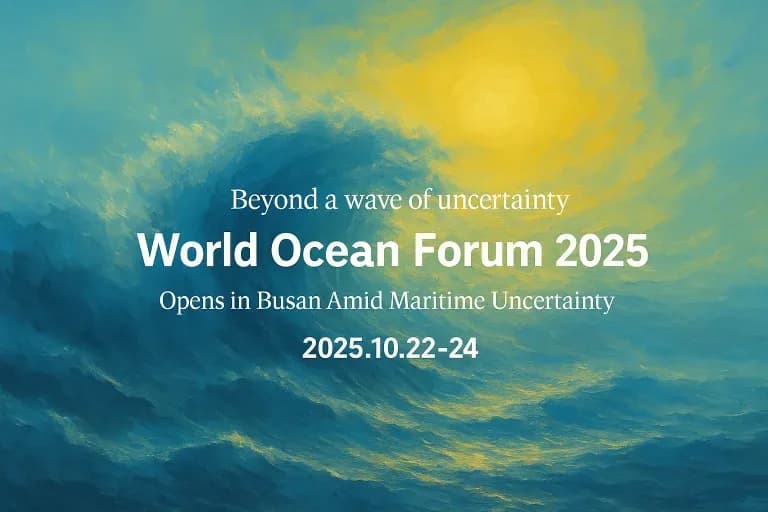
Busan, South Korea — The sea has always been uncertain, but in Busan this week the uncertainty feels measurable. The 19th World Ocean Forum opens today as the maritime world’s barometer, gauging not the weather but the pressure inside an industry remaking itself under duress.
Policymakers, engineers, financiers, and scientists from thirteen nations are gathering at the Lotte Hotel Busan—not to celebrate shipping’s legacy, but to negotiate its future. The theme, “Beyond a Wave of Uncertainty,” is less a slogan than a diagnosis. Every conversation returns to the same premise: the ocean economy is being reshaped by forces it can no longer predict, only manage.
Shipbuilding, once Korea’s most deterministic craft, now speaks the language of carbon and code. In the technical sessions, executives from major yards are discussing propulsion not in horsepower but in grams of emissions per nautical mile. Artificial-intelligence systems that anticipate sea conditions are becoming standard research tools, while methanol and ammonia prototypes promise cleaner wake trails at daunting cost.
Engineers admit the future fleet will be smarter, safer, and ruinously expensive. Behind each innovation lies a spreadsheet of liability—corrosion, crew training, fuel logistics—that will determine which nations can still afford to float steel.
Finance is following the same compression logic. Bankers and lawyers at the forum dissect volatility with surgical precision, describing a market where a vessel’s creditworthiness now moves with its carbon score. A decade ago, the risk premium on shipping loans depended on routes and age; today it hinges on compliance.
Busan’s ambition to anchor an Asian maritime-finance hub gives the city a front-row seat to that transition, but also exposes its fragility. Without consistent carbon-valuation metrics, green lending risks becoming educated guesswork. One participant puts it bluntly: the industry built on physical tonnage is now priced in probabilities.
Amid these technical and financial recalibrations, the idea of a blue economy offers a new axis of optimism. Instead of repeating the language of sustainability, participants treat marine ecosystems as resilience capital—a measurable buffer against both climate and credit shocks.
Economists discuss mangroves, reefs, and coastal wetlands not as moral causes but as infrastructure with cash-flow potential. Busan’s researchers present models that turn shoreline restoration into insurable assets, merging ecology with actuarial logic. The appeal lies in its arithmetic: survival rendered in balance-sheet terms.
The most geopolitically charged debates center on the Arctic. As climate change opens northern passages, nations are mapping potential corridors between Europe and Asia that could redraw trade geometry. For Busan, the prospect is seductive—a shorter maritime bridge connecting its port to northern routes, a new axis of commerce. Yet the ice still imposes its own arithmetic: limited navigation seasons, sanction-stricken infrastructure, and the moral hazard of building prosperity on melting seas.
Delegates from Nordic and Korean institutes describe the Arctic not as an inevitability but as an experiment, a corridor whose viability depends on both temperature and diplomacy. For Busan, the prudent course is to prepare without overcommitting—to treat the Arctic less as destiny than as rehearsal for uncertainty itself.
As sessions continue through the week, a shift in tone is already visible. The participants are not searching for consensus so much as rewriting the vocabulary of risk. Forecasts give way to scenarios, plans to pathways. Engineers talk about data integrity; financiers, transitional liquidity; policymakers, regulatory humility.
The recognition is almost philosophical: the maritime world cannot eliminate volatility, only design for it. Busan’s gathering feels less like a conference than a chart room—a collective attempt to navigate through data, policy, and doubt.
If the ocean economy is learning to think probabilistically, Busan may prove its natural capital: pragmatic, exposed, and attuned to the currents of change. The city’s effort to align shipbuilding, finance, and research into a coherent maritime identity is not a bid for dominance but for relevance—a way to turn uncertainty into a workable medium.
The sea will remain unpredictable; the challenge is to stay buoyant within it. What unfolds in Busan this week suggests that maritime leaders are finally learning to think like the waters they cross: fluid, restless, and never entirely sure of the shore.
Continue this reporting
Reporting on the same issue
Related coverage selected from the article's desk, topics and newsroom relationships.
 NewsOct 22, 2026
Busan Port’s LNG and Methanol Plan: Who Pays to Keep Fuel Ready?
Busan already supplies ships with LNG and methanol, drawing on regional and i...
 NewsOct 16, 2026
What Is Still Worth Going to See?
Busan’s biennale faces questions of artistic judgment and institutional care....
 NewsOct 14, 2026
What Became of Busan’s University Streets?
From 2015 to 2023, registered businesses grew near Pusan National University...
More from the author
More from this byline
Stay with the same line of reporting through more work from this byline.
- NewsOct 22, 2026
Busan Port’s LNG and Methanol Plan: Who Pays to Keep Fuel Ready?
 NewsOct 12, 2026
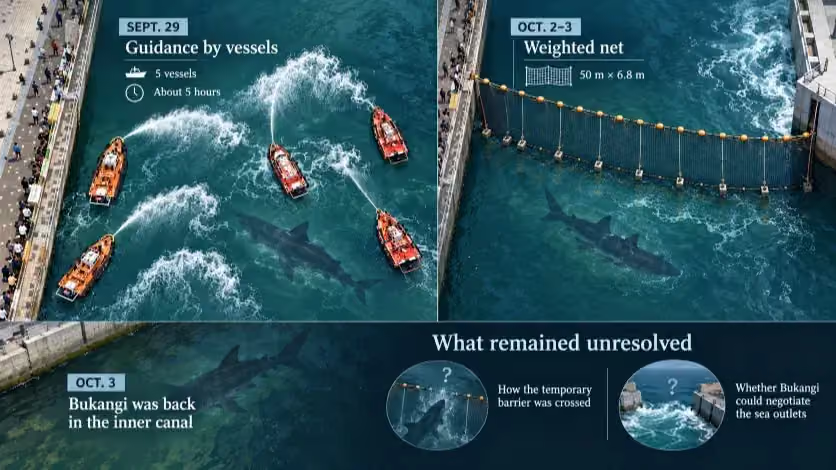
Bukangi, the Shark That Stayed in Busan’s North Port
Reader Signal
Community readWhat did this report leave you with?
Choose the signal that best reflects your reading. Select it again to remove it.
One response per article
No response selected
A moderated conversation about the reporting.
One-level replies and newsroom moderation keep the conversation anchored to this article.
Discussion Status
Open
Please sign in to join the discussion.
Newsletter
Weekly reporting and context from Busan and Korea.