The Road Moves First as Busan’s New Airport Remains Unbuilt
An access highway breaks ground on a fixed timeline while the offshore airport project stalls amid failed bids and unresolved risk.

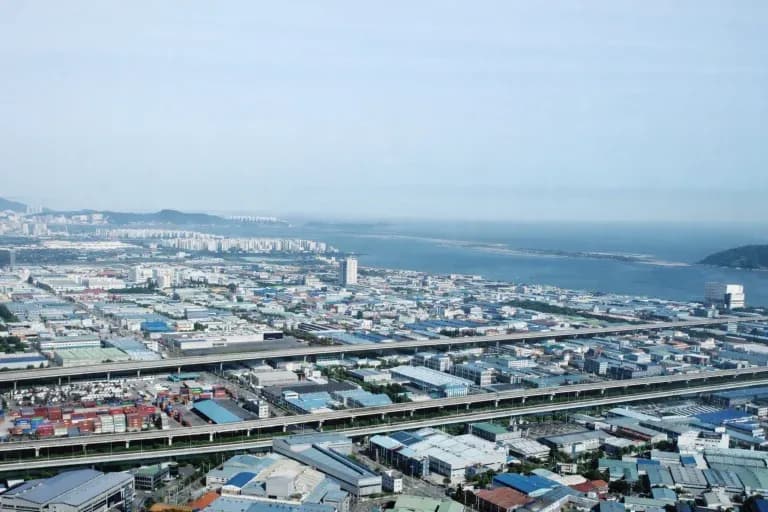
Busan, South Korea — Busan moved forward Monday with a groundbreaking ceremony for an elevated highway linking Gadeokdaegyo Bridge and the Songjeong Interchange. City officials described the 2.7-kilometer route as future access infrastructure for the planned Gadeokdo New Airport and nearby logistics areas, setting a completion target of 2030.
Airport construction, however, has yet to begin. Efforts to award the offshore site development contract — covering land reclamation, soft-ground stabilization and runway foundations — have failed to draw sustained competition, leaving the project without a builder and without a confirmed construction schedule.
Work on supporting infrastructure is advancing along a defined timeline, while the airport at the center of Busan’s aviation plans remains stalled at the procurement stage. With local elections scheduled for June, the sequence has drawn attention to how visible progress can move ahead even as core execution remains unresolved.
The access road stands as one of the few components of the broader airport initiative moving with certainty. Designed to bypass congested surface roads in Busan’s southwest, the elevated highway has cleared planning and budgeting hurdles that continue to constrain the airport itself. Construction risks are largely confined to land-based engineering, allowing timelines and costs to be set with relative confidence.
Officials have cited persistent traffic bottlenecks around the Noksan industrial complex and freight corridors linked to Busan New Port as justification for proceeding. Daily commuter flows and logistics traffic already strain existing routes, giving the project an independent rationale beyond aviation demand. In that sense, the highway does not rely entirely on the airport to demonstrate immediate utility.
Public messaging, however, consistently places the road within the airport’s future operations. Briefings and speeches have described the structure as part of a circulation network intended to carry passengers and cargo to and from a new aviation hub. The linkage folds a manageable project into a larger narrative, even as construction of the airport itself remains unresolved.
Progress slows where risk concentrates. The airport’s core construction depends on an offshore site development package that combines land reclamation, soft-ground stabilization, seawalls and runway foundations under a single design-build contract. The structure places responsibility for engineering performance, schedule and cost on one contractor, amplifying exposure in an environment where ground conditions and weather remain difficult to model with precision.
That exposure has narrowed the pool of bidders. Successive attempts to tender the package have failed to sustain competition, as major construction firms withdrew or declined to participate after assessing the scope and liability profile. Authorities have responded by extending construction periods and revising budget assumptions, but the adjustments have yet to produce a signed contract or a start date.
Without a builder in place, timelines remain provisional and dependencies unresolved. Planning documents outline sequences and targets, but execution cannot begin until risk allocation aligns with market tolerance. Land-based projects move through approvals and ceremonies; offshore works remain at the threshold of contract award.
The elevated highway now carries a firm timeline. The airport it is meant to serve does not.
Roads and bridges can advance on manageable terms even when the projects they support remain unresolved. Offshore construction, bound by uncertainty over ground conditions, cost exposure and liability, demands a level of risk tolerance the market has so far withheld. The difference has shaped not only construction schedules, but also the public face of progress.
Groundbreaking ceremonies offer clarity where contracts do not. Visibility, however, cannot substitute for execution. Until a builder is secured and work begins at sea, the airport will remain defined by procurement rather than construction, and by plans rather than runways.
For now, the sequence speaks plainly. Infrastructure advances where certainty exists and stalls where risk concentrates. The road moves first. The airport waits.
Continue this reporting
Reporting on the same issue
Related coverage selected from the article's desk, topics and newsroom relationships.
 NewsOct 22, 2026
Busan Port’s LNG and Methanol Plan: Who Pays to Keep Fuel Ready?
Busan already supplies ships with LNG and methanol, drawing on regional and i...
 NewsOct 16, 2026
What Is Still Worth Going to See?
Busan’s biennale faces questions of artistic judgment and institutional care....
 NewsOct 14, 2026
What Became of Busan’s University Streets?
From 2015 to 2023, registered businesses grew near Pusan National University...
More from the author
More from this byline
Stay with the same line of reporting through more work from this byline.
- NewsOct 22, 2026
Busan Port’s LNG and Methanol Plan: Who Pays to Keep Fuel Ready?
 NewsOct 12, 2026
Bukangi, the Shark That Stayed in Busan’s North Port
Reader Signal
Community readWhat did this report leave you with?
Choose the signal that best reflects your reading. Select it again to remove it.
One response per article
No response selected
A moderated conversation about the reporting.
One-level replies and newsroom moderation keep the conversation anchored to this article.
Discussion Status
Open
Please sign in to join the discussion.
Newsletter
Weekly reporting and context from Busan and Korea.