The City That Mistook Branding for Progress
As Busan reinvents itself as a design capital, its economy contracts and its citizens wonder whether creative slogans can build real prosperity.

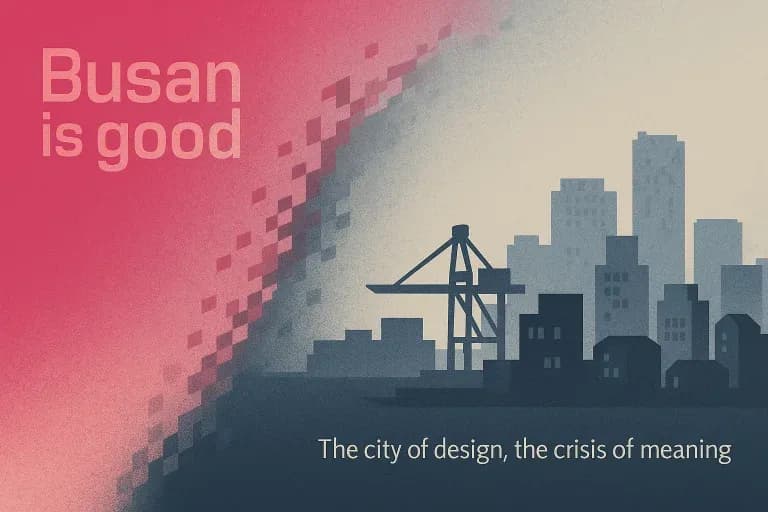
Busan, South Korea — At Busan City Hall, the term design city has become shorthand for an entire civic philosophy. It appears in planning documents, mayoral speeches, and public presentations with a frequency that would have been unimaginable a decade ago. Officials now use it to describe everything from waterfront regeneration to transport signage and administrative reform. The phrase signals more than an aesthetic turn. It represents the city’s chosen narrative for the next decade — a belief that design can become both the language and the instrument of urban transformation.
The shift in rhetoric follows a political turning point. When Busan lost its bid to host the 2030 World Expo, the disappointment forced city leaders to reconsider how to keep the city visible on the international stage without the debt and logistical drag of another mega-event. The World Design Capital title, awarded by the World Design Organization for a two-year cycle, seemed to offer the perfect solution: global attention without concrete poured, prestige without stadiums. In 2024, the administration established a new Future Design Bureau, a department placed directly under the mayor’s office and charged with coordinating every initiative that could fall under the heading of design — from architecture and cultural events to digital interfaces and transport systems. Its founding statement described it as “a control tower for creative policy,” a phrase that captures both the ambition and the ambiguity of the mission.
The bureau’s work so far has been largely conceptual. Budgets exist but are dispersed through multiple departments, and evaluation standards remain undefined. It operates more as a coordinator than as a policymaker. Still, its creation marks a symbolic shift: design has been reclassified from ornament to instrument, from decoration to “strategic resource.” Officials see it as a means to tie together the city’s fragmented ambitions — from smart-city experiments to tourism branding and waterfront redevelopment — into a single story of creative renewal. Yet outside City Hall, the economic landscape tells a more complex story. Busan’s self-employed sector — long the backbone of its coastal economy — has been shrinking for over a year, with small retailers and hospitality operators reporting double-digit declines in revenue. High rents and interest rates have eroded margins, and the city’s employment rate remains below the national average. For many, the city’s new fixation with design feels distant from the daily arithmetic of survival.
Much of Busan’s newfound visibility owes less to its own initiatives than to the broader rise of the Korean brand abroad. The surge of K-culture — from pop music and film to fashion and food — has elevated the profile of every Korean city by association. Busan’s festivals, architecture, and creative campaigns ride that current, but the city has yet to generate a narrative that stands on its own. Its identity remains derivative: the marine version of Seoul’s cultural economy rather than an independent brand. The risk is that the city’s “design leadership” becomes an echo of a national marketing machine — vivid in form, hollow in substance.
The World Design Capital framework appears to offer coherence, but global precedent suggests that symbolism rarely guarantees substance. Helsinki, which held the title in 2012, applied design principles to public administration, redesigning tax forms and hospital signage in an effort to make bureaucracy more humane. The result was improved usability but little in direct economic expansion. Cape Town, two years later, focused on community participation; its energy was real but its projects evaporated once funding ended. Valencia, in 2022, learned from those failures, creating a statutory Consell Local del Disseny that continues to shape public procurement and planning today. By contrast, San Diego–Tijuana, the 2024 host, suffered from overestimated revenues and collapsing sponsorships, its calendar halved before year’s end.
Across these cases, the pattern holds: design brings visibility, but visibility fades unless governance follows. For Busan, that distinction is existential. The administration’s rhetoric frames design as an engine of growth and a magnet for global investment, linking it to creative industries, startups, and tourism. Yet the causal path from design to economic recovery remains speculative. The city’s own data show stagnation in service wages and a contraction in small business employment. If Helsinki demonstrated that design could reform bureaucracy, Busan risks proving that branding alone cannot repair an economy’s foundations.
Developers have begun to market “design-led regeneration,” particularly along the northern and coastal districts. New mixed-use projects feature cultural studios and design museums timed to open before 2028. These ventures blur civic purpose and private marketing, raising questions about who benefits from the design narrative. Local designers and academics are divided: some welcome the visibility; others warn that the focus on spectacle and aesthetics may distract from deeper structural reform in education, research, and local industry. The tension between event and institution — between a city performing design and one governed by it — remains unresolved.
Measurement remains the central weakness. The World Design Organization asks host cities to report on “public engagement” and “innovation outcomes,” but such metrics typically reduce to visitor counts and social media mentions. Helsinki and Valencia quantified usability and administrative efficiency; Busan has yet to establish such baselines. Without data, progress remains anecdotal — easy to declare, impossible to verify. Meanwhile, financial opacity compounds the problem. The city’s budget disclosures do not isolate spending for the design capital program, making oversight difficult. Previous hosts like San Diego learned how quickly enthusiasm turns political once projections collapse. For Busan, the overlap between WDC funding and broader cultural initiatives risks the same fate unless transparency is institutionalized.
What the administration calls “creative governance” thus depends on whether creativity can be measured at all. The challenge is not only fiscal or aesthetic; it is structural. Design policy without economic grounding becomes another form of branding — an expensive way to say what a city wants to be, without proof that it can sustain it. And yet the city’s leadership insists that design will be the bridge between innovation and inclusion. That ambition deserves scrutiny. For design to matter, it must enter the city’s procedural DNA — the rules that shape zoning, procurement, education, and civic participation. Otherwise, it remains a costume for the same machinery it claims to reinvent.
The broader question, then, is what Busan wants design to mean when the banners come down. Codification, not celebration, defines endurance. The Future Design Bureau currently exists by administrative order, subject to electoral turnover. Unless Busan legislates a permanent design council with authority across departments, the apparatus will dissolve with the next political season. Participation, too, will determine authenticity. The Future Busan Design Corps has been introduced as a citizen platform, but its effectiveness will depend on whether it can shape actual projects rather than decorate policy. Without that agency, “citizen design” will become just another rhetorical flourish in a year of festivals.
All of this unfolds against an economic backdrop that remains fragile. Small businesses continue to close faster than they open; wage polarization deepens; and the city’s working-age population is shrinking. These indicators cast doubt on whether aesthetic governance can substitute for industrial policy. The rhetoric of creativity may offer hope, but it does not pay rent or salaries. For a port city built on trade, Busan’s new fixation on design carries an irony: the ships that once carried its prosperity have been replaced by slogans of innovation, while the everyday economy that sustains its citizens struggles to stay afloat.
A real design city is not one that looks designed; it is one that governs through design. It makes processes transparent, data verifiable, and decisions participatory. Busan’s challenge is to prove that design can move beyond imagery — to become the mechanism of better governance, not its ornament. If the city codifies its structures, clarifies its budgets, and opens its decisions to public scrutiny, it could redefine what a design capital means for non-metropolitan Asia. But if it remains content with exhibitions, campaigns, and light shows, the light of 2028 will illuminate only its own performance.
The harbor city that once defined itself by commerce is now wagering its future on creativity. As the world’s gaze turns toward Busan’s skyline in 2028, the measure of success will not be the spectacle it creates but the systems it leaves behind. When the lights dim and the visitors depart, the question will linger in the quiet offices of City Hall: did design build a city, or merely brand one?
A slogan can light a skyline, but it can’t keep a city alive.
True design begins when the lights go out and the work of building remains.
Continue this reporting
Reporting on the same issue
Related coverage selected from the article's desk, topics and newsroom relationships.
 NewsOct 22, 2026
Busan Port’s LNG and Methanol Plan: Who Pays to Keep Fuel Ready?
Busan already supplies ships with LNG and methanol, drawing on regional and i...
 NewsOct 16, 2026
What Is Still Worth Going to See?
Busan’s biennale faces questions of artistic judgment and institutional care....
 NewsOct 14, 2026
What Became of Busan’s University Streets?
From 2015 to 2023, registered businesses grew near Pusan National University...
More from the author
More from this byline
Stay with the same line of reporting through more work from this byline.
- NewsOct 22, 2026
Busan Port’s LNG and Methanol Plan: Who Pays to Keep Fuel Ready?
 NewsOct 12, 2026
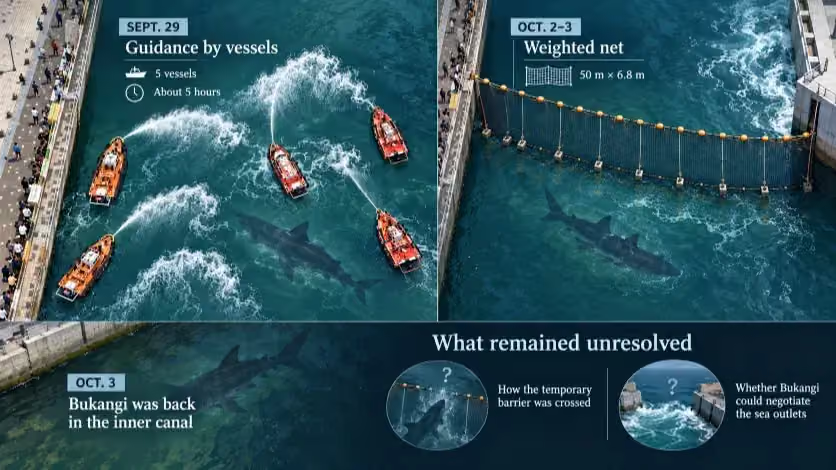
Bukangi, the Shark That Stayed in Busan’s North Port
Reader Signal
Community readWhat did this report leave you with?
Choose the signal that best reflects your reading. Select it again to remove it.
One response per article
No response selected
A moderated conversation about the reporting.
One-level replies and newsroom moderation keep the conversation anchored to this article.
Discussion Status
Open
Please sign in to join the discussion.
Newsletter
Weekly reporting and context from Busan and Korea.