The Airport Busan Can’t Use Yet — and Can’t Stop Needing
Gimhae is already under pressure, Gadeokdo remains years from opening, and the hardest question in Busan’s airport debate is no longer whether the city needs a new gateway, but how it lives through the wait.

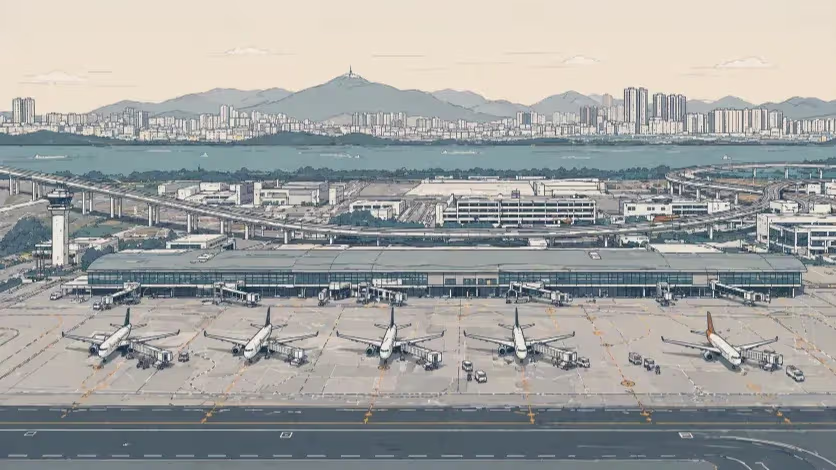
Gimhae is already carrying the scale of traffic that changes a city’s airport politics, while Gadeokdo remains years away from doing the job it was meant to solve. For years, Busan argued for a larger gateway in the language of ambition: a 24-hour airport, stronger long-haul access, a city no longer forced to route too much of its international movement through the capital region. That language still exists. It is no longer sufficient. Gimhae International Airport passed 10 million international passengers in 2025, the first regional airport in South Korea to do so, and international traffic rose another 27.1 percent year on year in the first quarter of 2026 to 3.21 million. Busan now describes Gadeokdo New Airport in the language of a long build: 106 months of construction, difficult marine conditions and a target opening in the second half of 2035.
Busan’s airport politics now revolve less around whether a new airport is needed than around how long the city has to wait for one that works. Gimhae is no longer a comfortable interim gateway, but Gadeokdo is no longer a near-term answer either. The city now operates between a present system under pressure and a future system still defined mainly by timetable, design and access planning. Even Busan’s most concrete sign of progress around the new airport, the rail link that passed preliminary feasibility review in March 2026, belongs to that future-facing system rather than to the daily airport experience residents and firms rely on now. The city’s own headline estimate of roughly 26 minutes from Bujeon to the future airport describes eventual reach, not present relief.
The old argument asked whether Busan deserved a bigger airport. The harder question now is who absorbs the cost of the long wait, how much of the current system can be improved before opening day, and whether rising traffic can be turned into broader local value before the flagship infrastructure arrives. Support in principle reveals very little at this stage. Operational specificity matters far more. Busan enters that test in a mayoral race already set between incumbent Park Heong-joon and Democratic Party candidate Jeon Jae-soo.
Gimhae Has Already Outgrown the Language of a Stopgap
Gimhae has grown beyond the political fiction that it is simply a tolerable bridge to a better airport. The airport’s 2025 traffic record did more than mark a post-pandemic recovery. City figures showed 42 destination cities and 1,546 weekly flights by the end of 2025, both above the pre-pandemic benchmark that had long framed regional aviation recovery. The first quarter of 2026 reinforced that trajectory rather than softening it. Busan is no longer dealing with a market it still hopes to create. It is dealing with one that has already arrived.
That growth changes Gimhae’s place in the regional transport system. A true stopgap holds demand in place while a larger answer is built. Gimhae is already doing more than that. It is carrying rising tourism demand, outbound leisure traffic, a broader route network and the day-to-day aviation needs of a metropolitan region that continues to describe its permanent answer as years away. Throughput at that scale alters the meaning of the airport. Gimhae is no longer politically temporary in any meaningful sense, even if it remains strategically incomplete.
Current improvements at the airport do not weaken that argument. They strengthen it. Busan secured 21 additional customs, immigration and quarantine staff for 2026, pushed for early operation of a second departure hall during peak periods and highlighted expanded passenger-processing capacity at the international terminal. The city also opened an emergency passport issuance center at the airport after reporting 2,795 emergency passports issued to Gimhae travelers in 2024. Those are the actions of a city trying to make a heavily used airport work harder and more smoothly because more people now depend on it.
Operational refinement, however, is not structural resolution. More staff can improve queue management. A second departure hall can reduce processing friction. An emergency passport center can eliminate one kind of last-minute disruption. None of those measures changes the physical and strategic character of the airport itself. Gimhae may continue to absorb more demand with better management. It still cannot become, through incremental fixes alone, the kind of airport Busan has spent years arguing it needs.
Gimhae’s recent success has made the case for Gadeokdo more exacting, not less. A record-setting airport is harder to dismiss as failing, but it is also harder to describe honestly as a merely temporary holding point. The stronger Gimhae performs, the less credible it becomes to speak of Busan’s airport future as though it were still safely deferred.
Gadeokdo Is No Longer a Promise of Speed
Gadeokdo now belongs less to the language of urgency than to the slower language of engineering time. For years, the new airport was promoted as the overdue correction to Gimhae’s known limits: a 24-hour offshore gateway, a longer runway, stronger long-haul capacity and a facility more aligned with Busan’s view of itself as a southern hub. That case remains politically durable. The official project timetable has changed the terms on which it must be understood.
Busan announced in March that the Gadeokdo land development project had entered the basic design stage under the Daewoo E&C consortium, with a 106-month construction period and an opening targeted for the second half of 2035. The city’s own descriptions of the site underscore why the timetable has lengthened into its current form. The project involves soft ground and offshore reclamation, conditions severe enough to affect cost, sequencing and margin for error. Official discussion has also described the site as technically demanding because of marine depth and wave conditions.
A project defined in those terms can no longer be written as a story of willpower alone. Political urgency may still drive rhetoric around the airport, but construction on difficult marine terrain is governed by a different discipline. Design, procurement, staging, access integration and construction risk now matter more than volume of advocacy. A city that keeps treating Gadeokdo as a near-term political breakthrough risks creating expectations that the project’s actual timeline cannot satisfy.
Skepticism around Gadeokdo has not disappeared simply because the political argument for the project grew stronger. The older criticisms — aviation demand, accessibility, environmental impact, constructability, safety and economic viability — have returned precisely because the project has become larger, slower and more expensive. A 2016 government review judged the site unsuitable across those dimensions, and although the political landscape has shifted since then, those objections have not been erased by repetition alone. In some respects, they have become sharper as the project has moved into a 106-month construction horizon and a second-half 2035 opening target.
The critical question no longer lies in whether Busan wants Gadeokdo. It plainly does. The harder question is whether the project has answered its most durable objections with the same force that its supporters invoke its strategic necessity. Demand forecasts, the scale of public cost, the degree of functional overlap with Incheon and the engineering burden of difficult marine terrain all remain live issues. A project can be politically entrenched and still analytically unfinished.
Busan’s own budget structure reinforces both the ambition and the uncertainty. The city does not describe Gadeokdo as a runway-and-terminal project alone. It separates airport facilities, access roads and access rail into distinct investment components, and it presents large economic benefits from reduced dependence on Incheon and increased cargo handling. Those projected benefits may prove substantial. They also raise the threshold of proof. The larger the claims, the harder the obligation to show that the project’s assumptions still hold.
The Waiting Period Is Now the Policy Story
The central airport question in Busan no longer concerns opening day. It concerns the years that have to be governed before it. Once Gadeokdo is understood as a long-horizon project rather than an imminent solution, the story stops being about a clean transition from one airport to another. The transition itself becomes the main policy field.
That shift changes the standard by which the city should be judged. Support for the project in principle is no longer enough. Historical necessity is no longer enough. A serious airport policy now needs to answer less glamorous questions. How much additional demand can Gimhae absorb without a visible decline in usability. Which short-term improvements meaningfully reduce friction and which merely make the system more bearable. How much of the burden falls on passengers, how much on neighborhoods and how much on businesses whose time horizon is far shorter than the construction timetable.
Transition management rarely produces dramatic political rewards. Completion does. Ribbon-cuttings do. Transitional governance is harder to credit because much of its success lies in preventing deterioration rather than unveiling transformation. Busan’s airport politics now depends on exactly that kind of less glamorous work. Gimhae’s growth, Gadeokdo’s long build and the still-developing access network around the future airport together create an extended governing condition, not a short waiting room between decision and delivery.
Delay is also being distributed unevenly. A frequent traveler experiences the waiting period as time lost and route limitation. A resident near current airport geography experiences it as prolonged exposure to the burdens of the existing system. A tourism business experiences it as a mismatch between rising arrivals and uncertain local capture. A delay that appears tolerable in aggregate can feel far more severe once it is broken down by who is absorbing inconvenience and who is actually gaining from the current arrangement.
The waiting period is not dead time between two airports. It is now the period in which the city’s competence will be measured most closely.
Access Will Decide Whether the Airport Becomes Real
Airports become politically real not when they open on paper, but when the journey to them feels reasonable in ordinary life. Busan’s promotion of the Gadeokdo rail link reflects that truth. The city has emphasized the link’s preliminary feasibility clearance and presented an eventual travel time of about 26 minutes from Bujeon to the future airport as part of a wider southeastern “Tri-Port” structure. That number is important. It is also incomplete.
Official travel times describe a segment of movement between selected nodes. Ordinary users do not travel that way. Their trips begin before Bujeon, often involve transfers, and are shaped by the east-west geography of Busan, the distribution of housing and employment and the friction of daily urban movement. Door-to-door time, not node-to-node time, determines whether infrastructure feels usable. An official benchmark can be technically accurate and still socially misleading if it masks the uneven geography of access.
Busan has supplied a headline travel time. It has not yet supplied a public district-by-district map of lived access — the kind of comparison that would show how the future airport feels from Haeundae, Saha, Buk-gu, Ulsan or Changwon rather than from a single central node. That absence matters. Official node-to-node times are useful for planning. Ordinary users measure airport infrastructure in full trips, transfers, reliability and variance by district. Without that wider geography, access remains easier to advertise than to assess.
Access therefore needs to be treated not merely as a transport question, but as a distribution question. A travel-time headline that looks impressive in aggregate may feel transformative in one part of the city and marginal in another. Residents near central rail nodes may experience the new airport as a significant gain. Others may find that the celebrated travel time begins only after they have already completed a long journey of their own. The politics of that unevenness will matter more than many airport proponents appear willing to acknowledge.
That absence does not invalidate the rail project. It does, however, limit the credibility of the access argument as presently communicated. A city asking the public to believe in the future usability of an offshore airport should be able to show, in plain comparative terms, who gains most, who gains less and what the full travel penalty still looks like from across the region. Until that map is made public in usable form, access remains more legible in official briefings than in daily life.
Busan can point to genuine progress in rail planning and road works around the future airport. Those are necessary elements of the project. Practical readiness depends on how these elements mature together, not on whether any single headline milestone can be presented as proof that the airport has become real. An airport without convincing access remains, for much of the city, a promise attached to a shoreline rather than a facility embedded in daily life.
Passenger Growth Does Not Automatically Stay in the City
Passenger records are easy to count; what the city actually keeps after those arrivals is far harder to measure. Busan’s airport politics has long relied on a familiar sequence: more flights bring more visitors, more visitors bring more spending and more spending strengthens the city’s position as a southern gateway. The chain of reasoning is plausible. It is not self-proving.
Busan’s own case for Gadeokdo makes large claims about the value the airport could generate. City materials describe annual savings of 718.3 billion won from reduced travel to Incheon by Yeongnam residents and 44.9 billion won in cargo-related benefits for the Busan-Ulsan-Gyeongnam area. The future airport is presented not only as a passenger gateway but as a 24-hour logistics platform and a strategic alternative to capital-region dependence. Those are serious claims. They should be treated as hypotheses to be tested, not conclusions to be repeated.
National tourism data adds weight to the broader opportunity. Korea.net reported that foreign visitors arriving through provincial airports rose 49.7 percent in the first quarter of 2026, while the share of visitors traveling beyond the Seoul metropolitan area also increased. In principle, a widening geography of arrival should favor Busan. Favorable arrival geography does not guarantee broad local capture after arrival.
Capture is the right word here. Traffic measures movement. Capture measures what remains in the city: hotel nights, local transport use, conference activity, neighborhood spending, freight activity and time saved inside the regional economy rather than exported to the capital region. A city can celebrate rising arrivals and still fail to retain enough of the value associated with them. Visitors may pass through briefly. Spending may concentrate in a few districts or event periods. Business convenience may improve for some sectors while leaking away elsewhere. Passenger throughput and civic payoff are related, but they are not the same fact.
That distinction becomes especially important during the long wait for Gadeokdo. The city can reasonably argue that a larger future airport will improve long-haul access, time savings and logistics flexibility. Many of those gains remain partly deferred. The more immediate question is what can be captured before the flagship infrastructure arrives. How much of current traffic growth is already showing up in tourism retention. How much stays in local hotels and transport. How much strengthens conferences, trade activity and business travel. How much remains in the city’s accounts rather than only in airport statistics.
Busan does not only need a bigger gateway. It needs a more credible account of what that gateway will leave behind. Passenger growth is visible. Retained value is harder to prove. The gap between those two kinds of evidence may become one of the sharpest tests of the airport strategy as a whole.
The Election Matters Only If It Produces Specificity
By this stage of the airport debate, endorsement reveals very little. The real test is whether anyone can describe the waiting period in operational terms. Gadeokdo has been absorbed so deeply into Busan’s civic vocabulary that broad support for the project is not especially revealing. The more demanding question is how political leaders explain the years before the airport opens.
The campaign already contains real lines of conflict. Park and Jeon are openly fighting over who bears responsibility for the 2035 opening target, and they are framing Busan’s future through different regional lenses. Jeon has tied the airport issue more directly to a broader PK and marine-capital frame, while Park has leaned more heavily on Busan’s global-hub position and the city’s wider autonomy agenda. Those are meaningful political differences. They are not yet the same thing as a detailed operational answer to the waiting period.
That distinction matters because the thinner part of the campaign lies elsewhere. Neither side has yet made the interim airport problem feel fully concrete. District-by-district access inequality, day-to-day management at Gimhae, and the question of how traffic growth is supposed to remain in the city before opening day all remain less developed than the rhetoric around the project’s long-term importance. A serious airport argument now requires four more exacting forms of clarity: an interim plan for Gimhae as traffic keeps rising; a district-level understanding of access rather than a reliance on headline travel times; a plausible account of what economic gains can be captured before opening day; and an honest explanation of which parts of the project lie outside municipal control.
Candidates who cannot separate those categories are not really offering airport policy. They are offering symbolic alignment with a project whose public legitimacy is already broad. The useful political distinction no longer lies between support and opposition. It lies between rhetoric and operational specificity.
Ordinary experience is where that distinction becomes visible. A frequent business traveler hears campaign language in one way: as a question of reliability, route convenience and time lost to friction. A family traveler hears it as a question of queue length, transfers and complication. A tourism operator hears it as a question of whether rising arrivals become nights stayed and money spent. An airport worker or service-sector employee hears it through repeated pressure on systems that still have to function before the new airport exists. Those are not decorative human-interest angles. They are the point at which infrastructure policy becomes socially legible.
The Hardest Part of Busan’s Airport Story Is the Interval
The hardest part of Busan’s airport story is no longer the argument for a new runway, but the long interval through which the city still has to live. Gimhae has already entered a higher-demand phase. Gadeokdo has already entered a slower and more technically demanding phase. The access network that is supposed to turn the future airport into a real part of metropolitan life remains under development. Those facts together have transformed the airport debate. The issue is no longer whether Busan can imagine a larger future. It is whether the city can govern the present honestly while that future is still being built.
Busan may yet get the airport it has argued for over so many years. The harder truth is that the case for Gadeokdo is now being judged on stricter terms than before. Record traffic at Gimhae has made the present system more pressing. A 106-month construction horizon has made the future system more distant. Critics still question the project’s assumptions, the public still lacks a full map of lived access, and the mayoral race still offers more rhetoric than operational detail on the years before opening day. Those gaps do not erase the strategic case for a new airport. They do mean the project can no longer be carried by strategic language alone.
The airport story now reaches beyond aviation. It has become a question of time, distribution and trust. Time, because the distance between current demand and future delivery is long enough to become a governing problem of its own. Distribution, because access and inconvenience are not felt evenly across the city. Trust, because large infrastructure projects are not judged only by approval dates and target years, but by whether the waiting period convinces people that the promised future remains worth organizing the present around.
Busan is no longer waiting for its airport story to begin. It is now being judged by how honestly it can govern a future that remains both necessary and not yet fully proven.
Continue this reporting
Reporting on the same issue
Related coverage selected from the article's desk, topics and newsroom relationships.
 NewsOct 25, 2026
The Long Bill for Busan’s Apartment City
Busan has about 958,000 apartments even as its population declines. Elevators...
 NewsOct 23, 2026
Busan’s Twelve-Year School Account Faces a Test Beyond Access
Busan’s PENZ promises one school account for 12 years, while BeAT brings AI t...
 NewsOct 22, 2026
Busan Port’s LNG and Methanol Plan: Who Pays to Keep Fuel Ready?
Busan already supplies ships with LNG and methanol, drawing on regional and i...
More from the author
More from this byline
Stay with the same line of reporting through more work from this byline.
 NewsOct 21, 2026
What a Small Mackerel Is Worth
Reader Signal
Community readWhat did this report leave you with?
Choose the signal that best reflects your reading. Select it again to remove it.
One response per article
No response selected
A moderated conversation about the reporting.
One-level replies and newsroom moderation keep the conversation anchored to this article.
Discussion Status
Open
Please sign in to join the discussion.
Newsletter
Weekly reporting and context from Busan and Korea.