Suyeong Police Station Opens, Ending Split Jurisdiction Era
On August 5, 2025, Busan formally launched the Suyeong Police Station, completing a decades-long process to install dedicated law enforcement facilities in each of the city’s sixteen administrative districts.

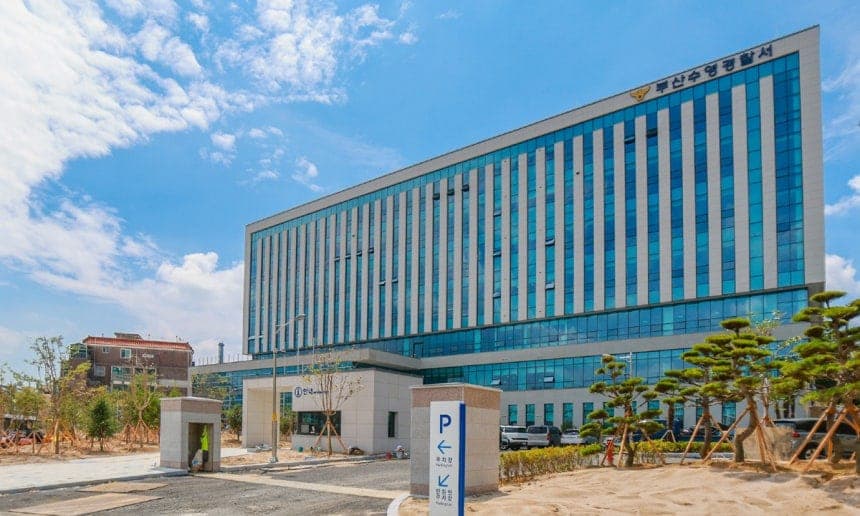
Busan, South Korea — For decades, Suyeong stood out in Busan for all the wrong reasons. It had the beaches, the traffic, the skyline, the crowds. But it lacked one thing every other district in the city had long taken for granted: a police station of its own.
| District (Gu) | Police Station Name | Notes |
|---|---|---|
| Jung-gu | Jungbu Police Station | Covers central downtown area |
| Seo-gu | Seobu Police Station | Includes Songdo and coastal zones |
| Dong-gu | Dongbu Police Station | Near Busan Port and Choryang |
| Yeongdo-gu | Yeongdo Police Station | Island district connected by bridges |
| Busanjin-gu | Busanjin Police Station | Central commercial district |
| Dongnae-gu | Dongnae Police Station | Historic area with hot springs |
| Buk-gu | Bukbu Police Station | Northern industrial area |
| Sasang-gu | Sasang Police Station | Transportation and logistics hub |
| Saha-gu | Saha Police Station | Includes Dadaepo Beach area |
| Haeundae-gu | Haeundae Police Station | Tourist hotspot with major beaches |
| Geumjeong-gu | Geumjeong Police Station | Home to universities and temples |
| Nam-gu | Nam Police Station | Previously covered part of Suyeong |
| Gangseo-gu | Gangseo Police Station | Rapidly growing western district |
| Yeonje-gu | Yeonje Police Station | Previously shared Suyeong coverage |
| Gijang-gun* | Gijang Police Station | Technically a county (gun) |
| Suyeong-gu | Suyeong Police Station | Newly opened in August 2025 |
That changed on August 5, 2025. After years of split coverage and slow coordination, the Suyeong Police Station opened its doors, becoming the final puzzle piece in Busan’s 16-district law enforcement map. It didn’t arrive with fanfare or political triumph. It arrived quietly, almost humbly — but it arrived.
The seven-story station sits near the Suyeong Historic Park, a nod to both continuity and renewal. Its location wasn’t chosen for symbolism, though there’s plenty of that to go around. It was chosen for practicality — close to transit, near dense residential zones, and on ground that’s long been in the public eye. Construction took just over two years, beginning in May 2023 and wrapping up this past June. The final cost: ₩37.5 billion, or about 29 million U.S. dollars.
Inside, the station houses eight departments and four local units. Around 420 officers are expected to operate from the building, serving the full area of Suyeong-gu — including its better-known neighborhoods like Gwangalli, Mangmi, Namcheon, and Suyeong-dong. Before this week, those same areas were split between two separate police stations: Nam and Yeonje. It was never an elegant solution, and over time it became less functional and more confusing. Complaints were sometimes misrouted. Officers dispatched from the wrong jurisdiction. In emergencies, seconds were lost to uncertainty.
Residents, too, felt the gap. “Which station do I call?” was a frequent — and often frustrating — question. Some even learned to call both.
The issue wasn’t just logistical. It was philosophical. A city that wants to call itself smart, connected, and people-centered cannot run public safety as a patchwork. Not in 2025. Not with a population like Busan’s.
Suyeong’s need was never about prestige. It was about fit — matching structure to people, authority to geography. The district isn’t small. With nearly 180,000 residents and one of the city’s busiest waterfronts, Suyeong routinely faces public safety challenges that demand a coherent, local response. Gwangalli Beach alone sees more than 10 million visits a year. During summer weekends, the streets are packed, and calls to emergency services spike. Until now, responsibility for managing that surge had to be negotiated between two different commands. No longer.
The new station doesn’t just unify oversight. It simplifies lives. Victims of theft, traffic accidents, or domestic violence no longer need to cross a boundary — literal or bureaucratic — to report an incident. Officers know the terrain. They live closer. They belong.
Behind the scenes, the path to this station was anything but straightforward. Land approvals, budget hearings, and bureaucratic limbo kept the project floating on and off city council agendas for over a decade. Early proposals were rejected on cost. Later ones were delayed by site disputes and shifting priorities. Some saw it as unnecessary duplication. Others called it a symbolic fix. In the end, it took pressure from residents, data from crime analysts, and a shift in administrative thinking for the project to gain traction.
City officials now call the station a step forward in localized governance — a phrase that might seem empty until you consider what it replaces. Before, if a minor car accident occurred near Suyeong’s eastern border, police from Yeonje might show up. A block away, it might be Nam. In both cases, back-end systems didn’t always sync. Reports got delayed. Residents gave up. That’s not a quirk. That’s a flaw.
The Busan Metropolitan Police Agency has made it clear: the goal isn’t more buildings. It’s smarter delivery. With Suyeong's addition, Busan finally fulfills the “one district, one station” principle. While other cities debate centralization versus decentralization, Busan has quietly built the infrastructure to do both — central control, local execution.
Architecture-wise, the station is modest. It wasn’t built to impress from the outside. But its design includes features long overdue in public buildings: full wheelchair accessibility, multi-lingual signage, eco-friendly insulation, and a citizen-facing lobby designed for comfort, not intimidation. Residents who need to file a complaint or ask for help can walk in without passing through a metal detector or looking over their shoulder.
None of this guarantees safety. A building can’t police a city. But it can make policing possible — more honest, more human. That’s what Suyeong gets, at last.
As the city’s final district to receive its own station, Suyeong is now in a unique position. Last to join, but first to watch. How the station operates — how it serves, responds, adjusts — will be closely monitored, both by residents and by other municipalities considering similar reorganizations. There’s no manual for getting it exactly right. But having a place to start — an address, a nameplate, a blue uniform at the door — is more than Suyeong had last week. And that’s something.
Continue this reporting
Reporting on the same issue
Related coverage selected from the article's desk, topics and newsroom relationships.
 NewsOct 22, 2026
Busan Port’s LNG and Methanol Plan: Who Pays to Keep Fuel Ready?
Busan already supplies ships with LNG and methanol, drawing on regional and i...
 NewsOct 16, 2026
What Is Still Worth Going to See?
Busan’s biennale faces questions of artistic judgment and institutional care....
 NewsOct 14, 2026
What Became of Busan’s University Streets?
From 2015 to 2023, registered businesses grew near Pusan National University...
More from the author
More from this byline
Stay with the same line of reporting through more work from this byline.
- NewsOct 22, 2026
Busan Port’s LNG and Methanol Plan: Who Pays to Keep Fuel Ready?
 NewsOct 12, 2026
Bukangi, the Shark That Stayed in Busan’s North Port
Reader Signal
Community readWhat did this report leave you with?
Choose the signal that best reflects your reading. Select it again to remove it.
One response per article
No response selected
A moderated conversation about the reporting.
One-level replies and newsroom moderation keep the conversation anchored to this article.
Discussion Status
Open
Please sign in to join the discussion.
Newsletter
Weekly reporting and context from Busan and Korea.