South Korea Shifts Maritime Power to Busan
President Lee pushes HMM and MOF to Busan, reshaping South Korea’s shipping sector, port governance, and green energy strategy.

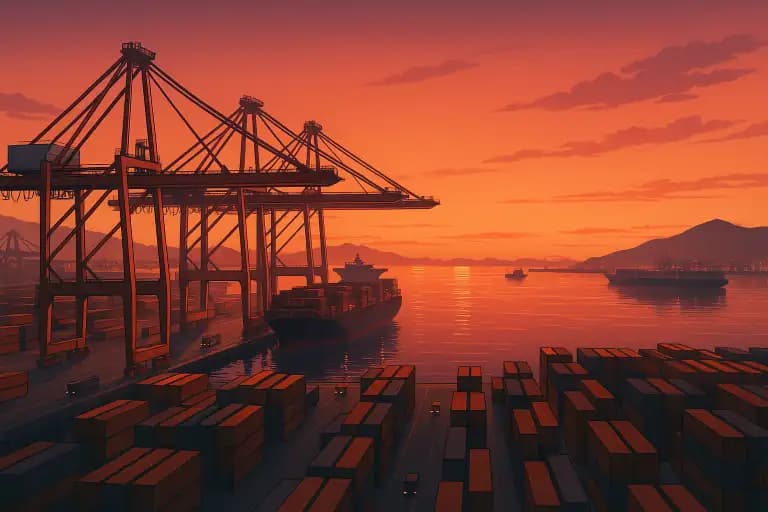
Busan, South Korea — In his first Cabinet meeting as president, Lee Jae-myung ordered the Ministry of Oceans and Fisheries to begin preparations for relocation to Busan, reaffirming one of the key regional pledges made during his campaign. The directive signals the administration’s intention to accelerate institutional restructuring around South Korea’s maritime and logistics sectors.
The proposed move aligns with broader efforts to strengthen Busan’s role as a global port city and maritime hub. In parallel, discussions are advancing around relocating the headquarters of HMM—South Korea’s largest container shipping line and one of the world’s top 10 ocean carriers. Both relocations are seen as part of a broader plan to consolidate governance, industry, and infrastructure closer to the country’s primary ports.
While the government cites efficiency and competitiveness as key drivers, the process faces internal friction. Labor unions have voiced strong opposition to the proposed changes, raising concerns about job disruption, corporate independence, and regional displacement. Nevertheless, state ownership stakes and policy momentum appear to be shifting the institutional balance toward implementation.
The initiative places Busan at the center of renewed national attention—poised not only as a gateway to international trade, but as a strategic node in South Korea’s evolving industrial map.
The proposal to relocate South Korea’s maritime leadership from Seoul to Busan was a centerpiece of President Lee Jae-myung’s regional platform during the 2025 presidential election, particularly aimed at voters in the southeastern coastal provinces. With record-high support in Busan and Ulsan—traditionally conservative regions—Lee’s victory reflected growing demand for decentralization and rebalancing of national development priorities.
Central to this agenda was the repositioning of key public institutions, including the Ministry of Oceans and Fisheries. The argument is twofold: proximity to the country's busiest ports would enable more responsive, field-oriented governance, and co-location with core maritime industries would drive policy coherence and industrial synergy.
The inclusion of HMM—a publicly controlled, yet publicly listed company—complicates the picture. Though technically a private firm, over 77% of its shares are held by public financial institutions, including Korea Development Bank (KDB), Korea Ocean Business Corporation (KOBC), and the National Pension Service. This structure gives the government significant informal influence over strategic decisions, including potential relocation.
The political logic is also spatial: despite being the world’s 8th-largest shipping nation by volume, South Korea’s maritime policymaking and shipping headquarters have remained concentrated in its inland capital. The Lee administration contends that realigning these assets toward Busan—a city home to the world’s 6th-busiest container port—would better reflect global logistical realities and enhance strategic coherence across ministries and markets.
The directive is now being shaped into policy by ministerial task forces, though inter-ministerial coordination and labor negotiations remain unresolved. Still, within the administration, the relocation is seen as a symbolic and structural correction long overdue.
Industrial Strategy and Maritime Realignment
At the core of the relocation effort lies a strategic industrial objective: to reinforce Busan’s status as South Korea’s primary maritime cluster and position the city as a global logistics powerhouse. For decades, the country’s maritime operations and regulatory command have been split between Seoul-based decision-making and Busan-based execution, a geographic dislocation increasingly seen as inefficient in an era of integrated supply chains and digitalized port operations.
Bringing HMM and the Ministry of Oceans and Fisheries closer to the docks is intended to resolve this administrative fragmentation. With Busan Port handling over 21 million TEUs annually and serving as a regional transshipment hub, the city offers both the volume and infrastructure to support a maritime-centered industrial strategy. The proximity is also expected to enhance operational agility, especially as shipping becomes more sensitive to environmental regulations, geopolitical risk, and technological disruption.
The move could accelerate the growth of related industries. Marine equipment supply chains, ship classification services, logistics IT firms, and port finance institutions—all currently distributed across different regions—would benefit from spatial consolidation. Analysts point to successful maritime clusters in Singapore and Rotterdam as models where physical proximity has produced measurable gains in innovation, investment, and policy coordination.
The Busan Institute of Industrial Science and Innovation (BISTEP) estimates the short-term economic ripple effect of the relocations at approximately ₩400 billion (USD 300 million), with long-term logistics cost savings reaching as high as ₩2.4 trillion (USD 1.8 billion) annually. These projections are based on anticipated reductions in inter-city administrative lag, enhanced intermodal efficiency, and new investment in port-adjacent real estate and infrastructure.
If realized, the relocations would not only deepen Busan’s maritime role, but also function as a test case for how South Korea might rebalance its economic geography—away from the concentration of capital and influence in Seoul, and toward specialized regional hubs with global relevance.
Maritime Green Transition and Energy Convergence
As global shipping faces mounting pressure to decarbonize, the relocation of maritime governance and industry to Busan places South Korea in a stronger position to align port operations with emerging environmental standards. The move coincides with—and in many ways supports—the government’s long-term strategy to develop the southeastern region as a center for green maritime innovation.
Just 60 kilometers northeast of Busan, the port city of Ulsan is constructing one of the world’s largest floating offshore wind complexes, targeting 6 gigawatts of generation capacity by the early 2030s. The project, led by a consortium of Korean and international firms, is not only intended to power regional cities and industrial facilities, but also to support the electrification and decarbonization of port logistics and maritime transport.
This regional ecosystem is being referred to in policy circles as the “Blue and Green Belt”—a fusion of maritime logistics, renewable energy infrastructure, and advanced shipbuilding concentrated across Busan, Ulsan, and Gyeongnam. The presence of Korea’s top shipbuilders in nearby Geoje and Tongyeong further strengthens the industrial logic. These firms are now increasingly focused on green vessel technologies, including hydrogen-powered ships, ammonia dual-fuel systems, and emissions monitoring platforms.
The Ministry of Oceans and Fisheries, once relocated, is expected to oversee tighter coordination between maritime environmental regulation, port development, and ship financing. Meanwhile, public entities such as Korea Ocean Business Corporation are rolling out new financial instruments tailored to green maritime projects, including transition bonds and decarbonization-linked loans.
Internationally, South Korea seeks to secure its position as a leader in clean port technology—joining efforts such as the Clydebank Declaration and the Green Shipping Challenge. Domestically, the convergence of administrative, industrial, and research capacities in one geographic corridor may enable South Korea to accelerate the development of scalable, exportable solutions.
By consolidating maritime governance and operations near renewable energy generation sites and innovation clusters, the relocations may serve not only as an economic rebalancing, but as a spatial foundation for climate resilience and global competitiveness.
Resistance, Risk, and the Limits of Relocation
Despite the strategic framing of the relocations, the path to implementation is far from unopposed. The HMM land-based workers’ union has expressed firm resistance, calling the government’s relocation efforts politically motivated and operationally unsound. Their concerns center on three key issues: employment disruption, loss of strategic autonomy, and the potential erosion of corporate competitiveness.
HMM’s labor union argues that a wholesale move to Busan would result in unnecessary fragmentation of teams, weakening both internal efficiency and customer relationships with international clients, most of whom maintain offices in Seoul or overseas. They further contend that the company’s partial privatization status should shield it from political directives that interfere with business decisions. In a public statement, the union denounced the relocation as "a form of political coercion that undermines shareholder value and managerial independence."
These concerns have gained some traction among corporate governance experts, who caution that relocating the headquarters of a publicly traded company—despite majority public ownership—risks setting a precedent that could destabilize investor confidence. HMM’s board of directors has so far avoided making definitive public commitments, opting instead to emphasize internal reviews and stakeholder consultations.
The Ministry of Oceans and Fisheries faces a different, but related, set of challenges. While many within the ministry support the move in principle, some civil servants express concern about organizational disruption, talent loss, and reduced coordination with other central agencies still located in Seoul. Skeptics point to the mixed outcomes of previous government relocation initiatives, such as the creation of Sejong Administrative City, which critics argue diluted inter-agency collaboration rather than enhancing it.
To address these tensions, the administration has proposed a phased relocation strategy, preserving certain overseas liaison and trade functions in Seoul while moving core operational, regulatory, and development teams to Busan. Still, the details remain vague, and no binding roadmap has been publicly released.
Without broad-based consensus among internal stakeholders, the relocations—though symbolically powerful—risk being perceived as forced administrative engineering rather than thoughtful structural reform.
Busan’s Emergence and the Politics of Strategic Geography
For Busan, the relocation of both the Ministry of Oceans and Fisheries and HMM is more than a logistical reshuffle. It is a chance to redefine its identity—from a port of throughput to a nerve center of maritime governance, climate strategy, and economic planning. The timing is notable: just two years after the city’s failed bid to host Expo 2030, this initiative offers a new platform for global relevance built on substance rather than spectacle.
Unlike past decentralization efforts that often stalled amid bureaucratic resistance and lackluster local integration, this move is backed by functional logic. Busan is not being offered symbolic offices; it is being positioned as the site where ocean policy, shipping strategy, and energy transition must increasingly intersect. It is an infrastructural correction long overdue, and one that aligns the geography of governance with the geography of activity.
Yet the transition is not only about Busan. It reflects a broader national recalibration—one in which Korea seeks to rebalance its economic topography, reduce overconcentration in Seoul, and build specialized regional ecosystems that can withstand global shocks. The "Blue and Green Belt" taking shape across Busan, Ulsan, and Gyeongnam is emblematic of this shift: not merely a cluster, but a strategic corridor for the post-carbon, post-globalization economy.
Still, geography alone does not guarantee success. Institutional alignment, labor consensus, regulatory agility, and global connectivity will all determine whether this relocation becomes a case study in effective structural reform—or yet another missed opportunity.
In a country defined by high-speed transitions and compressed development, the next chapter of South Korea’s maritime economy may very well be written not in Seoul’s towers, but along the industrial edge of the southern coast—where the land meets the sea, and strategy meets execution.
Continue this reporting
Reporting on the same issue
Related coverage selected from the article's desk, topics and newsroom relationships.
 NewsOct 22, 2026
Busan Port’s LNG and Methanol Plan: Who Pays to Keep Fuel Ready?
Busan already supplies ships with LNG and methanol, drawing on regional and i...
 NewsOct 16, 2026
What Is Still Worth Going to See?
Busan’s biennale faces questions of artistic judgment and institutional care....
 NewsOct 14, 2026
What Became of Busan’s University Streets?
From 2015 to 2023, registered businesses grew near Pusan National University...
More from the author
More from this byline
Stay with the same line of reporting through more work from this byline.
- NewsOct 22, 2026
Busan Port’s LNG and Methanol Plan: Who Pays to Keep Fuel Ready?
 NewsOct 12, 2026
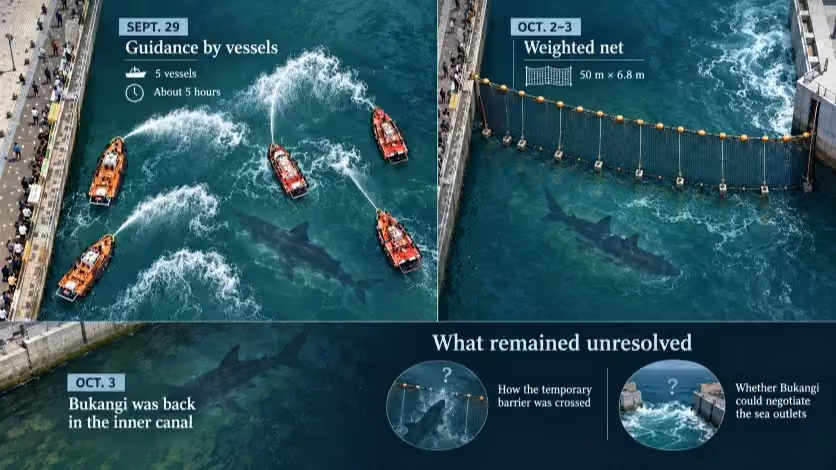
Bukangi, the Shark That Stayed in Busan’s North Port
Reader Signal
Community readWhat did this report leave you with?
Choose the signal that best reflects your reading. Select it again to remove it.
One response per article
No response selected
A moderated conversation about the reporting.
One-level replies and newsroom moderation keep the conversation anchored to this article.
Discussion Status
Open
Please sign in to join the discussion.
Newsletter
Weekly reporting and context from Busan and Korea.