Polestar Turns to Busan as Chinese Manufacturing Faces Western Scrutiny
Polestar’s financial constraints, narrowing U.S. product lineup, and exposure to evolving policy regulations make Busan a necessary adjustment rather than an expansionary move.


Busan, South Korea — Polestar’s gradual shift toward the Busan plant in South Korea has attracted growing attention, not because the factory itself has started to reshape the company’s global production structure, but because it reveals the tension inside a brand that has relied on China for most of its industrial capabilities while depending on Western markets for its revenue. What has emerged is less a story about an active export hub and more an illustration of how a mid-sized EV maker tries to create room for maneuver in a policy environment where the commercial and the geopolitical have become inseparable. Busan’s significance rests not on current output, which remains modest and largely unreported, but on the structural position it may occupy as Polestar attempts to remain viable in the United States and Europe without relying exclusively on Chinese production.
Polestar’s industrial identity has long been characterized by an imbalance. The brand broadcasts Scandinavian design and corporate origins, yet its manufacturing infrastructure is tied closely to Geely’s Chinese network. This was not considered an operational risk during the early years of the global EV transition, when scaling production quickly and minimizing capital expenditure were valued above all else. The situation changed as governments began to reassess the security implications of foreign production, data flows, and supply-chain control. The United States has introduced measures that do more than raise tariffs; they scrutinize the origin of software, hardware, and vehicle connectivity systems in ways that make Chinese-built cars difficult to sell in the country without additional complications. The European Union has taken its own steps, targeting the pricing structures and state support behind Chinese EVs. These developments expose Polestar’s dependence on a single geography and force the company to confront questions that previously could be postponed.
It is in this context that Busan entered the picture. The factory operated by Renault Korea has a long record of contract manufacturing, a labor force accustomed to adjusting for multiple brands, and established logistics links through the adjacent port. The partnership signed in late 2023 between Polestar, Geely, and Renault Korea lays out a plan for the Polestar 4 to be assembled there beginning in the second half of 2025. In the months following the agreement, the plant underwent EV-related upgrades and line modifications, details that appeared in Korean reporting and were acknowledged by the operator. The physical and contractual components of the project have therefore moved forward in a concrete way, and Polestar has begun to refer publicly to Busan as a future production site.
What remains absent, however, is evidence that Busan has already become a significant source of vehicles. Polestar has stated that initial units from the plant have been shipped to Canada, and these early shipments suggest the facility has begun pilot work. Yet the company’s regulatory filings still list only its Chinese plants and the Charleston, South Carolina facility as active production sites. There are no disclosed production volumes, no shipping statistics that point to sustained commercial exports, and no data on local supply-chain usage. This does not contradict the fact that early units have been assembled. Rather, it places those developments in their proper scale: they signal readiness, not yet operations of meaningful magnitude.
Understanding why Polestar presents Busan with such emphasis requires a look at its position in North America. The company’s sales in the region have weakened, and its model range has contracted. The Polestar 2, once its primary offering in the United States, is effectively exiting the market, leaving the Polestar 3 as the core model for the time being. The introduction of the Polestar 4 has been delayed, in part because the company has had to recalibrate its production strategy to reflect the regulatory climate. A large recall involving tens of thousands of vehicles added pressure to a brand already dealing with persistent financial losses. Under these circumstances, the company cannot justify large, capital-intensive production moves. It needs a manufacturing alternative that reduces regulatory exposure without requiring the construction of new facilities or long lead times. Busan fits that requirement.
The economic and industrial implications for the city of Busan are less immediate than the public narrative suggests. Although the plant has undergone technical upgrades, there have been no clear indications of substantial employment expansion tied directly to Polestar, nor has there been evidence of significant new orders for local suppliers. Export statistics from the adjacent port have not shown identifiable increases attributable to Polestar-related activity. This is consistent with the project’s current stage: preparation and limited initial production do not produce measurable economic effects, and the plant’s broader regional impact will depend on future production levels that are not yet known.
Some of the domestic reporting in Korea has framed Busan’s role in connection with adjustments in bilateral auto tariffs between Korea and the United States, implying that tariff changes might drive greater use of Korean plants for third-country exports. While tariff policy shapes the cost environment, the forces influencing Polestar are different. The brand faces structural exposure to Chinese manufacturing at a time when Western regulations increasingly penalize such linkages. The primary appeal of Busan for Polestar lies not in tariff differences but in its position outside the Chinese regulatory footprint, within an allied economy that participates in Western standards and has a mature EV ecosystem.
Looking ahead, Busan’s importance could grow. If Polestar eventually sources batteries or key components from Korean suppliers such as SK On, the combination of non-Chinese assembly and Korean-origin materials could help the company meet requirements related to subsidies or trade rules in the United States and Europe. The facility also offers a way to diversify production without dispersing the company’s operations across too many new sites, which would undermine the cost efficiencies of its current model. Whether these possibilities materialize depends on how aggressively the United States and Europe continue to regulate China-linked EV supply chains, how quickly Polestar can stabilize its finances, and how demand for premium EVs develops over the next several years.
At the moment, Busan occupies a space between aspiration and execution. The plant is ready to produce vehicles and has begun to do so in limited numbers. Its strategic value to Polestar is clear, yet its operational footprint remains largely theoretical until regular production and export volumes emerge. Treating Busan as a transformative development would misstate the current reality; dismissing it as symbolic would miss the pressures reshaping the company’s strategy. The most accurate reading is that Polestar is building options it previously lacked, and Busan is one of the few that can meaningfully address its regulatory exposure without compromising its financial constraints.
The real measure of Busan’s role will come not from announcements or early shipments but from sustained activity: consistent production cycles, integration with Korean suppliers, identifiable flows through North American customs, and clearer statements in the company’s filings. Until those indicators appear, Busan should be seen as a necessary adjustment in a tightening global environment—a production foothold designed to preserve market access at a time when geography has become a decisive commercial variable. Its long-term significance remains open, shaped by regulatory trends and the company’s ability to convert strategic positioning into lasting operational scale.
Continue this reporting
Reporting on the same issue
Related coverage selected from the article's desk, topics and newsroom relationships.
 NewsOct 22, 2026
Busan Port’s LNG and Methanol Plan: Who Pays to Keep Fuel Ready?
Busan already supplies ships with LNG and methanol, drawing on regional and i...
 NewsOct 16, 2026
What Is Still Worth Going to See?
Busan’s biennale faces questions of artistic judgment and institutional care....
 NewsOct 14, 2026
What Became of Busan’s University Streets?
From 2015 to 2023, registered businesses grew near Pusan National University...
More from the author
More from this byline
Stay with the same line of reporting through more work from this byline.
- NewsOct 22, 2026
Busan Port’s LNG and Methanol Plan: Who Pays to Keep Fuel Ready?
 NewsOct 12, 2026
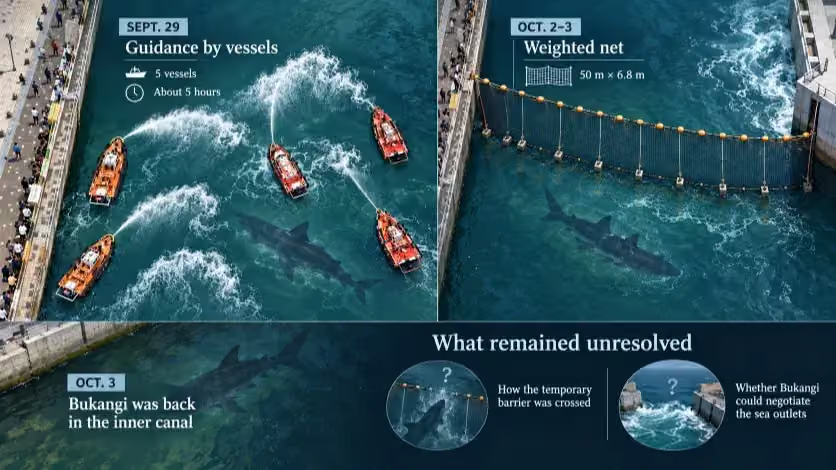
Bukangi, the Shark That Stayed in Busan’s North Port
Reader Signal
Community readWhat did this report leave you with?
Choose the signal that best reflects your reading. Select it again to remove it.
One response per article
No response selected
A moderated conversation about the reporting.
One-level replies and newsroom moderation keep the conversation anchored to this article.
Discussion Status
Open
Please sign in to join the discussion.
Newsletter
Weekly reporting and context from Busan and Korea.