Korea’s shipbuilders navigate change at KORMARINE 2025
Busan’s showcase reflects a sober transition for the maritime industry, with Korean yards focusing on resilience, digital design, and strategic balance between the U.S. and China.

Busan, South Korea — Busan’s KORMARINE 2025 opened this week amid one of the sharpest transitions the global shipbuilding industry has seen in decades. The four-day exhibition at BEXCO has drawn more than a thousand companies from forty nations. Yet behind the scale lies a more intricate reality — an industry caught between decarbonization, digital transformation, and a new geopolitical order that is reshaping maritime power.
Global ship orders have fallen to about sixty million gross tons by September, less than half last year’s level. Even so, Korean shipyards have lifted their share to roughly a quarter of total orders. The recovery has come not from higher volume but from concentration on high-value, low-carbon, and technically complex vessels. In LNG carriers, container ships, and offshore platforms, Korea is once again competing through design intelligence rather than output.
The newly introduced Next Energy pavilion inside BEXCO illustrates this shift. HD Hyundai presented an AI-based design system for energy-efficient hulls; Samsung Heavy Industries showcased cryogenic and hybrid propulsion systems; Hanwha Ocean unveiled its ammonia gas-turbine engine and wind-assisted propulsion device. The tone was measured, not promotional: the industry is preparing for a carbon-regulated era where competitiveness rests on propulsion technology, data integration, and automation.
A geopolitical narrative runs parallel. Shipbuilding has re-emerged as a strategic industry tied to energy security and alliance politics. The United States, wary of its dependence on Asian yards, is rebuilding domestic capacity through the SHIPS for America Act and new naval-production mandates. Korean firms are increasingly drawn into that effort: Hanwha Ocean has participated in U.S. Navy maintenance projects, and joint R&D channels are being mapped with American defense contractors. Korea now straddles two systems — supplying advanced engineering to Western allies while serving as a bridge between Western demand and Chinese industrial scale.
That balance is evident across KORMARINE’s halls. European participants promote digital navigation and green-fuel systems; U.S. delegations probe collaboration models linking Korean design expertise with Western financing; Japan quietly re-enters as a technology partner after years of silence. The atmosphere is pragmatic, reflecting an industry that has moved beyond expansionism. Shipbuilding now sits squarely at the junction of energy policy, trade architecture, and maritime security planning.
At home, the sector faces limits that temper confidence. Mid-tier yards remain thinly capitalized after years of consolidation. Large conglomerates shoulder heavy R&D costs and deliver increasingly complex vessels on narrow margins. Automation and digitalization have created demand for new technical talent that domestic labor supply cannot meet. Government initiatives in Busan and Ulsan — linking shipyards, universities, and technology institutes — aim to reinforce innovation capacity, but structural reform is slow and capital-intensive.
Korea’s position in the global hierarchy remains unusually strategic. With China facing tariff pressure and the United States pursuing re-industrialization, Korean shipbuilding operates between rival industrial regimes. It sells to both, often supplying technologies that neither side can easily replace — advanced LNG containment systems, hybrid propulsion modules, the software backbone of modern ship design. Executives admit that this leverage carries a cost: tighter political oversight and less room for commercial neutrality. A sudden policy swing in carbon pricing or green-fuel incentives could disrupt earnings faster than any market cycle.
Inside KORMARINE, that calculation is visible. Few speak about export volume; conversations revolve around stabilizing supply chains and securing domestic parts once sourced from China. The shift is from expansion to insulation — keeping order books steady, digitizing operations, and protecting margins in an unpredictable fuel market. Quiet meetings behind display booths focus on logistics and component pricing rather than new deals.
Competition today is measured less by price than by coordination. A shipyard’s edge depends on how effectively it links design software with regulation, how fast it can retool for a new emissions code, and how deftly it adapts to export-control rules. Korean managers increasingly see innovation without flexibility as a liability. What lies ahead is not another boom but a long test of resilience — whether Korea’s shipbuilders can preserve their technical lead while operating in a market driven as much by politics as by engineering.
Continue this reporting
Reporting on the same issue
Related coverage selected from the article's desk, topics and newsroom relationships.
 NewsOct 22, 2026
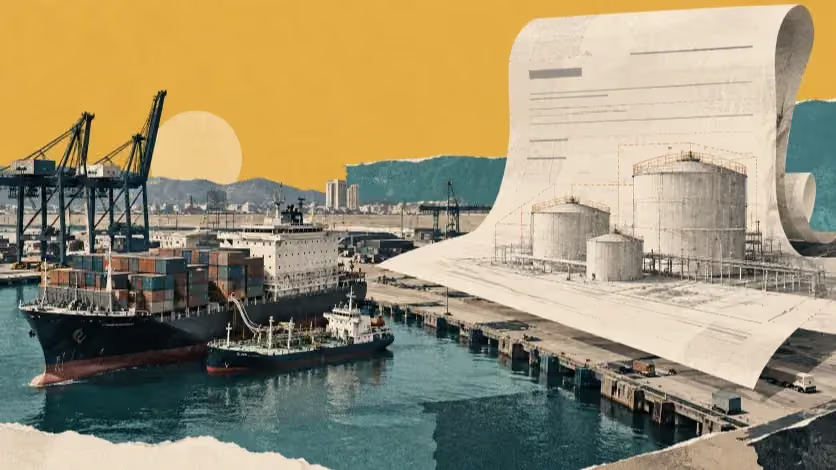
Busan Port’s LNG and Methanol Plan: Who Pays to Keep Fuel Ready?
Busan already supplies ships with LNG and methanol, drawing on regional and i...
 NewsOct 16, 2026
What Is Still Worth Going to See?
Busan’s biennale faces questions of artistic judgment and institutional care....
 NewsOct 14, 2026
What Became of Busan’s University Streets?
From 2015 to 2023, registered businesses grew near Pusan National University...
More from the author
More from this byline
Stay with the same line of reporting through more work from this byline.
- NewsOct 22, 2026
Busan Port’s LNG and Methanol Plan: Who Pays to Keep Fuel Ready?
 NewsOct 12, 2026
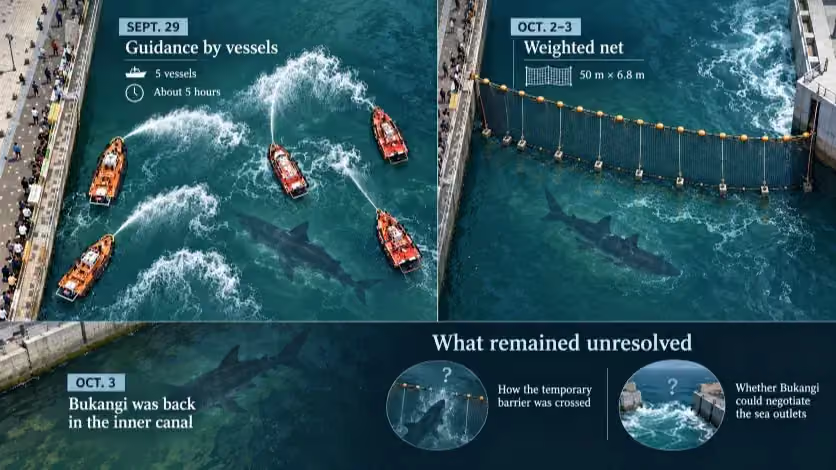
Bukangi, the Shark That Stayed in Busan’s North Port
Reader Signal
Community readWhat did this report leave you with?
Choose the signal that best reflects your reading. Select it again to remove it.
One response per article
No response selected
A moderated conversation about the reporting.
One-level replies and newsroom moderation keep the conversation anchored to this article.
Discussion Status
Open
Please sign in to join the discussion.
Newsletter
Weekly reporting and context from Busan and Korea.