Hwangnyeongsan Cable Car Plan Faces Questions Over Busan’s Strained Urban Mountain
Already reachable by road and trail, Hwangnyeongsan is being promoted for a paid tourism route even as old groundwater concerns, forest disease risks and long-term cable car demand remain unresolved.

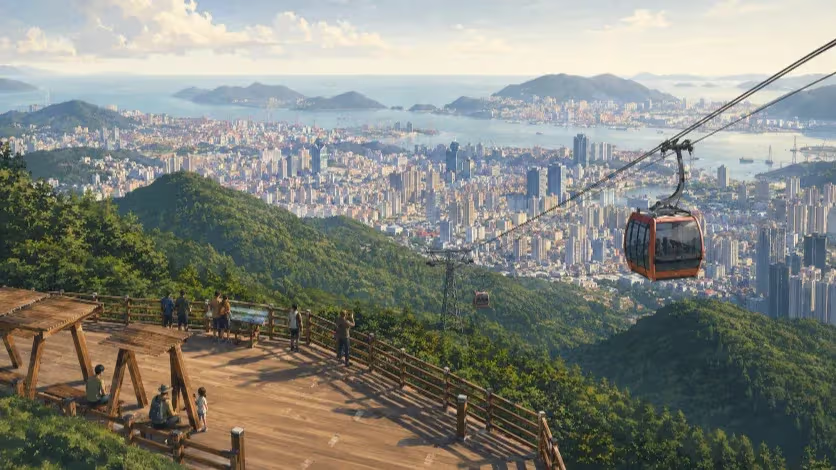
Busan’s central mountain is already reachable by road, trail and habit. The proposed cable car raises a deeper question: whether the city should add a paid tourism system to a mountain already strained by roads, housing pressure, groundwater decline and forest disease risks.
On clear evenings, Hwangnyeongsan Mountain already works like an attraction. Cars climb the road toward the lookouts. Hikers come up from Mangmi, Yeonsan, Yangjeong, Jeonpo and Daeyeon. Couples lean against railings for the night view, families stop for photographs, and residents who know the turns of the mountain road arrive without needing a map. From the ridge, Busan spreads out in the way only Busan can: towers and apartment blocks pressed into slopes, port lights in the distance, bridges cutting across black water, and neighborhoods gathered so close to the mountain that urban life and urban nature have become difficult to separate.
Ordinary familiarity sits at the center of the cable car debate. Hwangnyeongsan is not waiting to be discovered by a new transport system. The mountain is already part of the city’s daily geography, reached by road, by trail and by habit. A cable car would bring another way up, and perhaps a more marketable one, yet the project would also change the meaning of a place that has long been used without a ticket. The view that residents now reach through a drive, a walk or a climb would be reorganized into a paid sequence of boarding, ascent, photograph and descent.
Supporters of the project see an obvious tourism asset. Busan has spent years trying to turn scenery into longer stays, night-time spending and recognizable landmarks. Hwangnyeongsan offers a ready-made image: a central mountain, a wide city view, a skyline that can be sold to visitors in a few minutes. A cable car and a tall observatory would make that image easier to package. Tourism planners know the appeal of an attraction that can be named, priced, photographed and moved through quickly.
The mountain’s condition makes the argument less simple. Hwangnyeongsan has already absorbed roads, tunnels, residential edges, transmission facilities, recreational sites and spring-water facilities. It is neither untouched wilderness nor empty land. Earlier urban pressure does not make another layer of infrastructure harmless. A mountain already carrying the weight of the city may need a more careful form of investment than another fixed tourism machine.
Busan’s choice, then, is larger than a cable car. The city has to decide whether Hwangnyeongsan’s future should be built around selling the view more efficiently, or around repairing the public mountain that already gives that view away.
The project on the table
The current proposal is no small viewing deck. The plan that has moved through city procedures calls for a 125-meter observatory near the summit, designed around the image of the old beacon mound, and a first-phase cable car linking the observatory area with the Hwangnyeongsan Leisure Sports Park area in Jeonpo-dong, Busanjin-gu. A second-phase ropeway has also been pursued to connect the mountain toward the former Snow Castle area in Nam-gu. Taken together with related development plans, the project has been promoted as a large tourism package for the center of Busan.
That scale matters because the project is often discussed through a softer language of access, view and convenience. A cable car can sound like a simple improvement: another way for more people to reach a beautiful place. Hwangnyeongsan makes that description harder to accept without scrutiny. The mountain already has road access, hiking access, night-view demand and a place in the city’s leisure routine. A large paid system would not merely add a route. It would insert a commercial structure into a public mountain whose existing use is already dense and complicated.
The city and the developer therefore need to answer a more precise question than whether Hwangnyeongsan has tourism value. The mountain plainly does. The question is whether the proposed infrastructure is the best public answer to that value.
Access or paid view?
The road up Hwangnyeongsan changes the premise of the project before any environmental argument begins. Cable cars often gain public support when they promise access to places people cannot easily reach. Hwangnyeongsan starts from a different reality. The mountain stands inside the city, tied to surrounding neighborhoods by trails, roads and old routines of use. Residents already know where to park, where to walk, where to watch the lights come on and where the city opens below them.
Official tourism descriptions present the mountain in much the same way. Hwangnyeongsan is promoted as a downtown mountain, a hiking course and a night-view destination. The summit can be reached on foot, and the observatory area is associated with road access, parking and year-round views. The mountain’s appeal has never depended on remoteness. It comes from proximity. A resident can climb after work, drive up with relatives, stop briefly on a spring evening, or return to the same overlook in a different season.
That kind of access is imperfect, and a serious public policy would admit as much. A steep road is not universal access. A hiking trail is not enough for an elderly resident with bad knees. A night road without careful traffic management can become unsafe. A city that calls a mountain public has to think about people who cannot climb it or drive to it easily. The question is why that challenge should lead first to a cable car rather than to a wider repair of the access system already there.
A lower-impact approach would begin closer to the ground. Busan could strengthen transit links to trailheads, operate small electric shuttles at controlled times, improve lighting and emergency points, repair eroded paths, add accessible decks at selected viewpoints, manage summit parking more strictly and separate pedestrians from cars near the most crowded sections. These measures would not produce the same promotional image as a cable car cabin crossing the skyline, but they would address the actual ways people use the mountain.
A cable car would create a different kind of access. It would fix a commercial route into the mountain and attach a price to the experience of arrival. For a visitor with limited time, that may be convenient. For a tourism agency, it may be easy to market. For the mountain’s public life, the change is more consequential. Hwangnyeongsan’s value has grown from flexible, repeated, low-cost use: a walk, a drive, a lookout, a return. A ticketed ride would privilege a shorter and more concentrated form of consumption.
The economics of that consumption deserve attention. A cable car is easy to imagine before it is forced into a balance sheet. The cabin rises, the city opens, phones come out, and a familiar mountain becomes briefly unfamiliar from above. For a first-time visitor, the appeal is obvious. For a family showing relatives around Busan, the ride may feel like a convenient way to turn an evening view into a complete outing. For city officials and tourism promoters, the attraction is even clearer: a cable car is simple to name, simple to photograph and simple to place on an itinerary.
The harder part begins after that first ride. Hwangnyeongsan’s view is powerful, yet it is also fixed. The bridges do not move. The skyline changes slowly. The mountain offers different moods by season and weather, yet the cable car experience would still depend heavily on the same basic transaction: pay for ascent, look at Busan, take the picture, come down. That transaction can generate curiosity. Curiosity is a weaker foundation for a long-term public project.
Transport systems survive on repetition. People take the same subway, bus or road because they need to get somewhere again and again. A tourism ride works differently. Once the view has been consumed, repeat demand has to come from memory, guests, special occasions or new programming around the ride. Hwangnyeongsan already has the disadvantage of being reachable without that ticket. Anyone who wants the view can still walk, drive or arrive by a cheaper public arrangement if the city chooses to build one.
The price would shape the public meaning of the project. Cable cars are expensive to build, inspect, staff, insure, maintain and repair. Those costs usually appear at the ticket window. A ride priced for tourists may be tolerable as a one-time purchase; the same price becomes harder to defend as everyday access to a public mountain. A family fare turns the mountain into an outing with a bill. A citizen who once drove up for free or climbed after work begins to see the view through a commercial frame.
The strongest argument for caution begins here. Hwangnyeongsan is already open, known and used. A cable car proposal therefore has to prove more than convenience. It has to show why a paid system is a better public answer than repairing the mountain’s existing access, reducing the pressure of cars, improving trails and protecting the ecological systems that remain.
The record after the ribbon-cutting
South Korea’s recent cable-car record gives Busan enough evidence to ask harder questions before construction, rather than after ridership weakens. Cable cars have been built across coastal cities, mountain towns and river valleys with a familiar promise: a new view, a new landmark, a new reason for visitors to stay longer. Some have worked for a time. Some still do. The record after the ribbon-cutting is more uneven than the promotional language usually suggests.
Tongyeong remains the case every cable car proposal wants to borrow from. The city’s cable car became a national model because it drew large crowds, linked the mountain view to a recognizable tourism brand and generated real local attention. The example matters because it shows what success can look like. It matters more because even that success did not escape the slow pressure of declining novelty, competition and operating costs.
The company running Tongyeong’s tourism facilities returned to profit in 2024, reporting a net income of 352 million won after a difficult previous year. That figure can be read as a recovery, and local officials have described it as the result of emergency management and new revenue efforts. A stronger reading is less comforting for Busan: the country’s best-known success story had to fight its way back to a modest profit after demand weakened and expenses weighed on the balance sheet.
Newer projects offer a sharper warning. Uljin’s Wangpicheon Cable Car opened in 2020 and was promoted as a representative local tourism facility, yet the service was suspended in 2023 after the private operator ran into trouble. Uljin County later changed the operating structure, moving away from a model that handed the whole business to a private contractor in exchange for rent and toward a system in which the county retained revenue while paying a contractor for operation and service work. A cable car presented as a tourism asset had become an administrative problem.
Hadong and Myeongnyang point in the same direction. Recent reports have described accumulated losses at Hadong’s Geumosan Cable Car and heavy deficits at the Myeongnyang Marine Cable Car, both relatively new projects launched into a market already crowded with similar attractions. The numbers vary by operator, year and accounting method, but the pattern is harder to dismiss: opening a cable car is easier than keeping one financially useful after the first wave of visitors has passed.
A saturated market changes the meaning of a new project. A cable car once had scarcity value. A coastal or mountain city could promote the ride itself as something unusual. That advantage has thinned. Tourists now encounter similar promises across the country: ocean view, mountain view, glass cabin, night scenery, photo zone, local discount. When the form becomes common, the surrounding destination has to carry more of the burden. A cable car stops being the reason to travel and becomes one more item competing for time, money and attention.
Hwangnyeongsan would enter that market with an additional weakness. The mountain is already accessible. A visitor who pays for the ride would not be buying access to a previously unreachable place. The ticket would buy convenience, height, speed and a packaged version of a view that residents can already reach by road or trail. That difference should make Busan more cautious about any passenger forecast built on opening-year curiosity.
The public-risk question also needs to be asked before the project is built, not after an operator struggles. Cable cars require inspections, skilled staff, insurance, weather management, mechanical maintenance and eventual replacement of expensive parts. Strong wind, heavy rain or safety checks can close the service on days when tourists might otherwise come. A private operator may carry the business risk on paper, but the mountain, the skyline, the traffic, the complaints and the stranded infrastructure remain local when the numbers fall short.
Public contribution tied to profit sounds reassuring only if profit is durable and transparently measured. A project that promises to return a share of operating income to the public may produce little public return if ridership disappoints, costs rise or accounting reduces declared profit. The structure would still be there. The slopes would still have been altered. The lower station would still bring traffic. The city would still have to explain why a public mountain was used for a business whose public benefit depends on a surplus that may not appear.
Cable car proposals often look strongest before operations begin. At that stage, forecasts can treat future riders as a number and the view as an asset waiting to be activated. Years later, the story becomes less cinematic: ticket prices, staffing, repairs, weekday demand, seasonal gaps, bad weather, competing attractions and local resentment over traffic. South Korea’s experience does not prove that every cable car fails. It shows that the burden of proof has shifted. Busan should not be asking whether Hwangnyeongsan can attract riders in its first season. The city should be asking who will still pay, who will still benefit and who will carry the risk when the novelty is gone.
The older water problem beneath Hwangnyeongsan
Hwangnyeongsan’s water problem is older and deeper than a recent inspection table. The mountain’s springs and groundwater have already appeared in Busan’s development debates, especially in the 1990s, when reports described groundwater extraction, falling water levels and residents who feared that the mountain was losing the water they had relied on. That history does not prove that the cable car plan would deplete groundwater. It shows why groundwater should never be treated as a side issue when the mountain is again turned into a development site.
A spring-water test begins only after water can be collected. Busan’s 2025 inspection file does not show a mountain where every registered spring has failed. Across the city, most public spring-water facilities passed the latest listed tests, and several facilities in the Hwangnyeongsan–Geumnyeonsan belt were marked as suitable. That finding should be reported honestly. The more revealing line is the one that could easily be overlooked: one registered facility in Suyeong-gu was not tested because of insufficient water volume.
A spring that cannot be tested because there is not enough water tells a different story from a spring that fails a bacteria test. Contamination can sometimes be treated as an event: a sample fails, a warning is posted, a facility is disinfected, a later sample may pass. Low flow points to a slower change. It asks whether the mountain still holds and releases water in the way residents remember, whether dry periods have become longer, whether roads and paved surfaces have changed infiltration, and whether old spring sites are now surviving only as names on a public list.
The older record gives that question weight. In the mid-1990s, local reporting described groundwater sellers drawing hundreds of tons a day from the Hwangnyeongsan area while nearby residents complained that wells that once produced water at much shallower depths had begun to fail even after deeper drilling. Residents who depended on groundwater argued that the mountain’s water was already under stress, and the controversy over proposed development in the area became tied to a broader fear: that Hwangnyeongsan was being treated as a resource to extract before anyone had fully understood its underground system.
The parallel with the current cable car plan should be handled carefully. A cable car is not an old groundwater sales business or an attempted hot-spring development. It does not, by itself, imply mass extraction of groundwater. The relevant lesson is more basic. Hwangnyeongsan has a history in which development schemes and water anxiety have met before. A new tourism project on the same mountain should therefore disclose how construction, drainage, slope disturbance, road access and visitor facilities would affect runoff, infiltration and old spring-water sites.
A weak spring is also more vulnerable. Low flow can reduce dilution, leave water standing longer in aging facilities, and make a small source more sensitive to runoff, soil disturbance or nearby contamination. The relationship is not automatic, and Hwangnyeongsan needs local evidence before anyone draws a direct causal line. Still, water quantity and water quality should not be treated as separate files. A mountain losing reliable flow is already losing part of the system that once made its springs usable.
Official data can show whether a sampled facility passed on a given date. It cannot show how long the tap ran that day, whether hikers still fill bottles there, whether the signboard is current, whether water disappears in dry months, or whether former spring sites have quietly dropped out of use. Those are field questions. They require visits, photographs, seasonal checks and conversations with residents who have watched the mountain change.
For Hwangnyeongsan, that fieldwork matters more than a simple contamination claim. Old springs are evidence of how the mountain once functioned as more than scenery. They were places where residents stopped, rested, trusted a source of water and folded the mountain into ordinary life. When those sources weaken, the city loses something quieter than a forest clearing and harder to measure than a ticket sale.
A cable car should not be blamed for spring-water decline that predates the project. The stronger point is that a mountain with signs of weakening water systems deserves a hydrological account before another large tourism structure is added. Busan should be able to show where water still flows, where it has weakened, which facilities have been closed or removed from use, how road surfaces and drainage affect infiltration, and whether construction would change runoff or groundwater movement near old spring sites.
The spring-water record belongs in the cable car debate because it shifts the question from scenery to function. Hwangnyeongsan is not only a place to look from. It is a mountain that must hold soil, slow rain, release water, support trees and remain usable through heat, drought and heavy storms. A dry spring may not make a dramatic image. It may say more about the mountain’s future than another rendering of a cabin in the air.
Forest health before another attraction
The same caution applies to the forest above the springs. Pine wilt disease has long been part of Busan’s mountain history, and Hwangnyeongsan has not been outside that story. Diseased pines have been found and removed on the mountain before. Across Korea, warmer conditions, stressed trees and the movement of insect vectors have made pine forests harder to protect. A cable car project does not create that disease by itself. The point is different: an urban forest already under biological and climate pressure should not be treated as an empty frame for a new attraction.
Pine wilt is easy to misunderstand in an urban development debate. It does not produce the immediate visual drama of a landslide or a felled hillside. The damage appears tree by tree, then patch by patch, until a familiar ridge begins to thin. In a city like Busan, where mountains rise directly behind apartments, roads and schools, a sick forest is not a distant ecological concern. It changes shade, slope stability, walking routes, fire risk, landscape memory and the small climatic relief that urban trees provide during hot months.
Hwangnyeongsan’s trees already stand in a difficult place. The mountain is surrounded by heat, traffic, buildings and human movement. Soil is cut by paths and roads. Edges are exposed. Visitors concentrate at overlooks and popular routes. Maintenance vehicles, informal parking, stormwater runoff and past construction have all shaped the mountain’s condition. Forest disease enters that setting through a landscape that is already fragmented. Another construction project would have to be judged against that existing fragility, not against an idealized version of the mountain.
Tourism arguments often describe forests as scenery. Forest-health work begins from a less marketable premise: trees are infrastructure. They hold slopes, slow water, cool paths, shelter birds, filter air and make walking possible in a dense city. A cable car can pass above a forest and still depend on the forest below it for the experience being sold. If the ridge weakens, if dead pines spread, if slopes become hotter and drier, the view remains visible while the mountain becomes poorer.
A serious public plan for Hwangnyeongsan would therefore begin with forest condition, not with the silhouette of a cabin. The city should be able to show where pine wilt has appeared, how quickly infected trees were removed, which areas are being monitored, whether replacement planting uses more resilient native species, how construction routes would avoid spreading soil disturbance, and how visitor concentration would be managed around vulnerable slopes. Those questions are less glamorous than a tower rendering. They are closer to the mountain’s actual needs.
The case for ecological repair becomes stronger when water and forest are read together. Weak springs and stressed pines may not share a single cause, but they point toward the same policy failure when treated separately. A mountain can decline through many small absences: less water at a tap, fewer healthy trees along a path, more eroded ground after rain, more heat on an exposed slope, more signs telling citizens what they can no longer use. Development debates usually notice the large object being proposed. Urban nature often disappears through quieter losses.
The next phase of the debate should therefore require a forest-health account alongside any tourism account. Ridership forecasts, job estimates and projected visitor spending cannot be the only numbers on the table. Busan should disclose the condition of the forest, the history of disease control, the expected impact of construction and maintenance routes, the plan for native restoration, and the long-term cost of keeping the mountain healthy after the attraction opens. A view can be sold quickly. A forest has to be kept alive slowly.
A quieter way to open the mountain
Access is the strongest argument available to the cable car proposal, and it should not be dismissed too easily. A public mountain cannot belong only to people who are fit enough to climb it or wealthy enough to drive to it. Older residents, people with disabilities, visitors without cars and families carrying children all have a claim to Hwangnyeongsan’s view. A city that treats the mountain as public has to make that claim real.
The policy mistake would be to confuse access with a cable car. Hwangnyeongsan already has an access system, uneven and imperfect, built from roads, trails, parking areas, informal routes, neighborhood knowledge and repeated use. That system needs repair. Some paths are tiring, some approaches are poorly marked, some night movements depend too much on cars, and summit traffic can crowd the very places people go to breathe. A cable car would bypass parts of that disorder. It would not necessarily solve it.
A repair-first plan would be less cinematic than a cable car, but more administrative and more durable: transit links, electric shuttles, accessible lookouts, trail repair, groundwater monitoring, pine-wilt surveillance and stricter management of summit traffic. Trailheads could be made safer and easier to find. Lighting could be improved without turning the ridge into a theme-park outline. Eroded paths could be repaired with materials that slow runoff and protect soil. Selected viewpoints could be rebuilt as accessible decks, with seating, shade and clear emergency information. Bus and metro links could be tied to small electric shuttles on limited routes and hours, especially for older visitors and people who cannot climb.
Such work lacks the drama of a cabin moving across the skyline. It also avoids the weakness of a single expensive attraction. Trails, shuttles, decks, signs, water monitoring and forest restoration can be adjusted over time. If one route becomes crowded, the city can shift use. If a spring fails, it can be closed, restored or marked honestly. If pine-wilt damage appears, management can respond before the ridge is reduced to scenery around a failing forest. Ecological access treats Hwangnyeongsan as a living system rather than a fixed viewpoint to be packaged.
The tourism value of that approach is easy to underestimate. Visitors do not come to cities only for machines that lift them above the ground. Many now look for places that feel specific, walkable and rooted in local life. Hwangnyeongsan already has that quality. Its strength is not only the view from the top, but the way the mountain sits among neighborhoods, roads, old spring-water sites, small paths and repeated habits. A better tourism policy could make those layers legible instead of replacing them with a single commercial ascent.
Busan could build an urban-ecology route around the mountain’s existing character. A visitor might arrive by metro, take a small shuttle to a lower trailhead, walk a short accessible section to a viewing deck, read about the beacon mound and the city’s nightscape, learn why some springs no longer flow, and see how pine forests are being monitored and restored. Residents would gain the same improvements without being pushed into a ticketed ride. The mountain would still attract visitors, but the attraction would come from care, not spectacle.
The approach would also fit the condition of the city. Busan is dense, coastal and mountainous. Its best landscapes are often the ones already under pressure from housing, roads, tourism and climate. A policy that keeps adding visible attractions to those landscapes may produce short-term images while leaving the underlying systems weaker. A policy of ecological access would ask a different question: how can more people reach the mountain while reducing the damage caused by reaching it?
That question is more demanding than a cable car rendering. It requires traffic management, maintenance budgets, field surveys, forest-health monitoring, disability access design, resident consultation and a willingness to invest in improvements that will not dominate a skyline. Yet those are the responsibilities that come with a public mountain already used by so many people. Hwangnyeongsan does not need to become less accessible. It needs access that does not make the mountain pay for every visitor with another layer of pressure.
What Busan chooses to protect
Hwangnyeongsan will remain a viewpoint with or without a cable car. The mountain does not need a cabin in the air to make the city visible. Busan is already there from the ridge: the apartment slopes, the port lights, the bridges, the dense neighborhoods, the coastline that gives the city its beauty and its pressure at the same time. The question before the city is not whether the view has value. That has never been in doubt. The question is what kind of value Busan is willing to protect.
A cable car would give the city a visible answer. It would turn the mountain into a clearer tourism product, easier to sell, easier to photograph, easier to place in a brochure. It would create a new route, a new ticket, a new count of riders and a new claim of investment. Modern cities often prefer that kind of answer because it can be displayed. A cabin moving above the trees looks like policy in motion. A restored spring, a repaired trail, a healthier pine stand, a safer walk after sunset and a quieter summit road do not carry the same visual force. They ask the public to value maintenance, restraint and care.
Busan has already used the mountain for decades. It has used it as scenery, as a road, as a night-view platform, as a place for exercise, as a backdrop for apartments, as a corridor for infrastructure and as a convenient symbol of urban nature. The city’s debt to the mountain is not abstract. It can be read in the road cuts, the worn paths, the old spring-water sites, the traffic near popular lookouts, the forest disease risks and the uneasy closeness between residential life and mountain slope. A cable car would not arrive on empty ground. It would arrive after all of that.
Tourism policy often struggles with slow loss. A city can count ticket sales faster than it can count the disappearance of ordinary use. It can forecast riders more easily than it can measure the value of a free evening drive with an elderly parent, a familiar path after work, a spring that once shaped neighborhood memory, or a mountain road that still belongs to residents rather than visitors moving through a paid attraction. Those uses do not always appear in feasibility studies. They are still public value.
Hwangnyeongsan should force Busan to separate tourism from extraction. Tourism can support a city when it deepens local life, funds maintenance, widens access and makes visitors more attentive to the place they enter. Tourism becomes thinner when it takes an existing public asset, packages the easiest part of it and leaves the harder work of repair outside the frame. The view from Hwangnyeongsan is easy to package. The mountain itself is harder to care for.
The decision will say more than whether Busan wants a cable car. It will show whether the city understands the difference between access and monetization, between a landmark and a living landscape, between using nature as a stage and caring for it as civic infrastructure. Hwangnyeongsan is already open. The harder task is keeping it public, healthy and ordinary enough to be returned to again and again.
Busan may still decide that a cable car is worth the cost. If it does, the burden of proof should be far higher than promotional language about night views and landmark tourism. The city should show how the project will reduce existing traffic rather than add to it, how fares will not turn access into a luxury experience, how spring-water and forest-health risks will be monitored, how public contribution will be protected if profits fall, how residents will be shielded from congestion, and how the mountain will be restored rather than simply used.
Until those answers are clear, Hwangnyeongsan points toward a different future. The mountain does not need to be made spectacular. Busan has already done enough of that. It needs to be treated as a public landscape that has given the city more than it has received in return. A cable car would sell the view. Ecological repair would ask what the city owes the mountain after generations of looking from it.
Continue this reporting
Reporting on the same issue
Related coverage selected from the article's desk, topics and newsroom relationships.
 NewsOct 16, 2026
What Is Still Worth Going to See?
Busan’s biennale faces questions of artistic judgment and institutional care....
 NewsOct 14, 2026
What Became of Busan’s University Streets?
From 2015 to 2023, registered businesses grew near Pusan National University...
 NewsOct 12, 2026
Bukangi, the Shark That Stayed in Busan’s North Port
A rescue net guided Bukangi toward the sea, but the dusky shark returned to B...
More from the author
More from this byline
Stay with the same line of reporting through more work from this byline.
- NewsOct 14, 2026
What Became of Busan’s University Streets?
 NewsSep 28, 2026
Why Some Commercial Space in Busan Is Hard to Reuse
Reader Signal
Community readWhat did this report leave you with?
Choose the signal that best reflects your reading. Select it again to remove it.
One response per article
No response selected
A moderated conversation about the reporting.
One-level replies and newsroom moderation keep the conversation anchored to this article.
Discussion Status
Open
Please sign in to join the discussion.
Newsletter
Weekly reporting and context from Busan and Korea.