How Busan's New Concert Hall Will Shape the City's Cultural Identity
More than an architectural feat, the Busan Concert Hall signals the city’s most ambitious step yet toward cultural decentralization — but the real test will be whether it can fill its seats year after year.

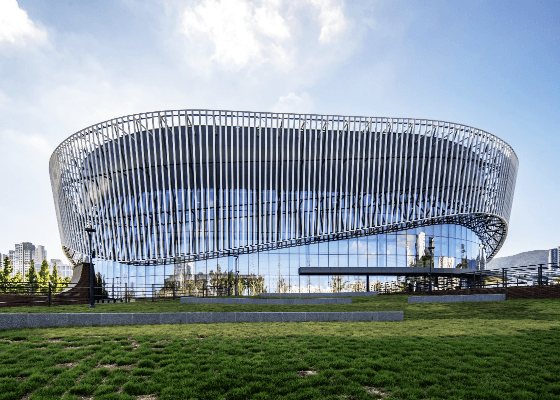
Busan, South Korea — On June 20, South Korea’s second-largest city will inaugurate the Busan Concert Hall, its first-ever dedicated classical music venue. Housed within the expansive Busan Citizens Park—once home to the former U.S. military base Camp Hialeah—the concert hall is more than an architectural milestone. It is a declaration of the city’s cultural ambition, a signal that Busan seeks to redefine its identity not just as a port city or a cinematic hub, but as a living stage for world-class music.
The facility boasts a 2,011-seat vineyard-style auditorium, a 400-seat chamber hall, and a 4,423-pipe Freiburger pipe organ—an unprecedented addition outside the Seoul metropolitan area. Designed as a “non-amplified theater,” the venue’s state-of-the-art acoustics and adjustable stage modules aim to offer an optimal listening environment that rivals Europe’s most prestigious concert halls. Early reviews from musicians who participated in spring preview concerts were effusive, with praise directed at both the hall’s sonic clarity and architectural openness.
Yet the true significance of the Busan Concert Hall lies not in its bricks and mortar, but in what it represents: a city attempting to build a sustainable ecosystem for classical music and cultural life. For decades, Busan’s musical infrastructure has lagged behind, despite a wealth of talent trained at institutions like Pusan National University and Kyungsung University. Many graduates have historically migrated to Seoul or overseas, citing limited performance opportunities and inadequate venues.
The hall’s launch comes as part of a broader strategy to shift this trajectory. Managed by the nonprofit Classic Busan, the concert hall is positioned as a civic platform rather than an elitist enclave. Community outreach initiatives—including lecture concerts, outdoor performances, and open rehearsals—are being introduced to cultivate a diverse audience base. This conscious pivot from passive venue to active cultural catalyst is viewed by observers as critical to the hall’s long-term viability.
Interest appears promising. All preview concerts held between April and May sold out in under two minutes. The hall’s online platform has already attracted over 17,000 members, 25% of whom reside outside Busan, indicating significant regional and national appeal. Still, questions remain over whether the novelty will sustain momentum, or whether Busan will follow the path of other regional cities where cultural infrastructure projects, once heralded, fell into disuse due to insufficient engagement and programming.
Lessons from abroad offer insight. Hamburg’s Elbphilharmonie in Germany, Sapporo’s Kitara Hall in Japan, and South Korea’s own Tongyeong Concert Hall have all successfully tied artistic excellence to community engagement. The key to their endurance lies in sustained educational outreach, dynamic curation, and institutional support that makes classical music accessible beyond the concert-going elite.
Busan’s moment is auspicious. As Korean musicians like pianist Cho Seong-jin and conductor Myung-Whun Chung gain international renown, the demand for decentralized infrastructure has become urgent. The upcoming 2027 opening of the Busan Opera House, with its 1,800-seat theater and elevated public space, is poised to complement the concert hall and consolidate Busan’s position as a cultural destination. However, experts caution that facilities alone do not create cultural life; people do.
The architectural transparency of the Busan Concert Hall—its glass walls that expose the stage from the outside, its integration with the park’s public space—is more than aesthetic. It is a metaphor for an institution seeking openness over hierarchy. Ticket pricing is designed to be accessible; education programs are aimed at schools and civic groups; and future plans include artist residencies and new commissions by Korean composers.
Behind these initiatives is a question of identity. Can Busan, a city with an industrial legacy and a globally known film festival, become a classical music hub as well? Will the concert hall nurture new audiences who see classical performance not as a distant luxury but as a meaningful part of urban life? Will it support the careers of local musicians who no longer feel they must leave to be heard?
While the opening concert, led by artistic director Chung Myung-Whun and featuring Asia Philharmonic Orchestra and renowned soloists, will no doubt attract headlines, the hall’s success will not be measured in marquee names alone. It will depend on whether the venue becomes embedded in the city’s cultural rhythm—serving not just visitors, but residents.
Busan has built the walls, tuned the strings, and raised the baton. What comes next is the slow and necessary work of listening—of cultivating a community not just for sound, but for shared experience. In the long arc of cultural development, the concert hall is not an end, but a beginning.
Continue this reporting
Reporting on the same issue
Related coverage selected from the article's desk, topics and newsroom relationships.
 NewsOct 22, 2026
Busan Port’s LNG and Methanol Plan: Who Pays to Keep Fuel Ready?
Busan already supplies ships with LNG and methanol, drawing on regional and i...
 NewsOct 16, 2026
What Is Still Worth Going to See?
Busan’s biennale faces questions of artistic judgment and institutional care....
 NewsOct 14, 2026
What Became of Busan’s University Streets?
From 2015 to 2023, registered businesses grew near Pusan National University...
More from the author
More from this byline
Stay with the same line of reporting through more work from this byline.
- NewsOct 22, 2026
Busan Port’s LNG and Methanol Plan: Who Pays to Keep Fuel Ready?
 NewsOct 12, 2026
Bukangi, the Shark That Stayed in Busan’s North Port
Reader Signal
Community readWhat did this report leave you with?
Choose the signal that best reflects your reading. Select it again to remove it.
One response per article
No response selected
A moderated conversation about the reporting.
One-level replies and newsroom moderation keep the conversation anchored to this article.
Discussion Status
Open
Please sign in to join the discussion.
Newsletter
Weekly reporting and context from Busan and Korea.