How Busan’s ‘Busan Is Good’ Branding and Design Agenda Shaped City Policy
Mayor Park Heong-joon’s administration has leaned heavily on the language of design and global recognition. From Busan is Good to World Design Capital 2028, the city has promoted its image abroad while struggling to deliver measurable improvements in transport, housing, or jobs.

Busan, South Korea — Busan has spent the past four years placing its name on global stages with slogans and designations that sound impressive at first glance. The city won the title of World Design Capital 2028, rolled out the “Busan is Good” brand, and declared itself an English-friendly and 15-minute city. Each initiative was presented as proof that Busan is becoming an international hub. Yet as the next local election approaches, the question is not how the city looks on paper but how these policies have altered life for residents.
The record shows a sharp divide. On one side are branding exercises—AI-translated press releases, festivals designed to attract short-term attention, and international design campaigns. On the other are persistent realities: a shrinking population, an aging workforce, uneven development between east and west, and local economies that continue to rely on apartment construction and central government projects rather than municipal planning.
This contrast defines Mayor Park Heong-joon’s administration. His term has been marked less by structural reforms than by the pursuit of image. The evaluation of his leadership now rests on whether those images carry weight beyond press conferences and ceremonial titles.
An examination of City Hall’s official communications during Mayor Park Heong-joon’s term reveals a striking pattern. A disproportionate share of press releases has revolved around design. From the launch of the Busan is Good slogan to the repeated promotion of the World Design Capital 2028 title, the word “design” has been a constant presence. Announcements about public design awards, architecture exhibitions, and branding campaigns have filled the city’s news cycle.
The volume of such releases is not in itself a problem; global recognition in design can enhance a city’s profile. But the imbalance is telling. While public communication has been saturated with design-oriented rhetoric, far less attention has been given to structural challenges: how to address shrinking neighborhoods, how to sustain small businesses outside the eastern coastal districts, or how to diversify the industrial base beyond construction and logistics.
The design narrative has also remained vague. Press releases highlight international forums, exhibitions, and titles, but rarely include measurable indicators or timelines. There is little evidence of how these initiatives will affect housing quality, transport accessibility, or job creation. For many residents, the repeated invocation of “design” has become synonymous with image management rather than governance.
This emphasis has shaped the identity of the current administration. It has cultivated the impression of a city branding itself for outside audiences, but in doing so has exposed the absence of detailed plans for the problems visible at street level. The press record suggests a government more comfortable speaking in the language of design than confronting the less photogenic demands of urban policy.
The 15-minute city was introduced as a framework to ensure residents could reach schools, clinics, and cultural facilities within a short walk or bicycle ride. The city announced pilot zones and opened several multi-use spaces under this banner. In practice, traffic congestion and limited public transport coverage remain unchanged. For most neighborhoods, daily commutes and access to services still exceed the promised threshold. The program exists more in brochures than in infrastructure.
The English-friendly city followed a similar pattern. City Hall launched an AI-based service that publishes English versions of press releases and promoted television segments in English as signs of progress. Yet the initiative has not extended to hospitals, local offices, or transit systems where foreign residents and visitors most often need support. Surveys indicate many citizens view the policy as inconvenient rather than helpful, and civic groups have criticized it as a distraction from more pressing administrative needs.
Both cases reveal a common strategy: ambitious branding supported by selective projects, but little structural change. The policies are visible in announcements and media, less so in the routines of those who live in the city.
Busan’s ambition to become a global marine hub has been a constant refrain, but the driving force comes from Seoul rather than City Hall. The Lee Jae-myung administration placed the relocation of the Ministry of Oceans and Fisheries to Busan on its national agenda in mid-2025. A relocation support team was formed, and central government statements have confirmed the move as a matter of policy.
For Mayor Park Heong-joon, the announcement has been framed as a civic victory, evidence that Busan is taking its place as a maritime capital. The reality is more limited. The city’s role has been to provide logistical assistance and to prepare office space, while the political momentum rests with the national government. Opposition lawmakers have condemned the plan as rushed and politically motivated, and surveys show that most ministry staff oppose leaving Sejong.
The outcome is almost certain—relocation will proceed and Busan will host the ministry. Yet the process underscores how little authority the municipal government holds in shaping strategic industries. When the mayor claims this as an accomplishment of his administration, the credit does not align with the facts. The marine hub narrative may enhance the city’s image, but the decisions that matter are being made elsewhere.
The administration often points to investment and employment figures as proof of progress. In mid-2025 officials highlighted that foreign direct investment in Busan exceeded six hundred million dollars in the first half of the year, with the Busan-Jinhae Free Economic Zone surpassing its annual target by May. The figures are accurate, but the context is less reassuring. Much of the increase came from a small number of large-scale projects, including a data center development backed by multinational firms. The result is that the headline numbers mask the narrow base of activity.
Employment statistics tell a similar story. The city celebrated record numbers of salaried workers and a high employment rate, but these gains follow national trends of recovery and demographic shifts rather than local reforms. Long-standing challenges—youth job insecurity, reliance on construction, and the decline of shipbuilding—remain unresolved. The administration’s initiatives have not produced new growth sectors strong enough to offset these structural weaknesses.
The gap between rhetoric and substance again appears. The mayor presents investment totals and job counts as achievements of city policy, when in practice they depend heavily on global market cycles and central government incentives. Without a clearer plan to diversify industries or retain younger workers, the gains risk being temporary.
While the administration speaks of balanced development, the divide between east and west Busan has deepened. The eastern districts, anchored by Haeundae and Gwangalli, continue to dominate the city’s tourism economy. International conferences, luxury hotels, and established nightlife ensure a steady flow of visitors. By contrast, the western shoreline, despite its long beaches and open spaces, relies on seasonal events that generate publicity but little lasting change.
The case of Dadaepo illustrates the problem. The city invested in festivals branded as wellness and music tourism, complete with headline acts and LED performances. Crowds arrived for the weekends, but once the events ended the area returned to its usual pattern: limited foot traffic, aging infrastructure, and small businesses struggling with thin margins. Local traders speak of temporary boosts followed by months of decline.
At the same time, older districts across the city continue to lose residents. Young families move to new apartment complexes in the west, but these developments add little beyond housing stock. Industrial corridors along the Nakdong River reinforce the sense of separation, leaving traditional neighborhoods more isolated.
The pattern is familiar: high-profile events and large housing projects substitute for sustained planning. The imbalance between east and west persists, and the city’s population continues to shrink. These conditions weigh more heavily on daily life than any of the slogans promoted by City Hall.
As Busan prepares for another election cycle, the record of the past four years comes into clearer view. The city has accumulated slogans and international titles, and it has presented investment figures that look impressive in isolation. Yet the daily realities of residents tell a different story: population decline, uneven development, reliance on central government initiatives, and limited progress in diversifying the local economy.
Mayor Park Heong-joon has governed with an emphasis on visibility. Designations such as World Design Capital and programs branded as English-friendly or 15-minute initiatives have been useful for promotion but thin on delivery. Even the most consequential development, the relocation of the Ministry of Oceans and Fisheries, is the result of national policy rather than municipal planning.
The administration’s legacy will be judged less by how often Busan appeared in international press releases than by what has changed on the ground. For many residents, the answer is not enough. The city’s challenges—aging demographics, the east–west divide, industrial stagnation—remain largely intact. The next phase of leadership will require more than image; it will demand structural work that the current term has yet to provide.
Continue this reporting
Reporting on the same issue
Related coverage selected from the article's desk, topics and newsroom relationships.
 NewsOct 22, 2026
Busan Port’s LNG and Methanol Plan: Who Pays to Keep Fuel Ready?
Busan already supplies ships with LNG and methanol, drawing on regional and i...
 NewsOct 16, 2026
What Is Still Worth Going to See?
Busan’s biennale faces questions of artistic judgment and institutional care....
 NewsOct 14, 2026
What Became of Busan’s University Streets?
From 2015 to 2023, registered businesses grew near Pusan National University...
More from the author
More from this byline
Stay with the same line of reporting through more work from this byline.
- NewsOct 22, 2026
Busan Port’s LNG and Methanol Plan: Who Pays to Keep Fuel Ready?
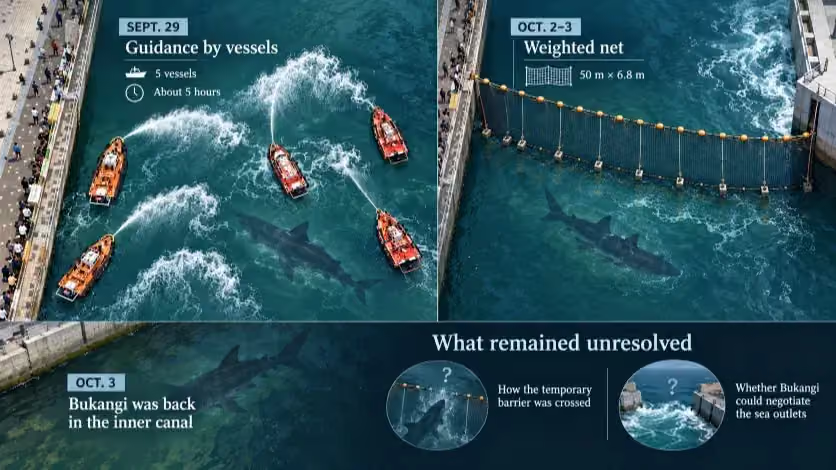 NewsOct 12, 2026
Bukangi, the Shark That Stayed in Busan’s North Port
Reader Signal
Community readWhat did this report leave you with?
Choose the signal that best reflects your reading. Select it again to remove it.
One response per article
No response selected
A moderated conversation about the reporting.
One-level replies and newsroom moderation keep the conversation anchored to this article.
Discussion Status
Open
Please sign in to join the discussion.
Newsletter
Weekly reporting and context from Busan and Korea.