HMM Headquarters Move to Busan Tests Korea’s Maritime Capital Ambition
HMM’s planned relocation from Seoul to Busan is a major win for Korea’s largest port city. But the real test is whether strategic functions, senior talent and maritime decision-making power move with the registered headquarters.

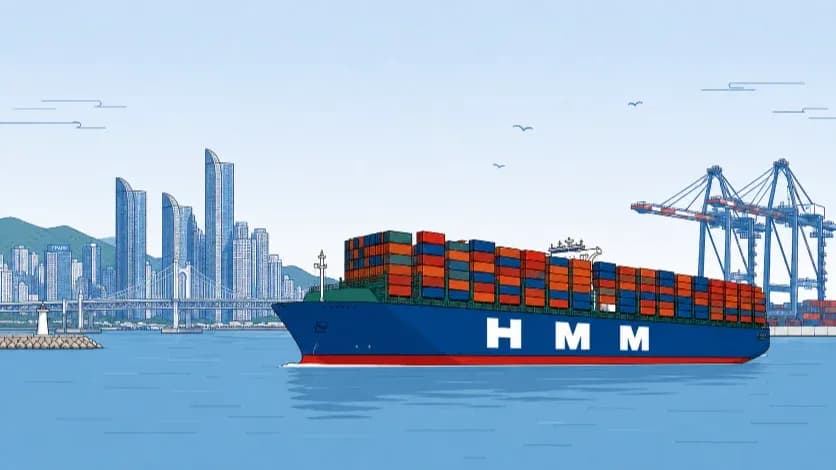
South Korea’s largest shipping line is preparing to move its registered headquarters from Seoul to Busan. The relocation is legally real and politically significant, but the harder test is whether the city gains the strategic authority that turns a port into a maritime capital.
Busan has spent decades calling itself South Korea’s maritime capital, and the claim has never been empty. The city has the port, the cranes, the terminals, the ship calls and the cargo volumes to make the title sound plausible. Much of Korea’s seaborne trade already passes through its waterfront. What Busan has lacked is something harder to see from the harbor: command.
That is why HMM’s planned relocation from Seoul to Busan matters. South Korea’s largest shipping line is not simply another company changing its registered address. It is a national carrier shaped by public finance, export logistics and state industrial policy. Its move south, if approved by shareholders and carried through in practice, could become one of the clearest tests yet of whether Korea is prepared to shift maritime authority away from the capital region and toward the city that handles much of the country’s ocean trade.
The legal process now appears highly likely to proceed. HMM and its labor union reached an agreement on April 30 to relocate the company’s headquarters to Busan, and the company is scheduled to formalize the move at an extraordinary shareholders’ meeting on May 8 before completing legal procedures within the following month. With Korea Development Bank and Korea Ocean Business Corporation together holding more than 70 percent of HMM’s shares, the vote is widely expected to pass.
But the more important question begins after the vote. A registered head office can move through a shareholder resolution and a corporate registry change. A chief executive’s office can be relocated. A future tower can rise at North Port and give the city’s maritime ambition a place on the skyline. None of that, by itself, proves that maritime authority has moved.
Power in a shipping company sits elsewhere. It sits in treasury teams and lender relationships, network-planning desks and fleet-investment committees, legal departments, investor relations, commercial sales leadership and boardroom routines. It sits in the authority to decide where vessels are deployed, where capital is allocated, which customers matter, which risks are taken and which routes are built or abandoned. That is the distinction now facing Busan.
A Legal Move With Political Weight
The first test is procedural, and HMM appears close to clearing it. In ordinary corporate language, changing the location of a registered head office may sound administrative. In this case, it is not. HMM is not a private regional employer moving between office markets. It is Korea’s largest shipping line, a company still shaped by public-sector ownership and national logistics policy. Moving its registered head office changes the formal geography of a strategic company whose decisions touch ports, exporters, creditors and the state’s long-running effort to rebuild maritime capacity after past shipping crises.
The labor agreement reached before the vote reduces the most immediate risk to the process. HMM’s land-based employees had opposed the relocation, and the dispute had already moved beyond routine workplace disagreement into strike warnings and legal pressure. The agreement therefore matters because it removes a visible obstacle before the shareholders’ meeting and gives the company room to proceed without open confrontation with its own office staff. But it should not be confused with a completed relocation plan. The harder questions — the number of employees moving, the departments included, the settlement support offered, the exceptions allowed and the future role of Seoul — remain the substance of the story.
That is why the legal sequence should be read as the beginning of the test, not the end of it. A change in the articles of incorporation would give Busan HMM’s formal headquarters. Registration procedures would make that change official. A transferred executive office would give the move a managerial face. But the quality of the relocation will depend on the less ceremonial work that follows: where HMM places authority, how it organizes reporting lines, whether senior staff actually relocate and whether public support is tied to more than symbolic presence.
Why HMM Is Different
HMM’s relocation would not carry the same weight if the company were merely another large employer shifting offices. Its importance comes from the kind of company it is: a national shipping line tied to exports, public finance, port strategy and Korea’s memory of what happens when maritime capacity fails. HMM is not just a participant in the shipping market. It is part of the infrastructure through which a trading economy keeps access to the world.
That role was sharpened by the collapse of Hanjin Shipping in 2016, a failure that exposed how quickly a country dependent on global trade can lose control over its own logistics channels. Korean exporters were left facing uncertainty over cargo, routes and carrier access, while policymakers were forced to confront the cost of treating container shipping as an ordinary cyclical business. HMM’s later restructuring and expansion were shaped by that lesson. The company became more than a surviving carrier. It became a vessel for Korea’s attempt to preserve national maritime capacity in a market dominated by global alliances, scale economies and extreme freight-rate volatility.
The company’s current strategy makes the question even larger. HMM reported 2025 revenue of 10.8914 trillion won, operating profit of 1.4612 trillion won and net profit of 1.8787 trillion won, even as freight rates weakened sharply across major routes. It is also pursuing a long-term expansion plan that would increase its container and bulk capacity by 2030. Such a plan requires capital, risk management, ship ordering, route planning, environmental compliance and coordination with ports and customers. If those functions are developed in Busan, the city gains more than headcount. It gains proximity to the decisions that define the future of Korea’s shipping capacity.
This is why HMM cannot be treated as a simple trophy in Busan’s campaign for regional balance. The company sits at the point where Korea’s industrial policy, export dependence and maritime geography intersect. Its move has the potential to deepen Busan’s role in national logistics, but only if the relocation changes the distribution of expertise and authority inside the company.
Busan’s Port-City Paradox
Busan does not need HMM to prove that it is a port city. That case has already been made by geography, infrastructure and cargo. The city sits on one of Northeast Asia’s most important maritime corridors, and its port has become the dominant gateway for Korea’s container trade. Its terminals handle the physical work of globalization every day: cranes lifting boxes, vessels rotating through berths, trucks and rail lines feeding inland supply chains, and transshipment cargo moving between regional and long-haul routes. On the waterfront, Busan already looks like a maritime capital.
But maritime power is not measured only by throughput. Busan Port handled 24.88 million TEU in 2025, setting another record, with transshipment cargo accounting for roughly 57 percent of total throughput. The city’s own data show that in 2024 Busan handled 24.402 million TEU, including 13.497 million TEU of transshipment cargo. Those figures confirm Busan’s port dominance, but they also sharpen the central paradox: a port can move enormous volumes of cargo while remaining distant from the decisions that govern that cargo.
The strategic authority in shipping often sits in places where capital is raised, customers are managed, legal risk is priced, fleet orders are financed and route networks are designed. Those functions do not always follow the containers. They follow banks, boardrooms, professional services, regulators, investors and corporate habits built over decades. Busan has had the evidence of maritime activity. It has not had the full density of maritime authority.
That distinction matters because port cities can be mistaken for command cities. The two are related, but they are not the same. A port city provides infrastructure and labor. A command city gathers institutions, capital, expertise and decision-making routines. In that sense, the cranes are only the most visible layer of maritime power. The less visible layers are the ones Busan has been trying to capture.
Inside the Company Map
HMM is not arriving in Busan as a company with no local footprint. That point matters because the relocation debate can easily be flattened into a before-and-after story: Seoul before, Busan after. The reality is more layered. A shipping company operating through Korea’s largest port already has operational reasons to maintain a presence in Busan. Port coordination, liner operations, transshipment work, logistics interfaces and customer support tied to vessel calls cannot be managed entirely from a distance.
That existing presence is important, but it should not be mistaken for the transfer now being promised. Port-facing operations are the functions a carrier needs in Busan because cargo moves through Busan. They help ships berth, containers move, schedules hold and customers solve immediate logistics problems. They are essential to the company’s performance, and they give the city practical maritime competence. But they do not necessarily determine the company’s strategic direction. They are close to the movement of cargo, not always close to the allocation of capital and authority.
The harder question is whether the relocation changes the geography of HMM’s higher-order functions. A global carrier is steered by decisions that are less visible than terminal operations but more decisive for the company’s future: how much capacity to deploy, which trades to prioritize, how to manage alliances, when to order ships, how to finance fleet expansion, how to hedge risk, how to negotiate with major customers, how to communicate with investors and how to respond to disruptions in chokepoints such as the Red Sea, the Panama Canal or Arctic routes. These are not back-office details. They are the architecture of maritime command.
That is why a department-by-department map matters. If Busan receives the registered head office, the chief executive’s suite and expanded operational management, the move would be meaningful but incomplete. If it also receives treasury, strategy, network planning, legal affairs, investor relations, procurement and senior commercial leadership, the relocation would begin to alter the institutional balance of Korean shipping. The difference is not semantic. It is the difference between a company being based in Busan and a company being run from Busan.
The Seoul Branch Test
The most revealing part of HMM’s relocation may not be what moves to Busan first, but what remains in Seoul after the move is approved. A Seoul office would not, on its own, weaken the logic of the relocation. For a company of HMM’s scale, maintaining a presence in the capital region may be commercially unavoidable. Major lenders, public financial institutions, investors, regulators, law firms, large corporate customers and much of Korea’s executive labor market are still concentrated in and around Seoul. A shipping line can move its headquarters to Busan without severing every tie to the capital.
That is why the question should not be framed as whether Seoul remains. It should be framed as what Seoul remains for. If the Seoul office functions mainly as a liaison base for customers, ministries, banks and investors, while Busan holds the company’s executive authority and strategic routines, the structure could be compatible with a real headquarters shift. The more complicated possibility is a dual-core structure. Under that model, Busan would hold the registered head office, the chief executive’s office, port-facing operations and the public symbolism of the relocation, while Seoul would retain the commercial and financial relationships that shape HMM’s daily authority.
Such a structure would not make the relocation meaningless. It would still alter HMM’s institutional map. But it would fall short of the kind of power transfer implied by Busan’s maritime-capital ambitions. The distinction will be visible in the company’s internal architecture: who signs, who approves, who negotiates, who briefs investors, who manages lenders and where senior managers are expected to be when the company faces its hardest decisions.
The Human Cost of Moving Command
A headquarters move is usually described in institutional language: shareholders, ministries, offices, registries, incentives and regional strategy. Inside the company, it is experienced more plainly. People have to decide where to live.
That is why the labor dispute around HMM’s relocation was not a procedural inconvenience but a central part of the story. The move asks employees to absorb the private costs of a public industrial project. For a ministry, a shareholder or a city government, relocation can be framed as national balance, maritime strategy or the long-delayed correction of Seoul-centered power. For office workers and their families, it can mean changing schools, renegotiating spouses’ careers, carrying two households, selling or renting homes, commuting across the country or accepting that advancement inside the company may now depend on mobility they did not plan for.
The April 30 agreement reduced the immediate threat of open confrontation and gave the shareholder process a clearer path. It also suggested that the company and union had found enough common ground to avoid turning the relocation into a prolonged industrial dispute. But an agreement to proceed is not the same as proof that the relocation has been socially or organizationally settled. The details still matter: how many employees will be required to move, what support they will receive, how long transition periods will last, whether Seoul-based exceptions will be granted, and whether promotion paths will favor those who relocate.
Those questions should be treated as economic questions, not merely human-interest details. If HMM wants to move high-value functions to Busan, it must move or rebuild the people who perform them. Treasury specialists, legal officers, network planners, investor-relations staff, procurement managers and commercial executives are not interchangeable units on an organizational chart. They carry relationships, judgment, institutional memory and tacit knowledge that often matter more than formal job descriptions.
The State Behind the Move
HMM’s relocation is corporate in form but public in consequence. The decision will move through company procedures — a board agenda, a shareholder vote, a change to the articles of incorporation and a registry filing — but the forces around it are not purely corporate. The company’s major shareholders are state-linked institutions. The Ministry of Oceans and Fisheries has already moved to Busan. The city has made HMM a central prize in its campaign to become a maritime capital. The administration has treated the relocation as part of a larger regional and industrial strategy rather than a private office-market decision.
The Ministry of Oceans and Fisheries officially opened its new Busan headquarters on Dec. 23, 2025, after beginning its relocation earlier that month under the government’s maritime hub initiative. The ministry said the move was aimed at concentrating administrative, judicial, financial and industrial functions related to the ocean industry in the southeast. HMM’s relocation follows that sequence, along with moves by smaller shipping rivals such as SK Shipping and H-Line Shipping.
That public architecture changes how the move should be judged. If HMM were an ordinary private firm relocating for rent, recruitment or operational convenience, the main questions would be managerial. HMM’s case is larger because the state helped shape the company’s post-crisis survival, remains influential through public finance and now stands to use the relocation as evidence that maritime authority is being redistributed toward Busan. The move is therefore not only about where HMM wants to sit. It is also about where Korea wants one of its strategic industries to be anchored.
The most important issue is conditionality. Government and city officials can promise tax, financial or settlement support, but those incentives should not be treated as ceremonial rewards for changing an address. They should be tied to measurable outcomes: headcount in Busan, department transfers, senior-executive presence, local hiring, relocation support for employees, university partnerships, supplier development and the actual placement of decision-making functions. Without such conditions, public support risks subsidizing symbolism. With them, it can help turn a headquarters move into a durable institutional shift.
North Port and the Politics of the Skyline
The most visible promise attached to HMM’s relocation is also the one most likely to distract from the deeper test. A future headquarters at Busan’s North Port would give the city’s maritime-capital project a physical symbol: a national shipping line on a redeveloped waterfront, close to the port, the ministry and the institutions Busan hopes to gather around them. For a city long frustrated by the gap between its maritime identity and Seoul’s corporate gravity, the image is powerful.
But a skyline is not an ecosystem. A headquarters tower can signal confidence, consolidate staff and give a company civic presence, yet it does not by itself prove where authority sits. Cities often treat corporate buildings as evidence of arrival because they are visible, photographable and politically useful. The harder evidence is less dramatic: who works inside the building, which committees meet there, what decisions are approved there, whether outside firms follow, and whether the surrounding district becomes a place where maritime professionals actually do business.
North Port makes that distinction especially important. The area is not a blank canvas waiting for a corporate logo. It is one of Busan’s most politically sensitive redevelopment zones, carrying expectations about public access, urban design, tourism, waterfront identity, commercial use and the city’s post-industrial future. Placing HMM there would tie the company’s relocation to a much larger story about what Busan wants its central waterfront to become. The risk is that the building becomes a symbol of maritime ambition before the institutional substance around it has been secured.
What the Economics Can — and Cannot — Promise
The economic case for HMM’s relocation is easy to overstate and difficult to measure. A headquarters move sounds large because the word itself carries weight. It suggests executives, salaries, suppliers, business travel, professional services and civic prestige. For Busan, it also carries the promise of correcting a long imbalance between the city’s maritime workload and the location of corporate authority. But the economic value of the relocation will not come from the label “headquarters” alone. It will come from the specific mix of people, functions, contracts and decisions that HMM brings with it.
There are several possible outcomes. In an address-centered relocation, Busan gains legal status, symbolism and some executive presence, but the broader economic impact remains limited. In an administrative relocation, the city gains management staff, support departments and a larger payroll base. That would matter locally, especially if employees and families settle permanently. But the larger transformation begins only if strategic functions move: treasury, legal affairs, investor relations, network planning, procurement, fleet investment, risk management and senior commercial leadership. Those functions bring higher wages, external relationships, specialized suppliers and professional demand that can deepen a city’s industrial base.
The most ambitious scenario is not HMM alone, but HMM as an anchor. A true maritime-capital effect would require the company’s move to draw in the ecosystem around shipping: maritime law firms, insurers, ship-finance specialists, logistics-technology firms, consultants, data providers, training programs, university partnerships and global customer-facing services. That is where the multiplier becomes more credible. Not because one company changes its address, but because the move helps reorganize the market around it.
Busan’s challenge is that clusters cannot be declared by policy language. They have to be built through repeated transactions, hiring patterns, institutional routines and career incentives. Lawyers and financiers will not move simply because a city brands itself as a maritime capital. They move when clients, deals, regulators, courts, investors and talent are close enough to justify the shift.
What Busan Must Build Around HMM
HMM can anchor Busan’s maritime-capital project, but it cannot complete it alone. The danger for the city is to treat the company’s relocation as the culmination of a long campaign when it should be understood as the first institutional test of a much larger project. A shipping line can bring status, jobs and strategic weight. It can also expose the weakness of the surrounding ecosystem if the city is not prepared to support the functions that a real maritime headquarters requires.
The first task is talent. Busan already has maritime universities, port-related expertise and a labor force shaped by logistics, shipbuilding and marine industries. But a command city needs a different mix of professionals as well: shipping-finance analysts, maritime lawyers, risk managers, data specialists, network planners, ESG and fuel-transition experts, insurance professionals, arbitration specialists and executives who can work across ports, capital markets and global customers.
The second task is finance. Shipping is not only an industry of ships and terminals; it is an industry of capital. Fleet expansion, vessel replacement, fuel transition, chartering strategy and balance-sheet management all require sophisticated financing. If HMM’s treasury and investment decisions remain dependent on Seoul-based financial networks, Busan’s maritime-capital claim will remain incomplete.
The third task is legal and institutional depth. A maritime capital needs more than companies. It needs rules, dispute mechanisms, professional services and legal expertise that make the city a place where maritime business can be structured and defended. That means maritime law, insurance, arbitration, compliance, sanctions screening, environmental regulation and contract negotiation. If major legal and risk functions continue to default to Seoul, Busan may become the place where ships call and companies register, but not the place where maritime risk is interpreted and managed.
Busan has begun to build a policy framework around this ambition. Its 2026–2030 marine-industry plan, announced in April, explicitly responds to the relocation of the oceans ministry and sets sustainability, digital innovation and global competitiveness as core values for the city’s maritime strategy. But the plan will matter only if it helps convert institutional relocation into industrial density.
The Risks Behind the Moment
HMM’s relocation gives Busan a rare opening, but it does not arrive in a calm industry. Container shipping is cyclical, capital-intensive and highly exposed to shocks that no city can control. Freight rates can rise sharply when routes are disrupted and fall just as quickly when capacity returns. Ship orders placed during strong markets can become liabilities in weak ones. A headquarters move may change the geography of corporate authority, but it cannot insulate HMM or Busan from the structural volatility of global shipping.
There is also a risk of overloading the relocation with political meaning. HMM can strengthen Busan’s maritime ecosystem, but it cannot by itself solve the city’s broader economic challenges: youth outmigration, weak high-value service density, limited global professional networks and the long-standing imbalance between port activity and corporate decision-making. Treating HMM as the answer to all of these problems would misread both the company and the city. The relocation is a lever, not a cure.
The most important risk is not that HMM’s move fails outright. The more plausible risk is partial success. Busan may gain the legal headquarters, a visible executive presence, some employees, a future North Port building and enough institutional movement to claim progress, while the deepest commercial and financial routines remain divided between Busan and Seoul. That outcome would still matter. It would be better than symbolism alone. But it would leave Busan short of the full command density required to become a maritime capital in more than name.
The Real Test Begins After the Vote
HMM’s move to Busan should not be dismissed as symbolism. In a country where corporate authority has long been pulled toward the capital region, the relocation of the largest national shipping line has real political and institutional weight. It follows the Ministry of Oceans and Fisheries, aligns with public shareholders, answers a long-running demand from Busan and gives Korea’s busiest port city a stronger claim to the maritime role it has asserted for decades. The vote, the registry change and the eventual movement of executives will matter.
But they will matter as a beginning, not as proof of completion.
The deeper question is whether Korea can move maritime authority closer to maritime activity. That is the imbalance HMM now exposes. Busan has carried much of the physical burden of Korea’s seaborne economy: the containers, the terminals, the transshipment networks, the port labor, the logistics infrastructure and the civic identity of a city built around the sea. Yet the highest-value decisions around shipping have often followed a different geography, one organized around Seoul’s concentration of banks, ministries, investors, law firms, corporate customers and executive networks. HMM’s relocation does not automatically erase that geography. It tests whether it can be altered.
That test will be decided in places less visible than a shareholders’ meeting or a North Port rendering. It will be decided in organizational charts, reporting lines, committee calendars, hiring patterns, settlement packages, public-incentive contracts and the daily habits of senior managers. It will be decided by whether finance, legal affairs, network planning, investor relations, procurement, risk management and commercial leadership acquire real Busan-based authority. It will be decided by whether employees with institutional memory build lives in the city, whether younger specialists see Busan as a place to advance, and whether outside firms begin to treat the city as a market for maritime decisions rather than only a site of maritime operations.
For Busan, that means the celebration must be paired with discipline. The city has spent years seeking institutions that can validate its maritime-capital claim, but validation will not come from collecting names on a map. A maritime capital is built through density: of expertise, capital, law, finance, policy, education, technology and corporate authority. HMM can become the anchor of that density only if its relocation is connected to a broader system. Without that system, the city may win an address and still remain dependent on decisions made elsewhere.
The most plausible outcome may not be success or failure in simple terms. HMM’s relocation could become a partial but meaningful shift: legally real, politically important, operationally mixed and institutionally unfinished. That would still change Busan’s position. But it would not complete the city’s transformation. The difference between a port city and a command city is not a slogan; it is the difference between handling cargo and shaping the decisions that determine how cargo, capital and risk move through the world.
That is why HMM’s relocation should be watched after the ceremony, not only before it. The real story begins when the address changes and the city must prove what the address means. If Busan gains the authority, people and professional ecosystem behind HMM’s name, the move could mark the beginning of a new maritime geography in Korea. If it gains the name without the command, the relocation will remain an important but incomplete victory.
Busan has spent decades proving that it can move the world’s cargo. HMM will test whether it can also hold the power that moves it.
Continue this reporting
Reporting on the same issue
Related coverage selected from the article's desk, topics and newsroom relationships.
 NewsOct 25, 2026
The Long Bill for Busan’s Apartment City
Busan has about 958,000 apartments even as its population declines. Elevators...
 NewsOct 23, 2026
Busan’s Twelve-Year School Account Faces a Test Beyond Access
Busan’s PENZ promises one school account for 12 years, while BeAT brings AI t...
 NewsOct 22, 2026
Busan Port’s LNG and Methanol Plan: Who Pays to Keep Fuel Ready?
Busan already supplies ships with LNG and methanol, drawing on regional and i...
More from the author
More from this byline
Stay with the same line of reporting through more work from this byline.
 NewsOct 21, 2026
What a Small Mackerel Is Worth

Reader Signal
Community readWhat did this report leave you with?
Choose the signal that best reflects your reading. Select it again to remove it.
One response per article
No response selected
A moderated conversation about the reporting.
One-level replies and newsroom moderation keep the conversation anchored to this article.
Discussion Status
Open
Please sign in to join the discussion.
Newsletter
Weekly reporting and context from Busan and Korea.