Gaza photo exhibition opens at Busan’s Arise Art Space
Arise Art Space in Busan opens On a Soil I Nourished on May 2, presenting photographs by Gaza-based artist Moayed Abu Ammouna that follow displacement, waiting and the persistence of daily life under siege.

BUSAN — Arise Art Space, an independent venue in Busan's Suyeong-gu district, opens On a Soil I Nourished on May 2 — a solo exhibition of photographs and film by Moayed Abu Ammouna, who was born in Gaza and remains there. The work spans two years of image-making under conditions that have continued to deteriorate. The exhibition runs through May 17, Thursday to Sunday, 1 to 7 p.m.; admission is free. An opening reception takes place May 2 at 2 p.m.
Abu Ammouna's practice turns on land, borders, memory and the lives shaped by forced displacement. These photographs do not handle those concerns as doctrine. They return them to the scale at which people actually endure war: on foot, under weight, in makeshift shelter, within a day that still has to be lived through. What comes into focus is not Gaza as headline category but the altered texture of daily life once rupture stops being exceptional and becomes the surrounding condition.
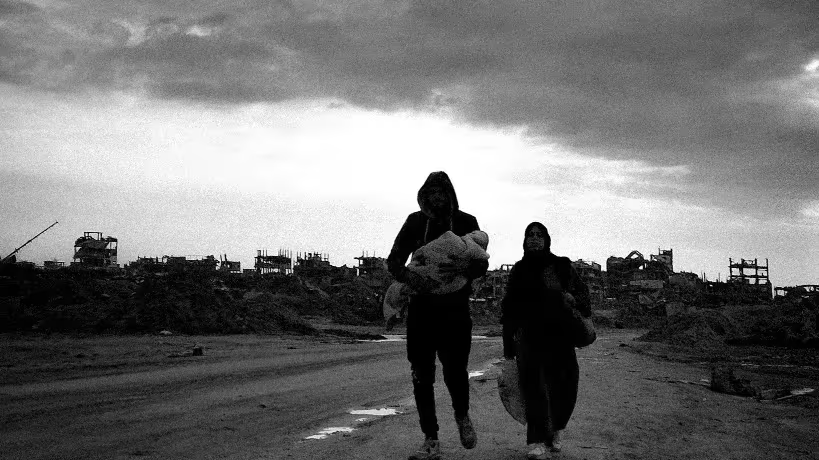
One of the strongest works described in the exhibition materials is a high-grain black-and-white image of a man and woman walking toward the viewer along a dust-choked road. The woman carries a bundle. The man holds blankets, his body tilted forward under their weight, likely shielding a child beneath them. Behind the pair, ruined buildings recede and a heavy cloud sits low above. The composition strips down to road, wreckage, two bodies and what they can carry. It does not attempt to explain displacement. It records the reduction of it: survival measured by what can be lifted and kept moving.
The second photograph changes key without easing pressure. A seven-year-old girl sits on a concrete water tank, a small bag beside her, looking out across a refugee camp that stretches to the horizon — tents assembled from blankets and patched coverings, built not as homes but as answers to having nowhere else to go. She is not running. She is seated, watchful, already inside a landscape reorganized by loss. The image's quietness is part of its argument. Displacement, it proposes, is not only a moment of flight but a condition children can be raised inside before they have language to name it.
The third work, in color, follows six boys across a beach at dusk. One younger child, caught in motion blur, appears to be smiling; the older boys carry more guarded expressions as the light begins to fail. There is no wreckage in the frame, no smoke, no visible impact — and that is what makes the image difficult. It holds open something harder to classify than destruction: the persistence of ordinary motion within a world already narrowed around it. Boys still cross the sand. Water still holds the last light. What the photograph preserves is not innocence intact but youth moving inside damaged time.
Together the works form more than a sequence of scenes. The first is forced movement. The second is enforced waiting. The third is what remains of daily time. Flight, encampment, dusk — each register distinct, each under the same sustained pressure. Gaza appears here not only as ruin, not only as testimony, but as a place where social life has been broken and compressed and forced into harsher forms without being extinguished. That is where the exhibition locates its authority.
Busan is not an incidental setting. During the Korean War, the city served as South Korea's wartime capital and as a refuge for large numbers of civilians driven south by fighting — a place where state functions, mass displacement and the improvisation of daily life under emergency conditions converged for over a thousand days. That history is not Gaza's, and the differences should not be dissolved. But Busan is not a neutral container for images of forced movement, makeshift shelter and children raised inside instability. Those pressures survive not only in archives but in the city's historical self-understanding and in family memory.
The wider Korean context sharpens the encounter further. The war ended in armistice in 1953, not a peace treaty. The peninsula remains structured by militarized division and unresolved conflict. That history does not license any claim that Korean viewers therefore understand Gaza. It does something more demanding: it places images of another people's displacement before a society whose own public life still rests on the political afterlife of war — and asks what kind of recognition that actually makes possible.
Arise Art Space, outside Busan's larger commercial and institutional circuits, is a deliberate fit for work that resists grand framing. A museum or biennale can absorb distant catastrophe into the established language of international exhibition-making, where scale itself becomes part of the mediation. Here the terms are tighter. The photographs are shown in a small local space, with a public program and a direct financial commitment to the artist. That does not remove mediation, but it shortens the distance between the work, the city receiving it and the person who made it.
The opening program matters for the same reason. The May 2 reception will include a talk by Raja Yesin, identified in the exhibition materials as a Palestinian woman settled in Busan. Her presence keeps the show from resting entirely in the register of image. The exhibition does not move in only one direction. It is interrupted by speech from someone who stands between Gaza and Busan, carrying the subject out of the frame and into local public language — which means the images do not simply settle once they cross the room. They remain attached to a living address.
The gallery has said that proceeds from the sale of works will go directly to the artist. That is a small detail, but not a minor one. Politically engaged work often circulates through institutions that convert urgency into programming while leaving the conditions of its production untouched. Direct transfer does not resolve that contradiction. It does make the transaction plainer, and it keeps the artist materially connected to the work as it travels.
On a Soil I Nourished insists on three things at once: that displacement is physical before it becomes conceptual, that waiting can harden into a child's only available world, and that life under siege does not simply stop but continues in reduced and damaged form. In Busan, those facts do not arrive from a fully external distance. They land in a city partly built through refuge, in a country still living within the unfinished structure of war. The exhibition's demand is not borrowed identification. It is the harder thing: to look at another people's catastrophe without converting it into either distant information or available metaphor.
Continue this reporting
Reporting on the same issue
Related coverage selected from the article's desk, topics and newsroom relationships.
 NewsOct 16, 2026
What Is Still Worth Going to See?
Busan’s biennale faces questions of artistic judgment and institutional care....
 NewsOct 14, 2026
What Became of Busan’s University Streets?
From 2015 to 2023, registered businesses grew near Pusan National University...
 NewsOct 12, 2026
Bukangi, the Shark That Stayed in Busan’s North Port
A rescue net guided Bukangi toward the sea, but the dusky shark returned to B...
More from the author
More from this byline
Stay with the same line of reporting through more work from this byline.
 NewsNov 10, 2025
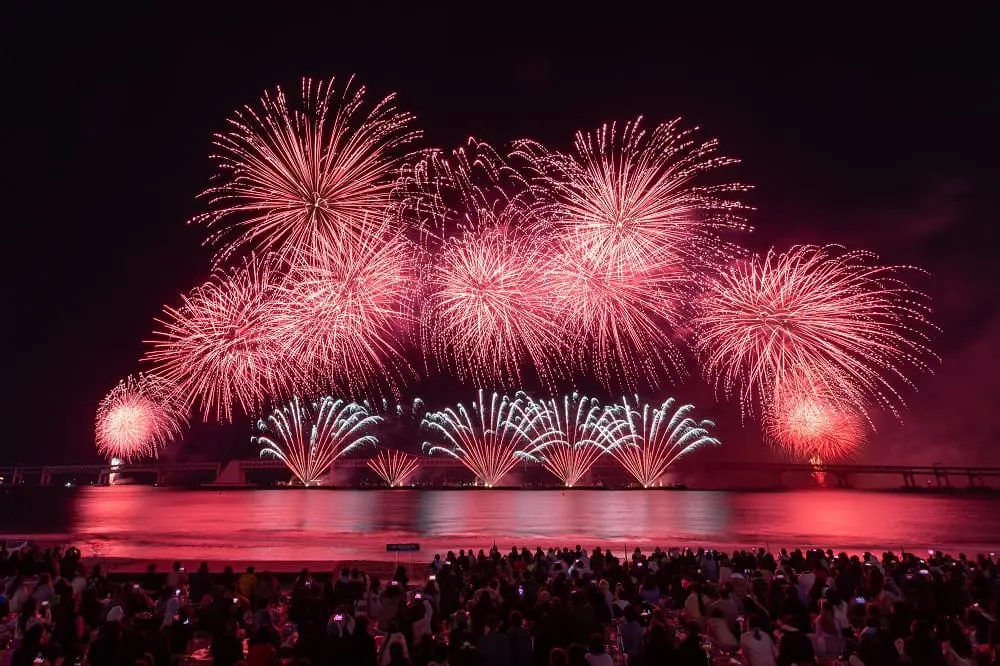
Busan Fireworks Festival Marks 20 Years With Expanded Show

Reader Signal
Community readWhat did this report leave you with?
Choose the signal that best reflects your reading. Select it again to remove it.
One response per article
No response selected
A moderated conversation about the reporting.
One-level replies and newsroom moderation keep the conversation anchored to this article.
Discussion Status
Open
Please sign in to join the discussion.
Newsletter
Weekly reporting and context from Busan and Korea.