Empty Halls and Rising Costs: Busan’s SOC Dilemma
A closer look at Busan’s SOC projects reveals a cycle of fast construction, underuse, and financial strain—pointing to systemic planning failures.


Busan, South Korea — For years, Busan has pursued urban development on an ambitious scale. Billions of won have gone into cultural centers, sports facilities, and transport links — all presented as part of a drive for modernization and civic renewal. One of the flagship efforts was Deullaknalak, a city program aimed at turning vacant buildings into cultural hubs designed to bring art, education, and community life into local neighborhoods.
The concept carried promise. City leaders spoke of accessibility and inclusivity, setting a target of 300 such hubs by 2030. Funding followed quickly, part of a broader social overhead capital (SOC) investment push, with officials eager to showcase Busan as a city on the move.
Social Overhead Capital (SOC) refers to large-scale public infrastructure projects — transport systems, cultural facilities, utilities — often funded by government budgets to stimulate development.
But beyond the headlines, a different reality has emerged. Some centers hum with activity; others remain silent, drawing only a handful of visitors each day. City audits point to delayed maintenance, underused facilities, and uneven management practices. Across Busan, nearly nine in ten public sports and cultural facilities now run annual deficits, while projects like the Busan–Gimhae Light Rail continue to require heavy subsidies after ridership projections fell far short.
Urban planners cite a recurring cycle: political incentives reward rapid construction, but operational oversight often comes too late. Site selection sometimes favors administrative convenience over community needs. Capital budgets and operational planning remain disconnected, producing impressive buildings with little thought given to long-term sustainability.
For residents, the effects are tangible. Many cultural hubs operate on limited schedules, often closed during weekends when demand peaks. Some open their doors before locals even know they exist. What begins as a civic dream too often fades into a hollow shell of unmet potential.
Analysts warn that this is not just a Busan problem, but the city illustrates the cost of what one expert described as “build fast, think later” governance. Without integrating auditing, demand analysis, and operational funding into the early stages, Busan risks repeating the same mistakes — regardless of how many new projects break ground.
• 9 in 10 public cultural and sports facilities in Busan run annual deficits.
• Busan–Gimhae Light Rail requires millions in yearly subsidies due to low ridership.
• Target set: 300 cultural hubs by 2030, but many remain underused.
Why the System Keeps Failing
A clear pattern runs through Busan’s SOC projects, rooted in how public infrastructure is planned and delivered. Too often, speed takes precedence over substance: budgets are pushed out the door and construction begins quickly, while questions about long-term viability receive little attention.
When the buildings finally open, city officials frequently move on to the next project. Operational oversight comes late — sometimes only when auditors step in years afterward, by which point empty halls, deferred repairs, and mounting losses have already become the norm.
Another layer of the problem is the separation of financial planning for capital projects and operational budgets. Construction funds come from one pool, while ongoing management relies on another, often smaller, stream of resources. The result is well-equipped facilities without the staffing, programming, or maintenance funds needed to make them thrive.
Location decisions also play a role. In several cases, cultural hubs and sports centers were sited based on land availability or administrative convenience rather than detailed studies of population density, accessibility, or local demand. Facilities placed in low-traffic areas naturally struggle to attract visitors, regardless of the quality of the space itself.
All of this creates what governance researchers often describe as “administrative inertia”: a system more focused on visible outputs — new buildings, announced budgets, completed projects — than on the invisible work of long-term operations, community engagement, and financial sustainability.
The effects of these underperforming SOC projects ripple far beyond empty buildings. For local residents, poorly planned facilities mean missed opportunities for the very services they were promised — cultural access, recreational space, or efficient transportation. When a new cultural hub opens but keeps irregular hours, or when a sports complex cannot afford to maintain its equipment, communities lose faith in the value of public investment itself.
Financially, the weight of underused infrastructure falls back on taxpayers. Annual operating deficits require subsidies to keep facilities open, diverting funds from other municipal needs such as education, welfare, or environmental programs. The Busan–Gimhae Light Rail alone has absorbed millions of won each year in government guarantees after passenger forecasts proved unrealistic. Similar deficits across sports and cultural facilities compound the strain, creating a cycle where funds for new projects compete with the costs of sustaining the old ones.
Moreover, the lack of early performance monitoring prevents timely interventions. Problems that might have been corrected through better programming, stronger promotion, or operational restructuring often remain unaddressed until facilities face chronic underuse or financial insolvency. This delays not only solutions but also public accountability, allowing the same planning mistakes to recur in future projects.
The cumulative effect is a cityscape marked by ambition but undercut by uneven execution — a pattern where the promise of renewal collides with the realities of governance and financial stewardship.
“Build fast, think later — that’s how public infrastructure risks becoming a burden rather than an asset.”
Busan’s experience with SOC projects shows how quickly ambition can outpace execution. The city has delivered an impressive number of facilities, but too often the opening day marks the high point. Empty halls, unplanned maintenance costs, and operating deficits soon follow. The problem lies less in the vision itself than in the way projects are planned, financed, and monitored.
To break this pattern, the planning process must integrate capital spending with long-term operational needs. Staffing, programming, and maintenance budgets cannot remain afterthoughts if facilities are to stay relevant and financially sound. Early performance audits — not years after construction, but within the first year of operation — would make it possible to catch low usage rates or maintenance lapses before they become entrenched problems.
Location planning also needs to move beyond administrative convenience. Too many facilities were built where land was available rather than where people actually live and gather. Demographic and accessibility data exist; the failure lies in using them effectively.
Equally important is giving local residents a real voice in how these spaces are run. Hours of operation, types of programming, and publicity efforts all determine whether a cultural hub becomes a community anchor or a locked, underused building.
The larger lesson reaches beyond Busan. Across South Korea — and in many other cities — infrastructure programs have prized speed and visibility over long-term impact. Without structural changes to how projects are planned, funded, and reviewed, the cycle of rapid construction followed by neglect will continue, draining public funds while delivering less than promised.
For Busan, the challenge now is not to build more quickly but to build more wisely: with clear demand forecasts, operational funding in place, early oversight mechanisms, and a commitment to keep facilities active long after the ribbon-cutting ceremonies end.
Continue this reporting
Reporting on the same issue
Related coverage selected from the article's desk, topics and newsroom relationships.
 NewsOct 22, 2026
Busan Port’s LNG and Methanol Plan: Who Pays to Keep Fuel Ready?
Busan already supplies ships with LNG and methanol, drawing on regional and i...
 NewsOct 16, 2026
What Is Still Worth Going to See?
Busan’s biennale faces questions of artistic judgment and institutional care....
 NewsOct 14, 2026
What Became of Busan’s University Streets?
From 2015 to 2023, registered businesses grew near Pusan National University...
More from the author
More from this byline
Stay with the same line of reporting through more work from this byline.
- NewsOct 22, 2026
Busan Port’s LNG and Methanol Plan: Who Pays to Keep Fuel Ready?
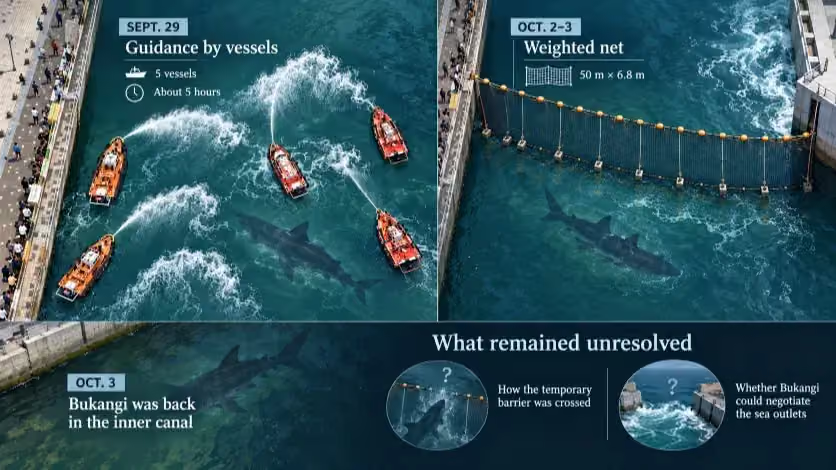 NewsOct 12, 2026
Bukangi, the Shark That Stayed in Busan’s North Port
Reader Signal
Community readWhat did this report leave you with?
Choose the signal that best reflects your reading. Select it again to remove it.
One response per article
No response selected
A moderated conversation about the reporting.
One-level replies and newsroom moderation keep the conversation anchored to this article.
Discussion Status
Open
Please sign in to join the discussion.
Newsletter
Weekly reporting and context from Busan and Korea.