Eco-Delta City Connectivity Boosted by Eomgungdaegyo Construction
The new Eomgungdaegyo bridge, set for completion by 2030, will ease congestion and connect key growth areas, including Eco-Delta City, to the rest of Busan, addressing long-standing traffic issues in the region.

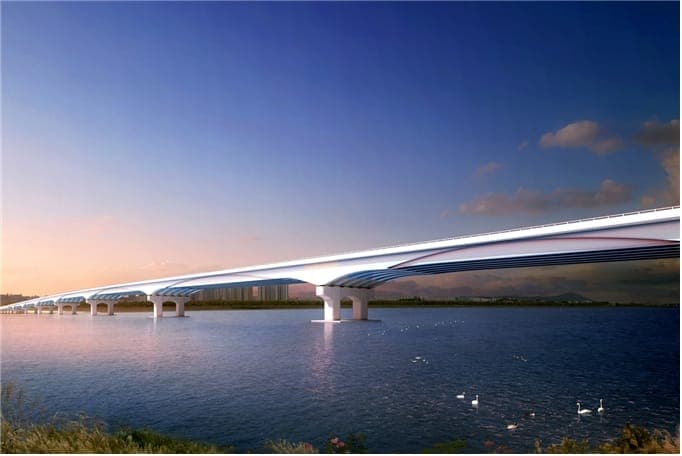
BUSAN, South Korea — On June 30, Busan Metropolitan City initiated construction on Eomgungdaegyo, a new arterial bridge crossing the Nakdonggang River, designed to improve connectivity across the city’s western corridor. The groundbreaking ceremony was held at the Eomgung Retention Basin in Sasang District, with approximately 300 participants including Mayor Park Heong-joon, members of the National Assembly, local council representatives, and residents.
Eomgungdaegyo is planned as a 2.91-kilometer-long, six- to eight-lane road bridge linking Daejeo-dong in Gangseo District and Eomgung-dong in Sasang District. The project also includes the construction of Maekdo Bridge and two interchanges, forming part of a larger road system supporting vehicular access between emerging residential and industrial areas. The total budget for the project is approximately KRW 344.4 billion, jointly financed by the central and city governments. Construction is scheduled for completion in 2030.
The bridge is intended to alleviate traffic congestion on existing Nakdonggang River crossings, where combined daily traffic volumes have exceeded 700,000 vehicles. According to city officials, the bridge will also serve as a key connection to Eco-Delta City, a smart city development underway in Gangseo District. With additional infrastructure demands anticipated in conjunction with the future opening of Gadeok New Airport, the city has emphasized the importance of reinforcing road-based access routes in western Busan.
However, Eco-Delta City—one of the bridge’s primary anchor points—has faced multiple implementation challenges. Despite being positioned as a national smart city pilot, the project has experienced difficulties in early operational stages. One of the most prominent concerns involves transportation access. As of mid-2025, the district remains insufficiently connected to Busan’s broader transit network, with limited public transport options and no direct rail links currently in place. Residents and planners have noted an overreliance on private vehicles, raising questions about the sustainability of current urban access strategies.
In addition to mobility concerns, analysts have pointed to governance and coordination issues in Eco-Delta City’s development. Stakeholders, including national agencies, municipal authorities, and private developers, have sometimes held conflicting visions for the city’s role—whether as a real estate-driven expansion zone or as a technology-forward innovation platform. Studies have identified a lack of shared operational goals and fragmented decision-making structures as barriers to efficient smart city deployment.
Environmental and land use challenges have also been noted. The area, part of a former river basin altered under national land reclamation policies, has seen disputes over land acquisition, compensation negotiations, and ecological impact mitigation. While many of these issues have been partially addressed through regulatory channels, they highlight the complex interplay between rapid development and long-term sustainability objectives.
Eomgungdaegyo, situated within this broader context, is expected to help resolve some of these structural limitations. By providing a direct road link between Eco-Delta City and Sasang’s existing transportation nodes, the bridge may reduce local isolation and improve access to employment, education, and services across Busan. It may also serve as a pressure valve for traffic congestion on older crossings such as Samnak and Myeongji Bridges.
The project has undergone a lengthy planning and review process. Initially proposed in 2014, construction was delayed primarily due to environmental review procedures. In 2021, the Nakdonggang River Basin Environmental Office rejected the original Environmental Impact Assessment (EIA), citing insufficient mitigation for impacts on migratory bird habitats near the planned construction zone. In response, Busan City revised its assessment to include additional wildlife surveys, seasonal construction schedules, and alternative habitat provisions. The updated EIA received approval in September 2024, followed by clearances from the National Heritage Administration and the river management authorities in 2025.
Although final permits have been issued and construction is now underway, the project’s long-term impact remains subject to evaluation. Urban development experts have emphasized the importance of integrating Eomgungdaegyo with sustainable transport systems, including future mass transit infrastructure, to ensure the bridge does not exacerbate car dependency. Environmental groups have likewise stressed the need for continued monitoring of ecological mitigation measures.
Eomgungdaegyo is one component of a larger effort to address longstanding infrastructure imbalances in western Busan. Its successful integration into both the city’s transportation system and the evolving Eco-Delta City development will likely influence future planning across the region. The bridge is expected to improve access and mobility, but its effectiveness will depend on complementary investments in transit, governance, and environmental management.
Continue this reporting
Reporting on the same issue
Related coverage selected from the article's desk, topics and newsroom relationships.
 NewsOct 22, 2026
Busan Port’s LNG and Methanol Plan: Who Pays to Keep Fuel Ready?
Busan already supplies ships with LNG and methanol, drawing on regional and i...
 NewsOct 16, 2026
What Is Still Worth Going to See?
Busan’s biennale faces questions of artistic judgment and institutional care....
 NewsOct 14, 2026
What Became of Busan’s University Streets?
From 2015 to 2023, registered businesses grew near Pusan National University...
More from the author
More from this byline
Stay with the same line of reporting through more work from this byline.
- NewsOct 22, 2026
Busan Port’s LNG and Methanol Plan: Who Pays to Keep Fuel Ready?
 NewsOct 12, 2026
Bukangi, the Shark That Stayed in Busan’s North Port
Reader Signal
Community readWhat did this report leave you with?
Choose the signal that best reflects your reading. Select it again to remove it.
One response per article
No response selected
A moderated conversation about the reporting.
One-level replies and newsroom moderation keep the conversation anchored to this article.
Discussion Status
Open
Please sign in to join the discussion.
Newsletter
Weekly reporting and context from Busan and Korea.