Development Pressures Erode the Sanctity of the UN Memorial Park
Busan’s plan to lift height limits near the UN Cemetery aims at “rational regeneration” but exposes a deeper paradox—growth without renewal.

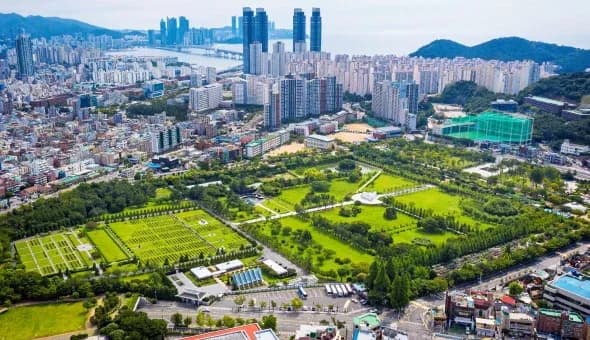
Busan, South Korea — The City of Busan plans to begin dismantling the ecological tunnel that runs between the Busan Cultural Center and the United Nations Memorial Cemetery in April 2026, marking the first physical step toward a long-delayed reconfiguration of the city’s southern corridor. Officials describe the move as the restoration of “urban function” and “balanced regeneration.” In practice, it signifies a major shift: the relaxation of one of Korea’s oldest preservation regimes governing the landscape around the world’s only United Nations cemetery.
On 23 October 2025, the Commission for the United Nations Memorial Cemetery in Korea (CUNMCK) conditionally approved Busan’s proposal to remove the “special scenic district” designation that had capped building heights in the twenty-six-hectare area at twelve to fifteen metres for more than half a century. The decision allows the city to raise limits to roughly thirty metres under a new district plan. The international commission’s consent was not unanimous; several member states expressed concern that easing restrictions might compromise the solemn horizon of the cemetery. Busan countered that the plan would preserve visual dignity while enabling “rational regeneration.” Beneath the diplomatic phrasing, however, lies a familiar dynamic—the conversion of protected ground into developable land.
The United Nations Memorial Cemetery was created in 1951 at the height of the Korean War and was placed under UN jurisdiction by the 1959 Agreement between the United Nations and the Republic of Korea for the Establishment and Maintenance of a United Nations Cemetery in Korea. That treaty obliges Korea to ensure that adjacent land uses do not “damage the dignity or environment” of the cemetery. The burial ground, which holds the remains of over two thousand soldiers from eleven nations, has since functioned as a rare fusion of sacred ground, diplomatic enclave, and urban green space. Its surroundings were intentionally low-rise, a buffer that preserved silence and sightlines. What Busan calls an update to obsolete regulation therefore touches the core of an international covenant.
City officials frame the shift as a prerequisite for revitalising the aging residential fabric of Daeyeon and Yongdang. But the policy’s architecture—scenic zone removal, urban-management revision, district-unit plan formulation—is the standard pathway to private redevelopment. Raising the height ceiling from twelve to thirty metres transforms the area’s economic logic: land that once accommodated detached homes and small schools can now sustain mid-rise apartment complexes. The city promises control through design guidelines and consultation, yet the practical effect is to invite the capital of major construction firms into one of the last undeveloped inner-city districts.
This is not a new story. Busan’s modern history reads as a sequence of engineered expansions: colonial-era port reclamations, postwar refugee settlements, industrial estuary fills, and, more recently, coastal megaprojects such as Marine City, Centum City, and Eco Delta Smart City. Each generation, facing a different crisis, reached for the same instrument—land creation—and named it progress. The pattern yielded growth in surface area but contraction in substance. The city’s manufacturing base eroded after the 1980s, its population began to age and decline, and its economy shifted from production to construction. Reclamation replaced reinvention; development became a substitute for direction.
The push around the UN Cemetery exemplifies that structural reflex. Busan’s fiscal machinery depends on land transactions that deliver immediate, quantifiable returns within a mayoral term. Tax receipts from property acquisition and construction feed short-term budgets, while industrial diversification demands years of uncertainty. Political logic thus favors the tangible spectacle of cranes over the slower work of policy reform. Every administration promises balance between growth and heritage, and each ends by redefining heritage as a manageable variable within growth.
The ethical and diplomatic dimensions make this site distinct. The UN Memorial Cemetery is not merely a local historic park; it is a sovereign UN enclave and a candidate component of the Sites of the Busan Wartime Capital, listed on UNESCO’s Tentative List since 2016. UNESCO’s operational guidelines treat the preservation of “visual integrity” and “buffer zones” as conditions of authenticity. International precedents—Dresden’s Elbe Valley, Liverpool’s waterfront, Macao’s heritage core—show that visible encroachment, even outside official boundaries, can disqualify or jeopardize inscription. In those cases, the construction of tall buildings near memorial or heritage vistas was cited as an irreversible loss of setting. Busan’s choice to dismantle its own scenic zone runs counter to that global trajectory.
The city’s assurances remain largely procedural: a promise to consult the CUNMCK when drafting detailed plans, to moderate heights according to topography, and to design façades in subdued tones. None of these measures, however, address the deeper transformation that accompanies market entry. Once redevelopment begins, the area’s economic structure shifts from local residency to speculative assetization. The visual calm of the cemetery may survive in renderings, but the social quiet that once surrounded it will not. Urban integrity, like memorial integrity, depends less on line-of-sight than on the continuity of purpose.
Meanwhile, Busan’s interior districts continue to unravel. Jung-gu, Dong-gu, Seo-gu, and Yeongdo—hillside neighborhoods that once sheltered refugees—have lost nearly half their population since 2000. Two-thirds of their remaining residents are elderly. Schools have closed; small factories have disappeared; and cultural “regeneration” projects have produced murals and cafés but not employment. The contrast between the glittering coast and the hollow core defines the city’s geography of inequality. High-value apartment zones by the sea coexist with decaying terraces in the hills, a spatial manifestation of a post-industrial divide.
In this broader context, the transformation of the UN Cemetery’s perimeter becomes symbolic of a city caught between reverence and repetition. The administration’s rhetoric of “harmonising heritage with habitation” masks a deeper exhaustion—the inability to imagine growth without construction. By converting a site founded on sacrifice into another corridor of real-estate ambition, Busan risks not only aesthetic dilution but moral inversion. The cemetery’s meaning was to remind the living of restraint; the city’s gesture is to erase the limit.
If Busan seeks genuine regeneration, it must redirect the energy of its engineering tradition toward structural renewal—linking its port to high-value logistics, green shipping, and maritime robotics; aligning its universities with industrial research; and reactivating its inner hills as viable living spaces rather than open-air museums of decline. Development should begin with function, not façade. The engineering century that built Busan’s land has ended; what the city now needs is an architecture of purpose.
As the ecological tunnel yields to excavation machinery in 2026, the scene will once again resemble progress. Yet the real measure of advancement will be whether the city can learn to grow within its own meaning. The UN Memorial Cemetery stands as a reminder that the ground on which Busan prospers was secured through collective sacrifice. To honor that legacy requires more than commemoration—it demands restraint, a discipline the city has not practiced in generations. In choosing how to build around silence, Busan will decide not only its skyline but its conscience.
Continue this reporting
Reporting on the same issue
Related coverage selected from the article's desk, topics and newsroom relationships.
 NewsOct 22, 2026
Busan Port’s LNG and Methanol Plan: Who Pays to Keep Fuel Ready?
Busan already supplies ships with LNG and methanol, drawing on regional and i...
 NewsOct 16, 2026
What Is Still Worth Going to See?
Busan’s biennale faces questions of artistic judgment and institutional care....
 NewsOct 14, 2026
What Became of Busan’s University Streets?
From 2015 to 2023, registered businesses grew near Pusan National University...
More from the author
More from this byline
Stay with the same line of reporting through more work from this byline.
- NewsOct 22, 2026
Busan Port’s LNG and Methanol Plan: Who Pays to Keep Fuel Ready?
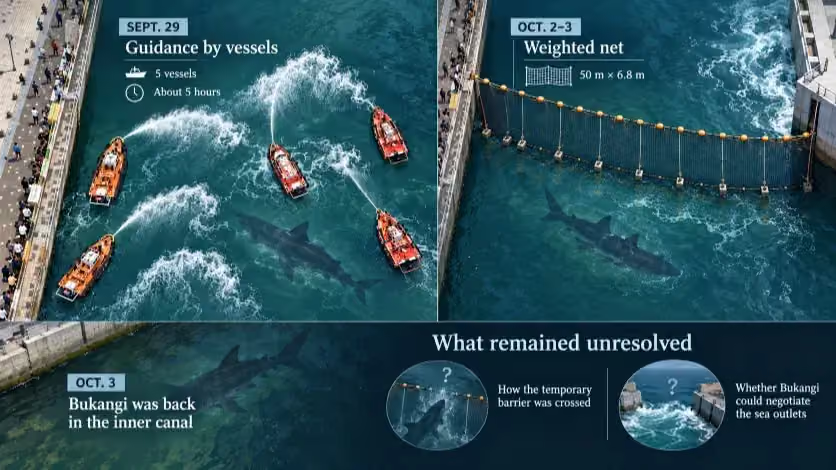 NewsOct 12, 2026
Bukangi, the Shark That Stayed in Busan’s North Port
Reader Signal
Community readWhat did this report leave you with?
Choose the signal that best reflects your reading. Select it again to remove it.
One response per article
No response selected
A moderated conversation about the reporting.
One-level replies and newsroom moderation keep the conversation anchored to this article.
Discussion Status
Open
Please sign in to join the discussion.
Newsletter
Weekly reporting and context from Busan and Korea.