Busan’s Underground Push Meets a Test of Proof
The latest settlement scare near the Mandeok–Centum Urban Expressway has sharpened scrutiny of a broader underground strategy in a city where buried risk has never been fully settled.

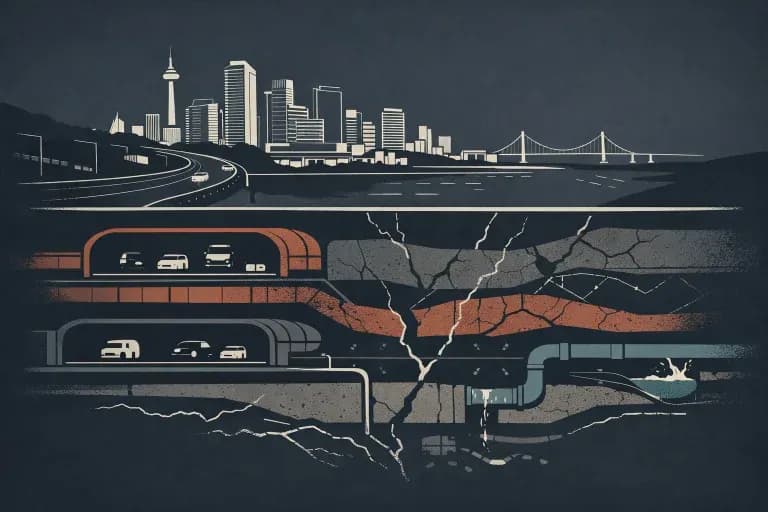
Busan is no longer adding underground infrastructure one project at a time. It is remaking the city below ground.Deep urban roads, new underpasses, railway undergrounding and North Port-linked redevelopment corridors now move in the same direction: shift movement, land and urban growth beneath the surface, then reorganize the city above it. On paper, that is the language of a more connected and more sophisticated metropolis. In practice, it is being pursued in a city where subsidence has recurred, buried utilities are aging, rainfall is becoming more punishing and the certainty implied by underground maps and engineering assurances remains thinner than official language often suggests. That is why the latest settlement scare near the Mandeok–Centum Urban Expressway should not be read as a narrow construction problem. It should be read as a test of Busan’s entire underground urban strategy.
City officials have tried to contain the immediate controversy by drawing a line between the latest settlement and the deep main bore. Their explanation has been straightforward: surveys found no cavity, the main structure lies far below the affected surface sections, and the most likely cause was weakened backfill compounded by winter conditions and traffic load. That explanation may yet prove technically correct. But even on its own terms, it does not resolve the larger problem now confronting Busan. A city does not expand underground through the main bore alone. It expands through the vulnerable zones around it — entrances, exits, backfilled sections, drainage edges, shallow utility corridors and every other seam where major infrastructure meets the unstable complexity of an existing city.
That distinction matters because Busan did not present the Mandeok–Centum Urban Expressway as a limited engineering work. It presented it as a flagship urban transformation project: a 9.62-kilometer underground expressway meant to complete the city’s inner ring road after 25 years, cut travel times sharply and reorganize movement across the metropolitan core. Once a project is framed in those terms, the standard by which it is judged changes. The question is no longer whether the deepest structural element remains intact. The question is whether the full corridor — including the points where citizens actually enter, exit and pass over it — was verified with the same confidence the city used to sell the project in the first place.
Inspection and Proof
Busan has shown that it can build underground infrastructure at scale. It has opened the Mandeok–Centum Urban Expressway and publicly framed it as the completion of a long-delayed inner ring corridor. That alone places the city beyond the stage of tentative experimentation. Busan is acting with institutional confidence, political continuity and a clear strategic direction. No fair reading of the record can describe the city as hesitant, passive or unsure of the model it is pursuing.
What the city has not shown with equal force is that its underground expansion is being verified at the same scale as its ambition. The official response to the latest settlement scare illustrates the problem. City officials separated the deep main bore from the affected surface sections and argued that poor backfilling, thaw conditions and traffic load were the likely causes, rather than a defect in the deep main structure itself. That explanation may ultimately prove correct. But even if it does, it would settle only one narrow question: whether the deepest core structure caused this specific event. It would not settle the broader one now hanging over Busan’s underground push — whether the full corridor, including the vulnerable interfaces around it, was inspected and verified with the same rigor implied by the city’s larger claims of readiness and safety.
That is why the inspection question matters more than the rhetorical comfort of a localized explanation. In a city pushing roads, rail corridors and redevelopment logic below ground, the real risk does not end where the deepest tunnel begins. It lives at the points of transition: access roads, shallow utility crossings, backfilled sections, drainage edges and the inherited layers of buried infrastructure that do not disappear simply because a new structure has been engineered beside or beneath them. The deeper Busan builds, the more these interfaces become the true test of whether its underground city model deserves public trust. The most important question is no longer whether the city can explain one incident. It is whether Busan can demonstrate that the margins around each major structure have been understood with the same seriousness as the structure itself.
Why Busan Builds Downward
Busan keeps building downward because undergrounding promises something surface politics rarely can: speed without visible sacrifice. A new road at street level brings immediate conflict over land, demolition, noise, visual intrusion and neighborhood severance. A corridor moved below ground can be sold differently. It can be described as congestion relief, redevelopment support, urban repair and future-proofing all at once. In Busan, that promise has become especially attractive because the city is trying to solve several problems at the same time — chronic east-west traffic strain, the long fragmentation of the old downtown, the redevelopment logic of North Port, and the political desire to remove elevated structures that have come to symbolize an older model of urban growth.
That is why the current pipeline matters. The Mandeok–Centum Urban Expressway is already open. The Busanjin Station–Busan Station section of rail undergrounding has been advanced as a formal pilot tied to deck development and land reuse. Additional tunnel and underpass projects have been folded into the city’s broader traffic and redevelopment strategy. These are not scattered worksites. They form a pattern. Busan is using undergrounding not simply to move vehicles and trains, but to clear land, reconnect districts, retire old elevated structures and rewrite the city’s surface hierarchy. Once that pattern becomes visible, undergrounding stops looking like a technical preference and starts looking like a governing idea.
Seen this way, undergrounding in Busan is not a technical preference. It is an urban doctrine. The city’s planning language does not describe only discrete road expansions. It links future projects to a broader geometry of removal and replacement — elevated roads that could eventually come down if alternative corridors are secured below ground or elsewhere in the network, waterfront zones that can be better integrated if traffic is re-layered, and a wider metropolitan structure that can be made to look cleaner, faster and more investment-ready if transport burdens are pushed out of sight. What surface redevelopment and transport modernization share in Busan is a common premise: the city can recover space above ground by pushing more of its circulation below it. That premise is politically elegant. It is also the reason the buried city now matters so much more than official project renderings above it.
There is a real logic to that ambition. Busan is topographically constrained, densely built and historically divided by infrastructure corridors designed for throughput more than urban continuity. It is not difficult to see why undergrounding appeals to planners. A buried corridor can do what a widened surface road often cannot: preserve or create redevelopment value while reducing the political cost of visible expansion. Railway undergrounding near Busanjin Station and Busan Station carries exactly that promise. So does the wider North Port corridor strategy. In the city’s own planning language, undergrounding comes to mean not just mobility but reconciliation — between land and transport, between the old downtown and the waterfront, between congestion relief and urban image. That is a powerful story. It is also one that can easily outrun the evidentiary burden required to make it convincing.
But what makes the strategy politically elegant also makes it analytically dangerous. Once undergrounding begins to function as an all-purpose solution, each project can be justified less by what is known about the ground beneath it than by the promise of what will happen above it. The argument shifts, subtly but decisively. Instead of asking whether a corridor has been verified as comprehensively as the city claims, debate turns to what the buried project will unlock: faster travel, freed land, removed overpasses, more coherent redevelopment. In that kind of planning environment, the underground condition itself risks being treated as a managed technical detail when it is in fact the hardest part of the entire urban bargain. What is being buried is not only traffic. It is also uncertainty, and uncertainty does not disappear simply because it has been relocated below street level.
Busan’s Subsurface Risk
The deepest weakness in Busan’s underground strategy is not that the city lacks risk tools. It is that the city’s underground condition is more complex than the language used to govern it. Official subsidence data already show that Busan’s problem does not run through a single failure mechanism. The city’s recorded cases are spread across sewer damage, water-pipe damage, poor compaction, excavation failure and other buried-work defects. That matters because it changes the meaning of any “localized” explanation offered after the fact. When multiple subsurface failure pathways are already established, no new settlement event begins from a position of innocence. It begins inside a known field of layered urban fragility.
The numbers themselves are difficult to dismiss. On the national underground-safety system, Busan records 148 subsidence cases in the official regional tally. By cause, the listed counts include 55 cases tied to sewer damage, 14 to water-pipe damage, 25 to poor compaction or backfilling, and 6 to faulty excavation, alongside additional categories linked to buried-facility and construction failures. That pattern reveals more than any single incident can. It shows that Busan’s underground risk is not episodic in the narrow sense. It is distributed across the buried systems of the city itself. In that setting, each new project does not enter untouched ground. It enters a city whose subsurface has already accumulated stress, patchwork, age and uncertainty.
That is one reason the current debate cannot be reduced to whether the main bore of one expressway remains structurally sound. The buried city does not fail only in spectacular ways. It fails through interfaces: where a new tunnel meets an old road, where a backfilled section settles unevenly, where drainage weakens surrounding material, where a utility corridor has already aged, where excavation changes stress conditions in ground that was never as stable as planners hoped. Busan’s underground condition is therefore not best understood as a map of isolated assets. It is better understood as an inherited field of interacting vulnerabilities — some old, some newly introduced, and some created precisely where old infrastructure and new ambition collide. The more projects Busan layers into that field, the less persuasive it becomes to describe each new event as though it belonged only to itself.
Climate, Water and Aging Utilities
Climate pressure sharpens that condition rather than replacing it. Busan’s problem is not that climate change suddenly creates sinkholes out of nowhere. It is that heavier rainfall, distorted urban water flow, older buried infrastructure and saturated ground conditions make preexisting weaknesses harder to predict and easier to trigger. The city’s own public safety architecture reflects that reality. Busan operates real-time rainfall information and flood-related public systems alongside subsidence and underground-risk management. That in itself is revealing. A city does not build that kind of safety architecture unless water, drainage and buried infrastructure have already become interlocking governance problems rather than separate technical domains.
The same contradiction appears in Busan’s planning response. The city is not acting as though the underground is unknowable. It has tried to make it knowable. It has pursued risk mapping, inspection disclosure and public-facing safety systems. But a risk map is not the same thing as a fully verified underground reality. It is an attempt to govern uncertainty, not proof that uncertainty has been eliminated. That distinction matters because modern underground governance often creates a false sense of closure. A map exists. A scan is performed. A page is updated. A risk appears to have been brought into view, and therefore into control. But buried cities do not become reliable merely because they become legible on an interface. They become reliable only when the act of seeing is matched by corridor-wide inspection, utility renewal, drainage integration, field verification and repeated post-opening scrutiny under changing seasonal conditions. That is a much harder standard than simply being able to say the city has a system in place.
The Credibility Gap
What this produces is not simple failure, but a widening gap between ambition and proof. Busan’s underground strategy is increasingly presented through the language of completion, connection and transformation. Inner-ring corridors are finished. Congestion is relieved. Old downtown and waterfront districts are reconnected. Elevated structures can eventually come down. Land can be freed and remade. All of that may be true. But none of it answers the harder subterranean question. What Busan has shown above ground is a coherent development story. What it has not shown with equal clarity below ground is a corridor-by-corridor standard of verification robust enough for a city that is steadily moving more of its transport and redevelopment logic into buried space. Above ground, the city has a narrative. Below ground, it still has a burden of proof.
That gap between ambition and proof is now the real subject of the story. Not whether Busan can explain one settlement event. Not whether one official statement turns out to be technically defensible. The real issue is whether the city has reached the point where underground expansion is being governed by a standard of evidence proportionate to its scale. Busan has built the language of an underground future. It has not yet fully demonstrated the public proof structure that future requires. Until it does, every new underpass opening, every tunnel announcement and every rail-deck plan will bring the same question back to the surface: not simply what the city is building, but what exactly it knows about the ground on which that future now depends.
What Busan Must Prove
Busan’s underground future will not ultimately be judged by the elegance of its plans above ground. It will be judged by the credibility of what the city can prove below it. That is now the harder standard. Deep roads can cut travel times. Underpasses can ease bottlenecks. Rail corridors can be decked over and turned into redevelopment land. Elevated structures can be removed and old districts can be visually repaired. All of that belongs to the city’s promise. But promises are the easy part of underground urbanism. Proof is harder. Proof means showing, corridor by corridor and interface by interface, that what has been buried is not merely buildable, but verifiable; not merely efficient, but durable; not merely politically attractive, but trustworthy under pressure, water, age and time. The city’s case for underground expansion now rests less on what it wants to unlock above ground than on what it can demonstrate beneath it.
That is the test now confronting Busan. The city is no longer experimenting at the margins. It is reorganizing mobility, land and redevelopment around a buried urban future. The question is no longer whether that future can be imagined. It can. The question is whether Busan has shown enough to make that future believable. Until it does, every new settlement scare, every underpass opening and every undergrounding announcement will carry the same unresolved charge. They will not simply ask what the city is building next. They will ask whether Busan is mastering the ground beneath it — or merely asking the public to trust what it still cannot fully prove.
Continue this reporting
Reporting on the same issue
Related coverage selected from the article's desk, topics and newsroom relationships.
 NewsOct 22, 2026
Busan Port’s LNG and Methanol Plan: Who Pays to Keep Fuel Ready?
Busan already supplies ships with LNG and methanol, drawing on regional and i...
 NewsOct 16, 2026
What Is Still Worth Going to See?
Busan’s biennale faces questions of artistic judgment and institutional care....
 NewsOct 14, 2026
What Became of Busan’s University Streets?
From 2015 to 2023, registered businesses grew near Pusan National University...
More from the author
More from this byline
Stay with the same line of reporting through more work from this byline.
- NewsOct 22, 2026
Busan Port’s LNG and Methanol Plan: Who Pays to Keep Fuel Ready?
 NewsOct 12, 2026
Bukangi, the Shark That Stayed in Busan’s North Port
Reader Signal
Community readWhat did this report leave you with?
Choose the signal that best reflects your reading. Select it again to remove it.
One response per article
No response selected
A moderated conversation about the reporting.
One-level replies and newsroom moderation keep the conversation anchored to this article.
Discussion Status
Open
Please sign in to join the discussion.
Newsletter
Weekly reporting and context from Busan and Korea.