Busan’s Two Futures
Busan is aging, losing younger residents, and struggling to sustain confidence in North Port, its flagship waterfront project. With World Design Capital 2028, the city is trying to show that visible ambition can still produce real urban renewal.

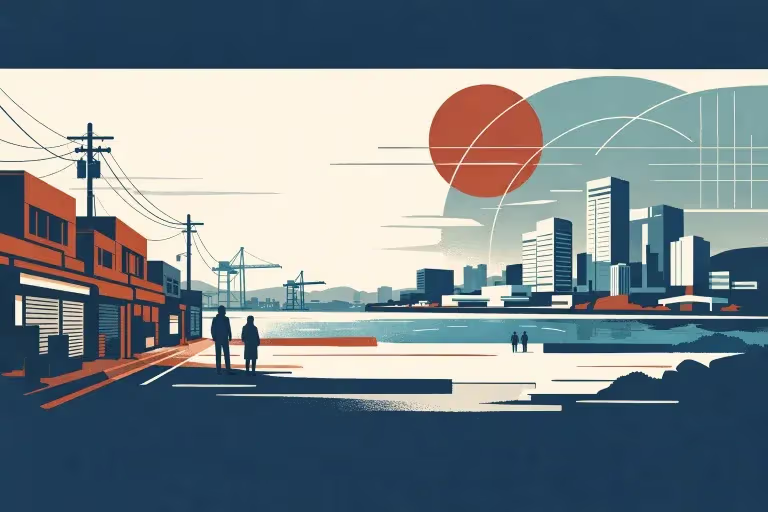
As demographic risk deepens, North Port strains under weaker market confidence, and World Design Capital 2028 offers a new language of renewal, Busan is confronting a harder question: can ambition still do structural work?
Still speaking in the future tense
Busan still speaks fluently in the language of ambition. Along the waterfront, the city has spent years promising a different future: a remade North Port, a new maritime gateway, a shoreline recast for a more competitive era. More recently, it added another claim to that future, securing the title of World Design Capital 2028 and presenting design as part of the city’s next chapter.
That promise comes at a harder moment than the slogans suggest. Busan is aging quickly. Younger residents continue to leave. The strain is no longer visible only in reports or policy debate. It can be seen in older neighborhoods, in thinning commercial streets, and in the quieter rhythm of districts that once depended on a steadier flow of customers, workers, and families. In these parts of the city, decline rarely arrives as drama. It settles in through smaller crowds, shorter business hours, and the growing absence of the generation expected to replace the last.
This is the tension now running through Busan’s public life. The city is pressing ahead with redevelopment and international design ambitions while the foundations that sustain urban confidence have grown less secure. A city cannot live on image alone. It needs work that keeps younger people from leaving, neighborhoods that remain habitable, projects that attract durable investment, and public spaces that serve the city as it is rather than a rendering of what it hopes to become.
North Port has become one measure of that tension. Long promoted as one of Busan’s defining projects, it was meant to turn old port land into a new civic and economic front door. Instead, key parts of the plan have struggled to secure private confidence, while disputes over land use, public access, and development logic have sharpened a basic question: what, exactly, is this waterfront being built to do, and for whom?
The same question follows Busan’s embrace of design. World Design Capital 2028 gives the city a powerful new vocabulary: inclusive, creative, globally connected, visibly transformed. Yet the issue facing Busan is not a shortage of language. It is whether design can reach beyond presentation and begin to alter the conditions underneath, where demographic decline, youth outmigration, weak job depth, and uneven development have been shaping the city for years.
Busan is trying to build a future and defend one at the same time. Whether those two efforts can still be made to meet is now one of the most important questions facing the city.
What the city is losing
Busan’s demographic problem is often flattened into the broader story of national decline. That is too soft for what is happening. Busan is not only shrinking. It is losing population in a pattern that cuts into its economic future: the population is aging, younger residents continue to leave, and the cohort most closely tied to household formation and long-term urban reproduction has weakened enough to push the city into the extinction-risk stage. In March 2024, Busan’s extinction-risk index fell to 0.490, making it the first major metropolitan city in the country to cross that threshold. The same data put Yeongdo at 0.256, one of the weakest district-level figures among Korea’s large cities. The share of residents aged 65 and over stood at 23.0 percent, while women aged 20 to 39 accounted for 11.3 percent of the population.
Those figures matter because they say something more precise than that Busan is getting older. They show a city in which the demographic base needed to sustain schools, neighborhoods, household formation, and local demand is narrowing while the elderly share rises quickly. Once that imbalance hardens, urban decline stops being a future scenario and becomes a governing condition. It affects what kinds of businesses open, what kinds of housing remain viable, how transit demand changes, and whether employers can imagine long-term expansion with confidence. In that sense, the extinction-risk index is not just a warning label. It points to a wider erosion in the city’s capacity to reproduce itself socially and economically.
The problem becomes clearer when the demographic picture is set beside the labor market. Busan Institute research has argued that youth outmigration is driven less by vague dissatisfaction than by the structure of opportunity itself: lower wages, limited job diversity, and weaker access to the kinds of positions younger workers associate with long-term advancement. If younger residents are leaving because the city cannot offer enough depth in employment, then demographic decline is not a separate social problem sitting beside the economy. It is one expression of the economy. Busan is not merely losing residents; it is losing earning power, future households, and the age cohort most likely to start firms, switch sectors, consume new services, and anchor the next phase of urban life.
That helps explain why official reassurances only partially settle the question. Busan’s case in 2026 is that the city is no longer moving in only one direction. Officials say the decline in the youth population has slowed markedly over the past five years, falling from about 33,000 in 2021 to about 17,000 in 2025, while the city’s big-data-based “active population” has remained broadly stable. That argument is not trivial. Port cities and regional hubs often have lives larger than their registered resident counts. But it does not erase the central problem. A city can remain regionally busy and still fail at retention. It can attract flows without holding on to the people needed to secure its long-term future.
What Busan appears to be losing is not only scale, but credibility in the everyday sense of the word. A city keeps people when they believe they can stay, work, form households, and move upward without having to leave for Seoul or the surrounding capital region. Once that belief weakens, the consequences spread outward. Local demand softens. Commercial districts thin. Employers face a shallower labor pool. Large projects must sell themselves into a market that no longer assumes the city’s trajectory points upward.
That pressure does not remain confined to population charts. It reappears in the terms on which the city tries to finance its future.
North Port and the weakening of belief
North Port was supposed to do more than redevelop old port land. It was meant to restate Busan’s future in physical form. For years, the project was presented as a decisive turn: the conversion of an obsolete waterfront into a new urban front door, a district that could bind together tourism, business, culture, transport, and the city’s global maritime identity. In practical terms, it was also expected to prove that Busan could still build at metropolitan scale and attract capital to a long-horizon vision of itself.
That is why the project’s difficulty matters beyond the site. A stalled or weakened landmark parcel is not only a development story. It is a measure of how convincingly the city can sell its future to investors, institutions, and the public. In North Port’s case, that test has been harder than the renderings suggested. Key parts of the redevelopment, particularly the landmark parcel, struggled to secure private-sector participation. Reporting and official explanations point to a mix of factors: a prolonged real-estate downturn, project-finance stress, and structural limits in the redevelopment model that left the Busan Port Authority dependent on private developers for commercially significant components. When those conditions deteriorated, the city’s flagship waterfront vision ran into a more basic problem. The market was no longer prepared to take the story at face value.
North Port did not falter simply because Busan is losing population. That explanation is too blunt. The more accurate reading is that a city already facing weaker long-term demand fundamentals entered a harsher financing environment with a project structure that reduced flexibility at exactly the wrong time. In stronger markets, a landmark waterfront scheme can absorb delay, cost inflation, and uncertainty because developers still believe the surrounding city will generate enough demand to justify the risk. In Busan, that confidence appears to have been harder to sustain. Demographic weakness did not mechanically cause the problem, but it formed part of the background against which risk was judged.
The result is that North Port has become a referendum on more than delivery. It now asks whether Busan’s most visible urban projects still command the kind of belief that large redevelopment requires. That belief is not aesthetic. It is economic. Developers, lenders, and public agencies may all talk about urban regeneration, but they make decisions on more practical grounds: who will live there, who will work there, what kind of demand can be sustained, how quickly land can be absorbed, and whether the project serves a city that is growing into itself or compensating for something it has started to lose.
That helps explain the growing discussion of a more public-led model. By early 2026, the direction of travel had become clearer: after repeated difficulties in private participation, officials were openly discussing a shift toward stronger public leadership. On one level, that is a practical response to changed market conditions and legal constraints. On another, it is an admission that the redevelopment could no longer rely on private confidence alone.
What North Port reveals, then, is not merely delay. It reveals a problem of belief. Busan still has strategic assets that most Korean cities would envy: a major port, national visibility, institutional ambition, and an urban geography with genuine redevelopment potential. But assets do not eliminate the need for conviction. A city has to persuade others that its next phase is real enough to build against.
When that conviction weakens, cities begin to look for another language in which to make the future persuasive. In Busan, that language is now design.
Design and the language of renewal
If North Port exposed a problem of belief, World Design Capital 2028 offers Busan a new way to restore it. The title does not solve the city’s structural problems by itself, and it should not be mistaken for an economic plan. But it matters because it gives Busan an official language in which to describe renewal at a moment when redevelopment alone no longer seems sufficient. Under the WDC framework, the city can speak not only about buildings and investment, but about public life, mobility, inclusion, everyday urban experience, and the quality of the spaces through which people move. That shift widens the conversation from growth to livability, from construction to urban experience, from physical expansion to the design of daily life.
That is why the designation has to be taken seriously. Busan was designated World Design Capital 2028 in 2025, and the city formally launched the designation at an official signing ceremony on March 27, 2026. The World Design Organization and Busan have framed the designation around “Inclusive City, Engaged Design,” presenting it as a citywide agenda rather than a stand-alone cultural event. In official terms, the ambition is broad: design is meant to touch public spaces, industry, culture, the environment, and everyday life. Those claims should not be dismissed as empty by default. They reflect a real contemporary belief in design as a governing instrument—something capable of reshaping how a city functions, not just how it looks.
The harder question is what exactly design is being asked to do in Busan. Cities turn to design most convincingly when they are trying to improve systems residents encounter directly: safer pedestrian environments, better transit interfaces, more habitable neighborhoods, stronger public-space access, and better ways of linking culture to industry. In that sense, design can matter deeply without pretending to replace economics. It can make urban life more coherent and more livable. For a city like Busan, with its port geography, steep topography, fragmented urban fabric, and unevenly aging districts, those are not trivial possibilities.
Yet design becomes harder to defend when it is asked to carry burdens that belong elsewhere. It cannot, on its own, reverse weak job creation, close wage gaps with the capital region, or guarantee that younger workers will see enough opportunity to remain. The risk is not that design is irrelevant, but that it becomes overburdened—turned into a premium language for problems whose real causes lie in labor markets, industrial structure, and long-term demographic change. Once that happens, the design agenda begins to drift. It no longer clarifies policy; it softens it.
This is where Busan’s design turn intersects directly with North Port. A waterfront is one of the clearest places where a city’s design claims can be measured against reality. If Busan is serious about design as a civic tool, then North Port is not simply a redevelopment site; it is a test case. How open will the waterfront actually be? How much priority will public access receive against commercial pressure? Will transit connections make the district easier to enter and move through, or will they reinforce separation? Will the project create a civic edge for the city, or another controlled landscape whose value depends more on saleable image than on public use? These are design questions in the strongest sense of the word, because they concern movement, access, allocation, and the kind of urban life the city is prepared to privilege.
Busan’s WDC story, then, cannot be treated as a parallel feature running beside the harder business of urban development. It belongs inside that harder story. The city’s embrace of design is not just a matter of reputation. It is an attempt to claim that the future can still be shaped intentionally, even under demographic and economic pressure. Whether that argument holds depends on execution, not rhetoric.
Busan’s case for recovery
Busan’s officials do not accept the idea that the city is simply sliding into decline while dressing the process in new language. Their case is more measured than that. In 2026, the city argues that some of the worst pressure has begun to ease. Officials say the decline in the youth population has slowed significantly compared with the start of the decade, while employment and income indicators have improved and the city’s “active population” has remained resilient. The message is clear: Busan may be under pressure, but it is not emptying out in a straight line, and it should not be understood only through the lens of demographic alarm.
That argument deserves careful treatment because it is not merely rhetorical. Cities are often measured too narrowly, especially when official population figures fail to capture commuters, students, temporary residents, visitors, and other people who sustain urban demand without appearing in resident-registration counts. Busan, as a port city and regional hub, has a plausible claim to that complexity. A city’s effective life can be larger than its registered population. Its institutions can remain nationally important. Its transport role can remain strong. In that sense, the city is right to resist a crude story in which every fall in population automatically proves comprehensive urban failure.
The difficulty is that this defense does not fully answer the deeper question. A city can remain regionally busy and still struggle to retain the people who matter most to its long-term future. It can sustain flows without securing settlement. It can host activity without renewing itself demographically. The issue is whether younger residents believe they can build a durable life there—whether they see enough work, enough mobility, enough urban confidence, and enough practical reason to remain.
That tension is visible in the city’s latest policy response. In March 2026, Busan announced the Second Basic Plan for Population Policy (2026–2030), covering 107 projects with planned spending of 3.3416 trillion won over five years. The scale of the package is significant because it shows that the city itself recognizes the seriousness of the challenge. At the same time, the content of such plans matters more than their size. The critical question is whether the spending is concentrated on the factors most closely tied to retention—industrial upgrading, wages, job depth, housing stability, childcare, mobility, and the practical conditions of long-term settlement—or whether it disperses itself across many smaller initiatives that ease symptoms without shifting the city’s underlying trajectory.
Busan is not wrong to insist that decline is neither uniform nor complete. It is not wrong to argue that design, investment, and population policy can work together rather than stand in opposition. But its case rests on a larger wager: that visible urban ambition can reinforce structural stabilization before structural stabilization is complete. That is a defensible political strategy. It may even be the only strategy available to a city that cannot afford to wait for perfect conditions before acting. But it carries a risk. If visible ambition outruns material change for too long, the city’s major projects begin to read less like evidence of renewal than as arguments in search of proof.
That leaves Busan with a narrower question than the rhetoric of reinvention sometimes suggests. Not whether the city can announce recovery, but whether residents can start to feel it.
What the city is really trying to save
The easiest way to describe Busan’s predicament is to say that the city is trying to stop decline. That is true, but it is not specific enough. What Busan is really trying to save is not population in the abstract, nor prestige in the abstract, nor even growth in the form it once understood it. It is trying to preserve the conditions under which urban life still feels durable: the belief that people can remain, that work can deepen, that investment can attach itself to something more than spectacle, and that public ambition still corresponds to a city residents recognize as their own.
The demographic data set the pressure. North Port reveals how difficult the city’s answer has become. World Design Capital 2028 offers a broader language of renewal, one that promises improvement in public life as well as in image. The city’s rebuttal reminds critics that decline is not the whole story, and that recovery may have to begin before every indicator turns. Taken separately, these are arguments about population, redevelopment, design, and policy. Taken together, they are arguments about credibility. Can Busan still make the future feel real enough for people to stay, for institutions to invest, and for public projects to command belief beyond the rendering? That is the standard now. The harder task is to show that Busan’s ambitions are not floating above its structural weaknesses, but beginning to work through them.
Busan, in that sense, is not merely trying to become more visible. It is trying to remain convincing. A city can survive a period of economic pressure, demographic aging, even strategic uncertainty, so long as enough people still believe that staying, building, and investing there makes sense. Once that belief weakens, the challenge is no longer just administrative. It becomes civic. The city must prove that its future is not only legible, but livable.
Whether Busan can do that remains unsettled. Its officials are right that decline is not the whole story. Its critics are right that symbolism cannot substitute for structural change. The city’s next chapter will be decided in the space between those two truths. If North Port begins to function as a genuinely public and economically credible waterfront, if design policy changes the texture of daily urban life rather than the tone of official language, and if younger residents begin to see Busan as a place where a future can be built rather than postponed, then the city’s current ambitions will look less like compensation and more like transition. If not, Busan may become better at describing renewal than achieving it.
The test of staying
In the end, cities are not judged only by the scale of their plans or the elegance of their language. They are judged more quietly, in the decisions people make about whether to remain. A young worker who chooses not to move. A family that decides the city still offers a future worth organizing around. A shop owner who believes the street will hold. A resident who can reach the waterfront and feel that it belongs, in some meaningful way, to the public life of the city. Those decisions rarely announce themselves as policy outcomes, but they are where urban strategy is either confirmed or exposed.
Busan’s future may depend less on whether it can announce another transformation than on whether it can make daily life feel durable again. That is the harder task, and the more important one. A city can survive a period of pressure if it remains inhabitable, believable, and shared. If Busan can make that case in practice, its current ambitions may yet amount to a turning point. If it cannot, the city risks becoming a place that continues to speak persuasively about the future while finding it harder, year by year, to persuade people to build one there.
Continue this reporting
Reporting on the same issue
Related coverage selected from the article's desk, topics and newsroom relationships.
 NewsOct 16, 2026
What Is Still Worth Going to See?
Busan’s biennale faces questions of artistic judgment and institutional care....
 NewsOct 14, 2026
What Became of Busan’s University Streets?
From 2015 to 2023, registered businesses grew near Pusan National University...
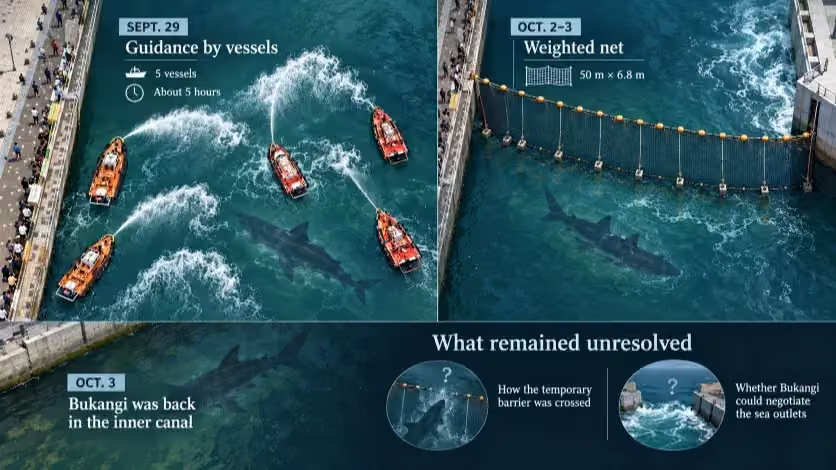 NewsOct 12, 2026
Bukangi, the Shark That Stayed in Busan’s North Port
A rescue net guided Bukangi toward the sea, but the dusky shark returned to B...
More from the author
More from this byline
Stay with the same line of reporting through more work from this byline.
- NewsOct 14, 2026
What Became of Busan’s University Streets?
 NewsSep 28, 2026
Why Some Commercial Space in Busan Is Hard to Reuse
Reader Signal
Community readWhat did this report leave you with?
Choose the signal that best reflects your reading. Select it again to remove it.
One response per article
No response selected
A moderated conversation about the reporting.
One-level replies and newsroom moderation keep the conversation anchored to this article.
Discussion Status
Open
Please sign in to join the discussion.
Newsletter
Weekly reporting and context from Busan and Korea.