Busan’s Renewable Shortfall
Busan produces far more electricity than it uses, yet less than one terawatt-hour comes from renewable sources. Physical limits, stalled offshore plans and rising industrial demand leave Busan with no large-scale path to expand clean power.

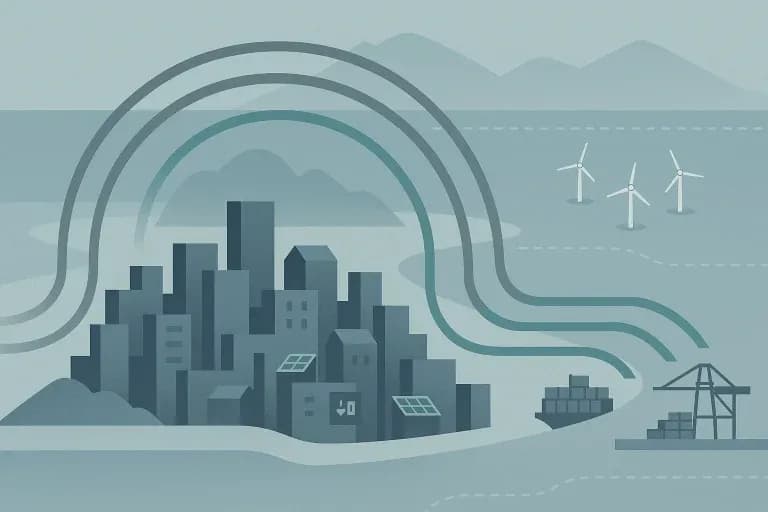
Busan, South Korea — Busan produces far more electricity than it uses in a year. The Kori nuclear complex on the city’s northeastern edge and several LNG-fired plants along the coast send large volumes of power into the national grid, creating a surplus that shows up in official self-sufficiency figures. On paper, the city generates well over 150 percent of its annual electricity demand, a level that suggests little reason for concern.
That number changes meaning once renewable energy is isolated. Busan consumes roughly 22 terawatt-hours of electricity each year, but renewable facilities inside the city generate well under one terawatt-hour. Most of that output comes from fuel cells in Haeundae and Gangseo, small rooftop solar installations and a handful of municipal units such as the wastewater methane plant. Combined, these sources cover only a small share of the load and do not resemble the surplus implied by the city’s overall self-sufficiency measure.
The gap reflects the physical structure of the city. Much of Busan is shaped by steep hillsides and narrow coastal plains where land for utility-scale projects is scarce. Port facilities, shipping lanes, fishing grounds and industrial complexes occupy most of the shoreline. Even in areas where small renewable systems can be placed, parts of the local grid lack the capacity to accept new connections without reinforcement. These conditions define what the city can build and explain why renewable output remains low despite high total generation numbers.
City officials have set goals that outpace the current level of local renewable production. Busan aims to raise the renewable share of its electricity use to 13.5 percent by 2030 and expects the share to exceed half in the 2040s as part of its 2050 carbon-neutral plan. Meeting those targets requires a several-fold increase in renewable generation within a decade, a timeline that depends on projects that have encountered delays or opposition.
The first and only utility-scale project proposed within city waters—a 99-megawatt offshore wind installation off Dadaepo—has drawn sustained resistance from residents and fishing groups. The dispute over its siting, turbine layout and potential impact on fishing grounds and coastal views has slowed administrative progress. Without this project or an alternative of similar scale, the city has no large source of renewable electricity expected to come online in the near term.
Local industries face their own constraints. Companies in export sectors must secure renewable electricity to meet the requirements of global buyers, yet the limited supply inside the city forces reliance on premium tariffs or certificate purchases. For some manufacturers, higher procurement costs influence investment and production decisions, adding pressure to secure renewable electricity either from within the city or through external contracts.
Busan enters the next stage of its energy transition with a power system built around nuclear and gas-fired plants and a renewable base limited by geography and grid capacity. The city’s targets require faster growth than current conditions allow, setting up a conflict between long-term ambitions and the physical limits of its urban and coastal environment. The details of this structure form the basis for understanding how the city produces, consumes and attempts to expand renewable electricity.
How Busan Produces Power — And Why Renewables Remain a Small Share
The graphic below shows Busan’s electricity balance, the constraints on local projects, and the composition of its renewable supply in a single view.
Busan records a surplus on paper, but only a small fraction of its electricity comes from renewable sources inside the city.
Rooftop solar on private buildings and small systems add further output, but each project contributes only in small increments.
What Counts as Busan’s Electricity
Electricity listed as produced in Busan comes mainly from facilities that do not belong to the renewable category. The Kori nuclear complex, positioned just outside the city’s northeastern boundary, supplies the majority of the output counted in regional statistics. Several reactors operate there, and most of the power they generate flows into the national grid rather than serving nearby districts directly. Because the complex sits close enough to be included in Busan’s regional accounting, its output dominates the city’s reported generation.
Gas-fired plants form the second major component of the city’s electricity base. The Busan Combined Cycle Plant in Saha District and related LNG units along the coast contribute large, dispatchable volumes that help meet industrial and commercial loads. These facilities ensure steady supply and bolster the city’s high self-sufficiency figure, but they do not expand the renewable share or reduce dependence on fossil fuels.
Local renewable or low-carbon generation remains comparatively small. Public solar arrays operated by the Busan Environmental Corporation total less than 8 megawatts and produce about 8,800 megawatt-hours annually. The city’s wastewater methane-to-energy plant adds 1.9 megawatts with roughly 12,500 megawatt-hours of output. Fuel cells provide the largest portion of the low-carbon supply: a 30.8-megawatt system operates in Haeundae, and a roughly 10-megawatt facility in Gangseo is expanding. These units supply predictable output but cannot match the scale of the nuclear and gas-fired plants that define Busan’s overall generation.
The city’s grid also shapes what counts as practical local supply. Several distribution lines, particularly in older districts, lack the capacity for additional solar or fuel cell connections without reinforcement. Industrial zones that could host rooftop solar installations are often tied to feeders already carrying heavy loads. These constraints limit where new renewable systems can be built and how much power they can deliver to the grid.
The result is an electricity profile in which nuclear and LNG plants overshadow all other sources. Busan’s self-sufficiency rate appears high because most of the generation counted as regional output comes from large facilities located at or near the city’s edge. Those numbers do not reflect the city’s ability to produce renewable electricity or secure low-carbon supply within its own boundaries. The gap between reported output and renewable availability becomes more evident when examining how little of the city’s demand can be met by local renewable projects.
Why Renewable Output Stays Small Inside the City
Renewable electricity inside Busan remains limited because few sites can host projects of meaningful scale. The city’s terrain is dominated by steep hillsides, narrow valleys and dense residential and industrial districts, leaving little open land available for utility-scale solar installations. Most of the remaining space is reserved for logistics, port operations or protected green zones, none of which are suited for large energy facilities.
Solar output therefore relies almost entirely on rooftops. Small installations on public buildings, schools, factories and apartment complexes form the bulk of the city’s capacity. These projects add incremental amounts of energy, but their potential is constrained by roof size, shading and structural limits. Even when space is available, some buildings sit on feeders that cannot accept additional generation without upgrades, slowing installation timelines.
Fuel cells provide steady, dispatchable output and avoid the land requirements of solar or wind projects. The Haeundae plant supplies 30.8 megawatts, and the Gangseo plant adds around 10 megawatts. Additional clusters are planned, although suitable sites are limited to areas with available industrial parcels and sufficient gas infrastructure. Fuel cells help stabilize the grid and contribute more than rooftop solar, but their combined output remains far below what would be required to shift the city’s energy balance.
Other options are similarly constrained. The wastewater methane facility produces about 12,500 megawatt-hours a year, and municipal solar adds roughly 8,800 megawatt-hours. Waste-to-energy plants add modest amounts but are limited by existing processing capacity. None of these facilities can scale significantly within the city’s boundaries.
The first proposal for a utility-scale renewable project in Busan—the 99-megawatt offshore wind installation off Dadaepo—was expected to become a major source of clean electricity for the city. The project’s ten turbines would be placed three to five kilometers offshore, with output feeding into the local grid. Residents and fishing groups objected to its nearshore location, turbine visibility from the beach, potential impacts on fishing grounds and the planned cable route. District officials also questioned the decision to design the project at 99 megawatts, noting that a capacity of 100 megawatts or more would trigger a full environmental impact assessment.
The dispute slowed the review process. Additional studies on marine conditions, cable routing and coastal landscape effects were requested by district and city authorities. With no approval timeline in place, the project remains uncertain. Without it or an equivalent alternative farther offshore, Busan has no large renewable installation capable of narrowing the gap between current output and its medium-term targets.
The city’s renewable capacity therefore grows at a pace defined by physical limits, grid conditions and community opposition to nearshore projects. Small systems can be added gradually, but Busan lacks a site—on land or at sea—that can support the type of high-volume generation required to change the overall composition of its electricity supply.
Industry Demand and the Limits of Local Supply
Export-oriented companies in Busan face growing requirements to secure renewable electricity from global clients. Firms supplying electronics, automotive components, chemicals and machinery report that major buyers now request documentation showing that a portion of their electricity use comes from renewable sources. These requirements do not apply uniformly across all sectors, but they have become common enough to influence investment plans and routine procurement decisions.
Because Busan produces less than one terawatt-hour of renewable electricity each year, companies seeking guaranteed renewable supply must use the green premium tariff offered by KEPCO or buy renewable energy certificates. Both methods cost more than standard industrial rates. Manufacturers in districts such as Sasang and Myeongji say the higher electricity costs add pressure to maintain margins in markets where product prices are tightly controlled by overseas buyers.
Limited local renewable supply also affects long-term planning. Factories preparing for equipment upgrades or expansions evaluate whether renewable electricity can be sourced at a predictable cost. Several firms note that if they cannot secure renewable energy inside the city or through affordable long-term agreements, parts of their production could move to regions where solar and wind capacity is larger and electricity prices for renewable products are lower. Provinces with extensive solar or offshore wind development offer companies long-term contracts that are not available within Busan.
The city promotes distributed energy systems as a partial answer to these constraints. Fuel cells in Haeundae and Gangseo contribute steady output and can be expanded in industrial zones where space allows. Battery storage projects in Gangseo are intended to ease peak demand and support rooftop solar installations. Microgrid projects in the Eco Delta Smart City district combine these systems to supply small areas with locally generated electricity.
These measures, however, do not resolve the scale difference between industrial demand and local renewable supply. Even with additional fuel cells, storage units and rooftop solar installations, the total renewable output available inside the city remains far below the levels needed for manufacturers aiming to meet global renewable sourcing standards. Companies can document their use of green electricity through premiums and certificates, but this does not increase the physical availability of renewable power in the region.
As a result, industrial demand for renewable electricity in Busan grows faster than the city’s ability to supply it. Manufacturers face rising procurement costs while the city’s renewable portfolio expands only in small increments. The imbalance highlights how the limitations of local generation affect not only municipal energy planning but also the competitiveness of the industries that operate within the city.
Where Busan Stands
The renewable share in Busan is low, but the scale of the gap differs from that of other major metropolitan areas. Seoul remains near the one-percent range, yet its strategy centers on installing solar panels on thousands of public and private rooftops, supported by budgets and programs that fit the capital’s administrative structure. Ulsan produces a similarly small share today but has access to offshore zones in the East Sea that can host floating wind projects far from populated coastline. Incheon is linked to multi-gigawatt wind clusters planned for the West Sea, giving it a route to increase renewable supply once those projects receive approval.
Busan does not have comparable sites. Much of the city’s shoreline is occupied by port terminals, industrial complexes, shipping routes and fishing zones. The remaining coastal areas sit near residential neighborhoods or tourist sites, limiting options for turbines visible from shore. The city does not have flat inland areas for utility-scale solar farms, and the steep terrain makes large installations impractical. These constraints leave the city with few opportunities to develop renewable projects that match the scale seen in other regions.
The city’s targets require growth that exceeds what existing conditions allow. Raising the renewable share to 13.5 percent by 2030 requires more than 3.6 terawatt-hours of renewable electricity. Current output remains below one terawatt-hour. The only project capable of adding a sizable amount of renewable power—the 99-megawatt offshore wind proposal off Dadaepo—has stalled amid objections from residents and fishing groups. Without this project or an alternative site farther offshore, the city has no large source of renewable electricity expected to come online within the next several years.
Distributed systems can expand local capacity in smaller increments. Fuel cells provide steady output, and storage projects in Gangseo can help manage peak demand. Microgrid programs in new development zones combine rooftop solar, fuel cells and batteries to supply local loads. These efforts improve local resilience and reduce pressure on parts of the grid, but they do not change the total volume of renewable electricity available to the city. Even with additional installations, the combined output remains well below what is required to meet mid-term targets.
Industrial demand adds another layer. Export-oriented manufacturers must document the use of renewable electricity to maintain supply-chain compliance for global clients. Because local renewable supply remains small, firms rely on green premium tariffs or renewable energy certificates, increasing procurement costs. Companies evaluating expansion plans note that access to affordable renewable electricity influences long-term investment decisions. Regions with large solar fields or offshore wind capacity offer long-term agreements that Busan cannot match.
Busan enters the next stage of its energy transition with physical and structural limits that differ from those of other metropolitan areas. The city’s geography, coastal use patterns and grid conditions restrict where large renewable projects can be placed. Its renewable output grows in small steps while industrial demand increases at a faster pace. Without a utility-scale project or a clear path to external procurement, the gap between the city’s goals and its available renewable supply remains wide.
Continue this reporting
Reporting on the same issue
Related coverage selected from the article's desk, topics and newsroom relationships.
 NewsOct 22, 2026
Busan Port’s LNG and Methanol Plan: Who Pays to Keep Fuel Ready?
Busan already supplies ships with LNG and methanol, drawing on regional and i...
 NewsOct 16, 2026
What Is Still Worth Going to See?
Busan’s biennale faces questions of artistic judgment and institutional care....
 NewsOct 14, 2026
What Became of Busan’s University Streets?
From 2015 to 2023, registered businesses grew near Pusan National University...
More from the author
More from this byline
Stay with the same line of reporting through more work from this byline.
- NewsOct 22, 2026
Busan Port’s LNG and Methanol Plan: Who Pays to Keep Fuel Ready?
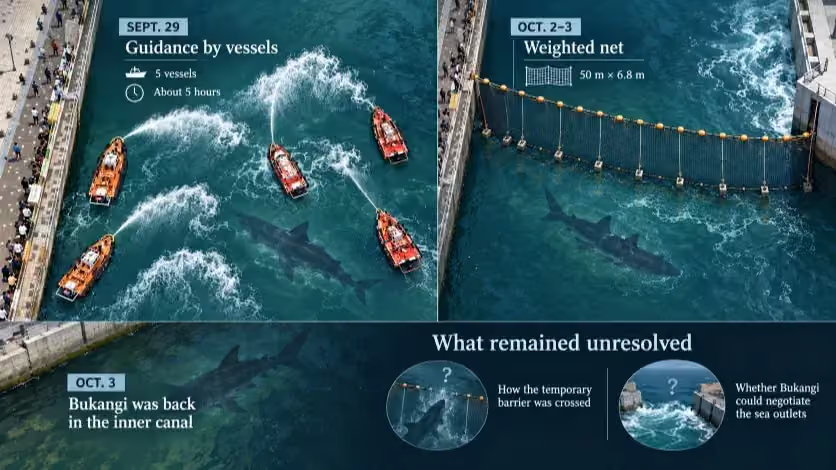 NewsOct 12, 2026
Bukangi, the Shark That Stayed in Busan’s North Port
Reader Signal
Community readWhat did this report leave you with?
Choose the signal that best reflects your reading. Select it again to remove it.
One response per article
No response selected
A moderated conversation about the reporting.
One-level replies and newsroom moderation keep the conversation anchored to this article.
Discussion Status
Open
Please sign in to join the discussion.
Newsletter
Weekly reporting and context from Busan and Korea.