Busan’s Maritime Court Faces the Case-Flow Test
Busan’s new Maritime and International Commercial Court gives the city a formal place in Korea’s maritime justice system. Turning that court into a legal forum will depend on whether cargo flows can become case flows.

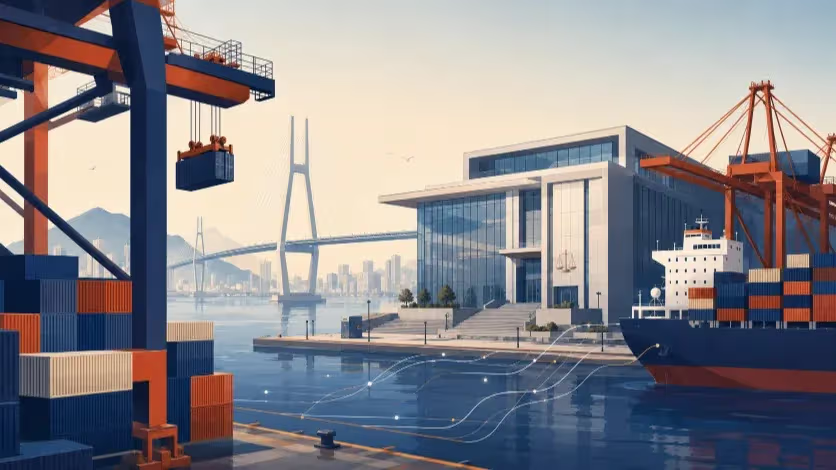
South Korea’s new Maritime and International Commercial Court gives Busan a long-sought judicial foothold. The harder test is whether the city can turn cargo flows into case flows.
Busan’s Maritime and International Commercial Court has entered the stage where a legal idea begins to acquire a physical address. Court officials have started reviewing possible sites, including the North Port area, and local lawyers are using the early implementation period to press for a question the building itself cannot answer: whether maritime expertise will remain in Busan after the first judgment is handed down.
The timing gives the debate its force. South Korea has already decided that Busan will host one of the country’s two new specialized courts for maritime and international commercial disputes, alongside Incheon, with opening scheduled for March 2028. Busan has long argued that such a court belongs where Korea’s largest container port, transshipment traffic and maritime industries are concentrated. The court now being built gives the city a trial forum. It does not yet give Busan the wider structure that turns a port economy into a dispute-resolution market.
Maritime disputes rarely arrive at court as isolated legal problems. They travel through contracts, insurers, cargo interests, shipowners, law firms and arbitration clauses before they reach a judge. A city gains authority in shipping law when those actors begin to treat it as a place where disputes can be filed, argued, appealed, enforced and understood with confidence. Busan’s 2028 opening will test whether the new court can join that chain, rather than stand beside a market that still looks elsewhere.
The court Busan won, and the hierarchy it still lacks
The new court gives Busan an institutional place in South Korea’s maritime justice system, but its design also marks the limit of the victory. Busan Metropolitan City says the court is expected to handle maritime civil cases, maritime administrative cases and international commercial cases from the Yeongnam, Honam and Jeju regions. Incheon will serve the other side of the new structure, reflecting a compromise between Busan’s port economy and the corporate, logistics and legal-market pull of the Seoul metropolitan area.
The court’s expanded name carries its own signal. A campaign that began around a maritime court has produced a broader Maritime and International Commercial Court. Its docket may reach beyond vessel collisions and cargo damage into charterparties, bills of lading, marine insurance, ship arrest, limitation of liability, arbitration-related proceedings and cross-border commercial disputes with a Korean connection. The institution gives Busan a formal channel into some of the legal work attached to shipping, trade and logistics.
The appellate layer remains outside that achievement. The new court is not a maritime high court, and the current structure does not create a single specialized maritime appeals track centered in Busan. A case may begin before a specialist maritime court, then move into the ordinary high-court system just as the legal questions become more consequential.
That split matters because maritime law develops through repeated clarification. Shipowners, insurers, cargo interests and lawyers do not look only at where a claim can be filed. They look at where legal standards are refined, where risk becomes predictable and where the next contract can be written with some confidence about how a dispute will be treated.
Busan’s push for an appellate layer is therefore more than a demand for another institution. It is an attempt to keep legal authority close to the cases the new court is meant to hear. Without appellate specialization, the city may receive the first instance of maritime litigation while the doctrinal work that gives a forum long-term credibility remains dispersed.
Where maritime law gains its weight
Maritime litigation rarely turns on a single damaged cargo claim or a single collision report. A dispute may begin with a vessel, a container, a port delay or a casualty at sea, but the legal questions often travel through several layers at once: the charterparty that allocated risk, the bill of lading that governed carriage, the insurance policy that responded to loss, the limitation proceeding that capped exposure and the arbitration clause that may have already sent part of the conflict elsewhere.
The first judgment may decide who wins a case. The appeal often decides how the next contract is read.
In maritime commerce, legal predictability is not an academic virtue. It affects freight pricing, insurance reserves, claims handling, settlement strategy and the language that lawyers insert into future agreements. A ruling on vessel collision may influence how fault is argued in the next casualty. A ruling on limitation of liability may change how shipowners and insurers assess exposure. A ruling on a bill of lading may affect cargo interests long before another container is lost. A ruling on ship arrest may determine whether a creditor sees Busan as an effective place to secure a claim before a vessel leaves port.
The new court’s docket is likely to touch precisely those areas. Legal analysts expect the Maritime and International Commercial Court to handle disputes involving marine insurance, carriage and charter contracts, shipbuilding and repair contracts, vessel collisions, limitation of liability, general average, salvage, oil pollution, ship arrest, enforcement of foreign judgments and court proceedings connected to arbitration. Those categories are not merely labels for specialized litigation. They are the legal infrastructure of shipping.
A specialized appellate practice can turn that infrastructure into authority. It can produce a body of decisions that lawyers, insurers, shipowners and cargo interests begin to treat as a guide to commercial behavior. The system does not need every maritime appeal in Korea to be filed in Busan. It does need concentration of expertise somewhere. If the new trial court develops one set of maritime habits while appellate review remains scattered across generalist benches, specialization may be strongest at the point of filing and weakest at the point where doctrine is refined.
Busan’s claim rests on more than proximity to the port. The city is arguing, implicitly if not always in those terms, that maritime disputes should not be separated from the appellate expertise needed to make them predictable. A court that hears cargo, insurance, collision and ship arrest cases can build experience. A court system that carries that experience into appeal can build authority.
The difference will be felt most clearly by parties that choose forums before any lawsuit begins. Shipowners, charterers, cargo interests and insurers do not wait for a dispute to decide where law matters. They choose governing law, jurisdiction and arbitration clauses at the contract stage. If Busan wants those choices to point toward Korea, and toward Busan in particular, the city will need a visible path from first judgment to appellate clarification, from court procedure to enforcement, and from local expertise to international confidence.
Cargo flow is not case flow
Busan’s strongest claim begins outside the courtroom. The city does not need to invent a maritime identity for the new court. It already sits beside the port that handles the vessels, containers and transshipment flows at the center of Korea’s shipping economy.
The scale gives Busan a serious argument. The Ministry of Oceans and Fisheries says Busan Port handled about 24.4 million TEU in 2024, its highest annual volume on record, while transshipment volume reached about 13.5 million TEU. More than half of the port’s container traffic now comes from cargo moving between ships rather than simply entering or leaving Korea. That structure gives Busan a role larger than a domestic gateway. It is a switching point in regional supply chains, where delays, cargo claims, vessel schedules, terminal operations and commercial risk can spread beyond one port call.
Yet maritime legal work does not follow cargo automatically. Disputes follow the documents and institutions that parties choose before anything goes wrong: the charterparty, the bill of lading, the insurance policy, the financing agreement, the arbitration clause, the governing-law provision and the lawyers who draft them. A container may pass through Busan. The contract governing the dispute may still point to English law, London arbitration, a Seoul law firm, a Singapore hearing room or an insurer whose claims strategy is formed elsewhere.
That is the gap Busan has to close. The city has port gravity, but legal-market gravity remains harder to capture. Shipowners, cargo interests and insurers may operate through Busan’s physical infrastructure while relying on legal infrastructure concentrated in other cities. Seoul and Incheon bring a different kind of pull: corporate headquarters, logistics companies, major law firms, foreign business services and proximity to the capital region where many forum decisions are made.
The two-court structure reflects that tension. Busan’s case rests on the port economy and the concentration of maritime activity in the southeast. Incheon’s case rests on the metropolitan economy and the concentration of companies, logistics operators and legal services around Seoul. The compromise gives Korea two maritime and international commercial courts, but it also divides the question that matters most for Busan: where will parties choose to bring disputes that are not forced there by statute?
The court’s future will be decided partly in that market. If the new institution receives only disputes that must be filed there, Busan may gain a specialized docket without gaining a larger maritime legal economy. If shipping contracts, terminal agreements, ship-repair contracts, marine insurance arrangements and logistics disputes begin to name Busan as a forum, the court could become part of the commercial architecture of the port itself.
Cargo flow measures what passes through the harbor. Case flow measures whether the legal consequences of that activity are handled in the same city. Busan already has the first. The second will depend on whether shipowners, cargo interests, insurers, terminal operators and lawyers begin to treat Busan not only as a port of call, but as a place where maritime risk can be priced, argued and resolved.
What established forums already know
The international models often invoked in Busan’s maritime court debate were not built by courts alone. London, Singapore and Hong Kong each show a different route by which maritime and commercial disputes are pulled toward a forum before a claim is filed. Their strength lies less in the name of any single institution than in the habits, clauses and services that make parties comfortable choosing them.
London’s authority begins at the contract stage. Charterparties, bills of lading, marine insurance contracts and shipbuilding agreements often point to English law or London arbitration long before a dispute arises. By the time a claim reaches lawyers, the forum may already have been chosen by a clause drafted months or years earlier. The London Maritime Arbitrators Association recorded 3,469 appointments under its terms in 2025, with an estimated 2,015 references and 563 awards. Those figures describe a market in which legal work is not waiting for a state to direct cases into a court. The market has already learned where to send them.
That is the part of London that matters most for Busan. Admiralty procedure and maritime expertise are important, but the deeper advantage is contractual habit. London’s position is reinforced every time a shipowner, charterer, insurer or cargo interest accepts a clause that sends future disputes into English law and London arbitration. Once that pattern is embedded, the city’s legal authority travels with ships that may never enter the Thames.
Singapore offers a different lesson. It has treated dispute resolution as infrastructure. The Singapore International Commercial Court presents itself as a court designed for international commercial parties, with flexible procedure and a model often described as bringing features of arbitration into litigation. Maxwell Chambers adds another layer: hearing rooms, digital support, arbitration institutions and legal-service providers placed inside a purpose-built dispute-resolution environment.
International parties do not choose a forum only by reading jurisdictional statutes. They ask whether documents can be handled in English, whether foreign law can be argued competently, whether hearings can be managed across time zones, whether interim relief and enforcement can be obtained, and whether the forum understands the commercial tempo of cross-border disputes. Singapore has spent years reducing those frictions into a recognizable product.
Hong Kong shows the competitive pressure facing Busan. Asia does not lack established dispute forums. HKIAC received 582 new cases in 2025, including 388 arbitrations, and maritime disputes made up a visible share of its caseload. Hong Kong’s position has been shaped by China-facing commerce, common-law procedure, bilingual legal practice and a long arbitration record. For Busan, the point is not to replicate Hong Kong’s model, but to recognize that regional competition already has depth.
The comparison leaves Busan with a more demanding benchmark than port size. London shows how maritime legal authority can be written into contracts. Singapore shows how a state can build a dispute-resolution product around courts, arbitration and services. Hong Kong shows that Asia already has forums with international caseloads and professional memory. Busan will enter that market with a port, a new court and a strong domestic rationale. It will still need the contractual pathways, procedural confidence and professional density that make foreign parties choose a forum without being compelled to do so.
Before the opening, a forum has to be built
The work left for Busan is neither ceremonial nor architectural. A courthouse can open on schedule and still fail to change where maritime disputes are fought. The harder task is to make the new court visible inside the commercial decisions that precede litigation: the contract clause, the insurance review, the arbitration agreement, the enforcement strategy and the lawyer’s advice about where a claim should be brought.
Appeals are the first test. Busan does not need to frame the issue only as a demand for another court. A more immediate route would be appellate specialization within the existing high-court structure, with maritime and international commercial appeals handled by judges who can carry the expertise of the new first-instance court into the next stage of review. A specialized bench inside the Busan High Court would not settle every jurisdictional question, but it would give the system a clearer path from trial judgment to appellate clarification. Without that path, specialization may thin out just as the legal questions become more important.
The next task lies outside the judiciary. If Busan wants disputes to arrive by choice rather than by statute, the city and its maritime industries will have to work at the contract stage. Port operators, terminal companies, logistics firms, ship-repair businesses, insurers and shipping companies can shape future case flow through forum-selection clauses, governing-law provisions and arbitration agreements. A Busan court will matter more if Busan appears not only on sailing schedules, but also in the documents that allocate risk when cargo is delayed, a vessel is arrested, a repair contract breaks down or an insurer contests a claim.
Arbitration will determine how far that strategy can reach. APMAC and KCAB cannot remain background institutions invoked only when officials describe Busan’s maritime credentials. They would need standard English-language maritime clauses, fast procedures for smaller claims, emergency options for urgent disputes, credible international arbitrator lists and public statistics that show foreign parties how the system works. London’s arbitration market did not grow because cases were assigned to it from outside. It grew because contracts repeatedly sent disputes there.
The court will also have to be usable by parties who do not experience Korean procedure as local users do. Foreign shipowners, cargo interests and insurers will ask practical questions before symbolic ones. Can documents be handled in English? Can foreign law be argued without procedural uncertainty? Can expert evidence, remote testimony and interim relief be managed at the pace of shipping disputes? Can a party understand the likely route from filing to appeal to enforcement? A maritime forum earns trust when those questions have ordinary answers.
The final piece is publication. If the new court is to influence behavior beyond individual cases, its decisions will have to circulate. English summaries of major judgments, anonymized case digests, statistics on ship arrest, limitation of liability, arbitration-related proceedings and enforcement cases would make the court legible to the market it hopes to serve. Maritime law gains authority when lawyers can read it, cite it and use it to advise the next client before the next dispute begins.
Busan’s advantage remains real. The city has the port, the cargo flows and the maritime identity that make the new court plausible. Its weakness is just as clear. Legal authority in shipping does not rise automatically from harbor traffic. It is built when contracts point to a forum, when appeals refine the rules, when arbitration institutions handle real cases, when foreign parties can use the procedure, and when decisions become part of the commercial record.
The 2028 opening will mark the beginning of the test, not its completion. Busan has secured the right to host the court. Its larger challenge is to make the shipping market treat Busan as a place where maritime risk can be argued, enforced and resolved.
Continue this reporting
Reporting on the same issue
Related coverage selected from the article's desk, topics and newsroom relationships.
 NewsOct 25, 2026
The Long Bill for Busan’s Apartment City
Busan has about 958,000 apartments even as its population declines. Elevators...
 NewsOct 23, 2026
Busan’s Twelve-Year School Account Faces a Test Beyond Access
Busan’s PENZ promises one school account for 12 years, while BeAT brings AI t...
 NewsOct 22, 2026
Busan Port’s LNG and Methanol Plan: Who Pays to Keep Fuel Ready?
Busan already supplies ships with LNG and methanol, drawing on regional and i...
More from the author
More from this byline
Stay with the same line of reporting through more work from this byline.
 NewsOct 21, 2026
What a Small Mackerel Is Worth

Reader Signal
Community readWhat did this report leave you with?
Choose the signal that best reflects your reading. Select it again to remove it.
One response per article
No response selected
A moderated conversation about the reporting.
One-level replies and newsroom moderation keep the conversation anchored to this article.
Discussion Status
Open
Please sign in to join the discussion.
Newsletter
Weekly reporting and context from Busan and Korea.