Busan’s Glocal Picks Ignore Maritime Strength
The Ministry of Education’s Glocal University program promised innovation. In Busan, it produced three designated projects centered on cultural branding and enrollment drives, not maritime engineers or energy specialists. The question now is whether these models can survive once subsidies run out.


Busan, South Korea — Busan has now placed three models under the Ministry of Education’s Glocal University 30 program: the integration of Pusan National University with the Busan National University of Education, the consortium between Dong-A and Dongseo Universities, and, most recently, the solo designation of Kyungsung University. On paper, the city looks well positioned, having secured a broad share of the initiative’s attention and resources.
The substance, however, tells a different story. Busan’s economy has long been defined by maritime trade, shipbuilding, logistics, and energy — industries that demand advanced technical expertise and long-term research capacity. Yet the universities chosen as “glocal” models are aligned with cultural branding, teacher training, or loosely defined notions of convergence. The exclusion of the Korea Maritime and Ocean University, the one institution directly tied to the city’s strategic identity, underscores the disconnect.
What emerges is less a blueprint for sustainable transformation than an illustration of how national higher education policy can drift away from regional priorities. The question is no longer whether Busan’s universities can attract short-term subsidies, but whether they can generate the talent and research needed to anchor the city’s future industries.
Pusan National Univ. + Busan National Univ. of Education
- Combine PNU research capacity with teacher training expertise.
- K–12 collaboration platforms for classroom reform.
- Weak linkage to Busan’s maritime/logistics/energy workforce.
- Integration delays; full launch expected around 2027.
Dong-A University + Dongseo University
- Joint degrees and industry-linked research projects.
- Programs designed to break departmental silos.
- Heavy reliance on foreign enrollment invites “visa-school” concerns.
- Seat-filling incentives risk sidelining instructional quality.
Kyungsung University
- In-house holding company for content production/distribution.
- Non-departmental, non-year system for flexible learning.
- Links to film festival and MICE industries.
- Ties to culture are symbolic; limited industrial weight.
- Lacks concrete curriculum redesign and faculty training detail.
- Misaligned with maritime/logistics/energy labor demand.
A Policy Built on Slogans, Not Classrooms
The central weakness of the Glocal University program lies in its reliance on language rather than implementation. Proposals submitted to the ministry consistently highlight “convergence,” “global talent,” or “K-Culture” without detailing how curricula, governance, or faculty structures will change. Plans remain largely at the level of branding, while classrooms, credit systems, and departmental boundaries remain intact.
Funding dependency is another flaw. Universities are promised up to one trillion won over five years, yet none of the designated institutions has presented a credible plan for sustaining programs once subsidies expire. In many cases, survival depends not on reform but on the continuous inflow of state support.
The reliance on foreign students compounds the problem. With the domestic student base shrinking, institutions increasingly treat international enrollment as a financial lifeline. The model carries risks: quality assurance is secondary, and the perception of “visa schools” — colleges focused on issuing residency documents rather than education — continues to grow. This strategy may fill seats, but it does little to strengthen academic standing or integrate universities into regional economies.
Most striking is the misalignment with local industry. The initiative was sold as a vehicle for regional revitalization, yet in practice it has rewarded proposals heavy on abstract rhetoric and light on sectoral relevance. In Busan, a maritime capital facing global competition in logistics, shipbuilding, and energy technology, the absence of targeted investment in these fields reveals the program’s structural blind spot.
Three Models, One City — and No Maritime Anchor
Busan’s designated universities illustrate the contradictions of the Glocal initiative with unusual clarity.
Kyungsung University was chosen as a solo model on the strength of its plan to build a K-Culture MEGA Campus, centered on immersive training in entertainment, media, and the arts. The proposal clearly resonates with Busan’s image as a city of film festivals and exhibitions. Yet this contribution remains largely symbolic. Cultural industries carry weight for the city’s profile, but compared to shipbuilding, logistics, or energy, they lack the scale to drive long-term economic competitiveness. In that sense, the university’s designation highlights a misalignment between policy incentives and the city’s industrial backbone.
The consortium between Dong-A and Dongseo Universities has promoted itself as a hub for hydrogen energy, semiconductors, and creative content. These fields, at least in principle, move closer to industrial demand. But the proposal leans heavily on the promise of recruiting 7,000 foreign students over five years, raising questions about whether enrollment goals take precedence over the substance of program design. The trend is not isolated. Many of Busan’s private universities already enroll foreign students at levels exceeding one-fifth of their intake, a pattern that has fueled debate over whether institutions are functioning primarily as visa-granting schools rather than centers of higher learning.
The integration of Pusan National University with the Busan National University of Education has been framed as consolidation for efficiency and teacher training. While it may ease administrative burdens, its orientation does little to strengthen the technical workforce that local industries demand.
The most striking absence is the Korea Maritime and Ocean University. As the only institution directly tied to Busan’s identity as a maritime hub, its exclusion is difficult to reconcile with the stated goals of regional revitalization. Civic groups have already condemned the decision as undermining the very sector that anchors the city’s global role.
Taken together, the three designated models form a patchwork of projects that may secure temporary subsidies but fail to establish a coherent strategy for the city’s industrial future.
Talent Drains, Visa Schools, and a Weakened Industrial Base
The divergence between designation and necessity carries consequences that extend beyond campus walls. Busan’s core industries are already under pressure from demographic decline, rising competition in East Asia, and the demand for advanced technical skills. Yet the universities chosen as “glocal” institutions are not positioned to meet these pressures. By emphasizing cultural branding and teacher training, the city risks producing graduates disconnected from its industrial base.
Reliance on foreign enrollment as a financial lifeline adds a further layer of fragility. International students bring immediate tuition income, but without improvements in teaching and research, their presence does little to strengthen the region’s competitiveness. Employers grow wary of credentials that do not reflect technical depth, while universities expose themselves to sudden shocks if immigration policy or global recruitment trends shift.
The absence of Korea Maritime and Ocean University is especially consequential. At a time when other regional economies are investing in maritime technology, logistics innovation, and renewable energy, Busan’s universities are left without a designated institution to lead in precisely those areas. The result is a weakening of the city’s claim to be a global maritime hub, and with it, the erosion of one of its few structural advantages.
From Subsidy to Substance: What Busan’s Universities Must Do
If Busan’s participation in the Glocal University program is to have lasting value, its institutions must move beyond short-term visibility and subsidy-driven planning. The city’s industrial identity provides a clear roadmap: maritime engineering, shipbuilding, logistics, and energy should form the backbone of any serious reform. Unless universities commit to these areas, the mismatch between training and employment will only deepen.
The credibility of Busan’s universities will hinge on their capacity to restore educational quality. Subsidies should not be treated as windfalls but as seed capital, tied to verifiable changes in curricula, laboratories, and faculty expertise. Without such changes, the initiative risks reinforcing the very decline it was meant to arrest.
Equally important is the role of industry itself. Maritime and logistics firms, along with energy companies, must have a place in program design and governance if universities are to produce graduates equipped for the labor market. Absent that connection, higher education will continue to operate in isolation from the city’s economic reality.
Finally, planning must extend beyond the five-year horizon of government funding. If glocal projects collapse once subsidies expire, Busan will be left with little more than temporary relief. Sustainable models, grounded in industrial partnerships, research collaboration, and diversified revenue, are essential if these designations are to amount to more than symbolic recognition.
Continue this reporting
Reporting on the same issue
Related coverage selected from the article's desk, topics and newsroom relationships.
 NewsOct 16, 2026
What Is Still Worth Going to See?
Busan’s biennale faces questions of artistic judgment and institutional care....
 NewsOct 14, 2026
What Became of Busan’s University Streets?
From 2015 to 2023, registered businesses grew near Pusan National University...
 NewsOct 12, 2026
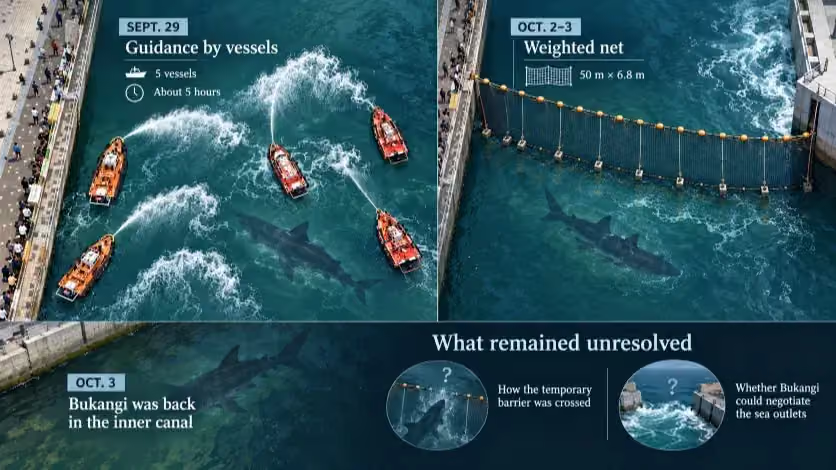
Bukangi, the Shark That Stayed in Busan’s North Port
A rescue net guided Bukangi toward the sea, but the dusky shark returned to B...
More from the author
More from this byline
Stay with the same line of reporting through more work from this byline.
- NewsOct 14, 2026
What Became of Busan’s University Streets?
 NewsSep 28, 2026
Why Some Commercial Space in Busan Is Hard to Reuse
Reader Signal
Community readWhat did this report leave you with?
Choose the signal that best reflects your reading. Select it again to remove it.
One response per article
No response selected
A moderated conversation about the reporting.
One-level replies and newsroom moderation keep the conversation anchored to this article.
Discussion Status
Open
Please sign in to join the discussion.
Newsletter
Weekly reporting and context from Busan and Korea.