Busan’s Glocal University Plans Raise Doubts Over Execution and Impact
Kyungsung University and BUFS promise immersive learning and multilingual AI platforms, yet offer little evidence of actual educational reform.


Busan, South Korea — In July 2025, the city of Busan convened high-profile strategy sessions showcasing the visions of Kyungsung University and Busan University of Foreign Studies (BUFS) under the Ministry of Education’s Glocal University 30 initiative.
Framed as a final push for designation before the program’s deadline, both institutions presented detailed transformation plans aimed at reshaping themselves as global-regional education hubs. At stake: five-year eligibility for state support totaling up to 100 billion KRW and regulatory privileges designed to accelerate educational innovation.
Kyungsung University’s proposal centered on building a “K-Culture MEGA Campus,” an interdisciplinary space meant to collapse traditional departmental boundaries and promote immersive education across media, film, entertainment, MICE, and arts.
BUFS pledged to become a multilingual AI powerhouse by aggregating language, cultural, and industry data from over 50 languages into open platforms, positioning itself as an international education and tech hub. City officials and the mayor endorsed both strategies and committed to supporting the universities through regional industrial cooperation and infrastructure investments.
Yet beneath the public narrative of transformation, signs of systemic fragility are already emerging. Despite nearly a year of proposal development, neither institution has implemented significant academic restructuring.
Kyungsung’s departments remain intact, and its course catalog shows no operational shift toward non-major, non-year education. BUFS continues to deliver instruction through its standard language and international studies departments, with no indication that an AI-based multilingual curriculum has been integrated into actual classrooms. No public records show revised academic regulations, updated credit structures, or cross-disciplinary pilot courses under the glocal model.
Faculty and student engagement in shaping these transformations appears minimal. There are no formal university-wide resolutions from faculty bodies supporting the proposals. Student input was not included in reported curriculum planning discussions, and no outreach sessions were held to explain the implications of academic reorganization.
One attempt to submit a joint glocal campus between Kyungsung and BUFS—initially framed as a collaborative “Busan K-Hub” platform—was quietly abandoned in the final proposal stage, and both universities now pursue separate designations.
These patterns mirror national trends. The Ministry of Education’s February 2025 internal audit acknowledged that although most glocal universities had submitted formal strategies, only a minority had begun instructional redesign. At Gangwon National University, an ambitious merger with Gangneung-Wonju National University encountered governance delays and failed to launch scheduled joint programs. Ulsan University’s model attracted significant private capital, but was met with criticism from faculty over transparency and corporate influence on academic direction.
Survey results released by the Korea Education Development Institute in late 2024 show that over 60% of students at glocal-designated institutions were unaware of the initiative or its objectives. Fewer than 15% reported taking part in courses or projects associated with the glocal transition. Education experts have noted a widening gap between the policy’s stated aims—regional innovation through university reform—and the actual pace and quality of its pedagogical implementation.
While implementation delays and structural tensions pose visible hurdles, a more fundamental issue lies within the design of the universities’ glocal strategies themselves. At their core, both institutions rely on abstract concepts—reminiscent of previous government programs—without clearly articulating how these ideas will materialize into academic innovation.
Kyungsung University’s MEGA campus strategy, for example, repackages existing disciplines like media, arts, and entertainment under a new brand acronym. While it promises “immersive, ultra-realistic learning,” it offers no publicly available plan for how AR, VR, or studio-based production methods will be integrated into the curriculum or supported by faculty training. Similarly, the proposal to dissolve traditional departments into cross-sector “labs” lacks detail on credit recognition, academic advising, or course design.
BUFS’s vision of a multilingual AI-driven data ecosystem is also ambitious but structurally vague. The commitment to leverage over 50 foreign languages through AI technologies assumes infrastructure and linguistic datasets that currently do not exist at the institutional level. There is no mention of partnerships with computational linguists, dataset providers, or cloud architecture experts capable of supporting such a platform. Furthermore, the notion of “opening this data to the region” is not accompanied by legal, technical, or ethical guidelines on how that data would be collected, stored, or shared.
In both cases, the strategies appear to rely heavily on familiar keywords—“innovation,” “global,” “immersion,” “AI”—while offering few mechanisms for actual execution. Without grounded timelines, budgeted resources, or instructional design roadmaps, these proposals risk becoming formal responses to funding incentives rather than transformative models of education.
Despite Busan’s strong political will and institutional endorsements, the absence of internal consensus, pedagogical clarity, and executional readiness casts doubt on whether these universities can become more than symbolic glocal campuses. As final selections approach in September, the initiative’s success will depend not just on visionary language but on whether these institutions can convert ambition into action, and rhetoric into reform.
Continue this reporting
Reporting on the same issue
Related coverage selected from the article's desk, topics and newsroom relationships.
 NewsOct 16, 2026
What Is Still Worth Going to See?
Busan’s biennale faces questions of artistic judgment and institutional care....
 NewsOct 14, 2026
What Became of Busan’s University Streets?
From 2015 to 2023, registered businesses grew near Pusan National University...
 NewsOct 12, 2026
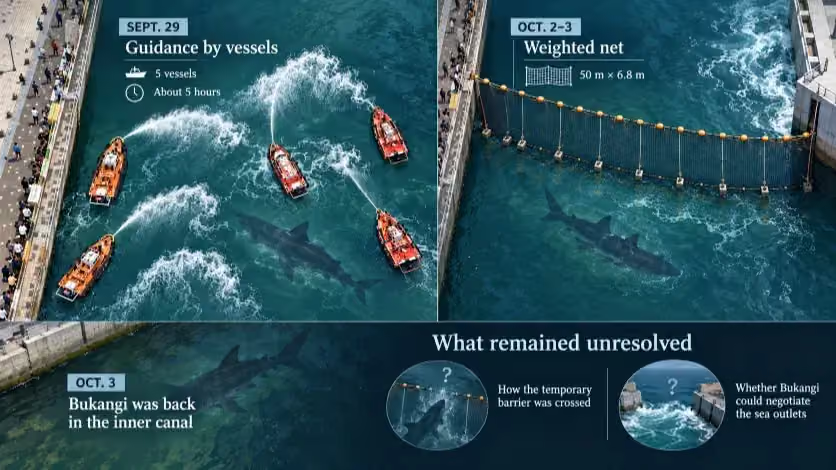
Bukangi, the Shark That Stayed in Busan’s North Port
A rescue net guided Bukangi toward the sea, but the dusky shark returned to B...
More from the author
More from this byline
Stay with the same line of reporting through more work from this byline.
- NewsOct 14, 2026
What Became of Busan’s University Streets?
 NewsSep 28, 2026
Why Some Commercial Space in Busan Is Hard to Reuse
Reader Signal
Community readWhat did this report leave you with?
Choose the signal that best reflects your reading. Select it again to remove it.
One response per article
No response selected
A moderated conversation about the reporting.
One-level replies and newsroom moderation keep the conversation anchored to this article.
Discussion Status
Open
Please sign in to join the discussion.
Newsletter
Weekly reporting and context from Busan and Korea.