Busan’s Design Obsession Turns Industry into Image
“Design became Busan’s new industrial policy — not a means of production, but a method of presentation.” The city’s shift toward design governance turned aesthetics into administration.

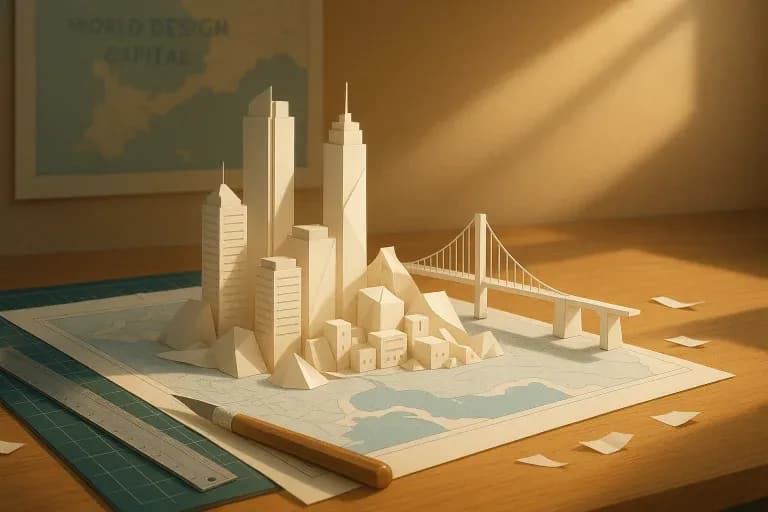
Busan, South Korea — For much of the past century, Busan’s identity has been anchored in production — shipbuilding, machinery, and logistics that helped power South Korea’s rise as a trading nation. Over the past two decades, however, that industrial base has gradually thinned. Corporate headquarters have drifted toward Seoul, port operations have grown increasingly automated and regionally fragmented, and manufacturing employment, while fluctuating, has trended downward overall. Once defined by heavy industry, Busan now finds itself a modern port city with fading engines of growth.
The collapse of Busan’s 2030 World Expo bid in late 2023 exposed this uncertainty in sharp relief. For nearly a decade, the Expo had served as a unifying industrial narrative — a symbolic promise that global recognition could catalyze a new development cycle. Its defeat delivered more than a political setback; it revealed a strategic void. The city had no clear alternative blueprint for economic modernization.
Into that vacuum stepped design. Beginning in 2024, Busan repositioned itself around the language of creativity and aesthetics, culminating in its selection as World Design Capital 2028 by the World Design Organization. What started as a cultural honor quickly evolved into an administrative principle. Within months, official documents, project proposals, and mayoral speeches began to frame design thinking not merely as an artistic process but as a model for governance.
The pivot was pragmatic as much as symbolic. Large-scale industrial reinvention demands long-term investment and national coordination — resources beyond the fiscal reach of local government. Design, by contrast, offered a narrative of renewal that was relatively inexpensive, rapid, and visually compelling. It allowed City Hall to project transformation without confronting the harsher arithmetic of deindustrialization.
By mid-2025, “design” had become the connective tissue of Busan’s policy discourse — embedded in slogans, departmental titles, and public programming. It filled the semantic space once occupied by “innovation” or “industrial renaissance,” marking a shift toward a post-industrial mode of self-representation.
Yet the substitution carries risk. Aesthetic policy can sustain optimism, but it cannot replace structural capacity. As Busan rebrands itself through the language of creativity, the question remains whether it is designing a future — or simply designing the perception of one.
Inside Busan City Hall’s Shift from Industrial Policy to Design Governance
The reorientation toward design did not stop at rhetoric — it has been built into the architecture of Busan’s administration. Since 2022, the municipal government has expanded a cluster of divisions dedicated to “design-related governance”: Design City Policy, Design Industry Innovation, Urban Public Design, and 15-Minute City Planning. Each reports through separate bureaus but operates under similar mandates. Collectively, they form what city officials describe as a network for “citizen-centered, design-driven policy.”
At first glance, the structure projects modernization — a government reorganized around creativity, participation, and urban aesthetics. In practice, however, it reveals a bureaucracy where language increasingly shapes function.
Each unit pursues overlapping objectives — promoting design awareness, managing exhibitions, and regulating visual standards in public space — yet coordination remains limited and performance metrics unclear. The outcome is an administrative ecosystem that multiplies visibility while diluting accountability.
Budgetary data reflects this pattern. Between 2022 and 2025, municipal spending labeled under design initiatives expanded significantly, while funding for industrial R&D, logistics innovation, and AI-based manufacturing support grew more slowly. The Design Industry Innovation Division, originally intended to support creative SMEs, now dedicates much of its budget to digital content production, international showcases, and promotional campaigns tied to the World Design Capital 2028 title. Other bureaus have followed suit, incorporating “design” terminology into proposals to access discretionary funding streams.
The cumulative effect is what observers have described as semantic governance — a system in which programs are justified less by measurable outcomes than by alignment with an aesthetic vocabulary. “Design” functions both as a policy keyword and as a protective frame: it allows initiatives to bypass conventional performance criteria because success is narrated rather than quantified.
Meanwhile, the structural core of Busan’s economy — industrial modernization, technology transfer, and manufacturing renewal — remains comparatively underdeveloped. While the city maintains units for innovation and digital policy, it lacks a comprehensive bureau dedicated to advanced manufacturing or AI-industry integration beyond port automation. This gap is notable given that the national government’s growth strategy emphasizes AI convergence and “physical-AI” manufacturing ecosystems. By contrast, Busan’s digital programs remain concentrated in administrative convenience tools — automated translation of press releases, chatbot services, and AI-assisted visual design generation — promoted as evidence of innovation rather than engines of production.
This contrast captures the paradox of Busan’s design governance: an administrative expansion that strengthens symbolic cohesion while exposing structural fragility. The city has, in effect, redesigned its bureaucracy to be more legible to itself — capable of producing coherent imagery but less capable of coordinating material transformation.
In doing so, Busan illustrates a broader pattern of post-industrial governance by image. Its organizational map resembles not a system of production but a tableau of aspirations — departments named for participation, happiness, and design: linguistically modern, functionally diffuse. The challenge ahead is not merely to modernize the bureaucracy, but to restore substance to a structure optimized for storytelling.
Why Busan’s 15-Minute City Became a Branding Project, Not Urban Reform
Busan’s so-called 15-Minute City initiative offers perhaps the clearest example of how the language of design has been converted into a political instrument. The concept, adapted from compact European urban models, envisions that every resident can reach essential services within a fifteen-minute walk or ride. In dense, mixed-use cities with balanced land distribution, this framework delivers tangible social value. Busan, however, faces a very different geography.
Topographically fragmented by mountains and coastlines, the city evolved as a linear port metropolis — residential areas stretching between industrial corridors, with employment concentrated along transit arteries. Even the city’s own planning data indicate that roughly two-thirds of districts fall short of the service-density thresholds needed to realize a genuine 15-minute model. Yet the administration has pressed ahead, declaring the program a cornerstone of its citizen-centered design agenda.
In 2023, City Hall established a 15-Minute City Planning Division, and by 2025 its projects accounted for roughly ₩900 billion (2021–25 total) across the Citizen Happiness and Urban Design budget lines. Much of this funding has supported placemaking interventions — street resurfacing, pocket parks, unified signage, and public-art installations. These efforts have produced visible improvements, but little evidence of deeper structural change.
Accessibility metrics, transport integration, and employment distribution remain only partially assessed; evaluation frameworks still emphasize citizen satisfaction and visual enhancement rather than mobility or equity outcomes.
Politically, the logic is effective. Design-based urbanism yields results that can be photographed and publicized within a single election cycle. It enables City Hall to claim progress without confronting the harder work of housing reform, land-use balance, or industrial redistribution. The phrase “walkable community” thus becomes a rhetorical proxy for “functional urban equity.”
The 15-Minute City has also served as a continuity narrative linking the city’s failed World Expo bid to a new storyline of global relevance. After the Expo defeat, it provided a domestic analogue to international design discourse — a way to project progressive governance tied to sustainability and participation, while channeling attention toward visible construction. Yet, stripped of transport integration and economic policy, the program increasingly reflects what urban economists call aesthetic compensation: the improvement of appearances to offset underlying stagnation.
In practice, residents in peripheral wards still commute more than an hour to industrial or service jobs. Public-transport coverage remains uneven, and affordable-housing clusters continue to form far from cultural and administrative centers. Within this spatial reality, the 15-Minute City operates less as a planning framework than as a branding layer — posters, maps, and “design for all” campaigns constructing an image of cohesion that the city’s topography resists.
The outcome mirrors Busan’s broader governance by design. The initiative has produced new streetscapes and a coherent visual identity, but has yet to shorten travel times, balance development, or diversify job centers. What it has achieved — decisively — is a rhythm of visible progress that sustains political narrative and bureaucratic momentum.
In Busan’s current policy architecture, that appears to be enough.
How ‘Urban Design’ Became the Language of Redevelopment and Real Estate Power
If “design” has become Busan’s administrative language, then “landscape” has emerged as its material vocabulary. Since 2022, the city has approved an expanding roster of large-scale coastal redevelopment projects — high-rise complexes stretching from Suyeong Bay to Haeundae and westward along the port corridor. Official announcements frame these ventures as exercises in urban beautification and skyline renewal. Yet within planning documents, the underlying mechanism appears more pragmatic: landscape policy has evolved into a tool for regulatory flexibility.
Revisions to the Scenic Management Ordinance and the establishment of a Landscape City Policy Division have, according to planning records, broadened the role of design-review bodies relative to the traditional Urban Planning Committee. This procedural shift has allowed height and density exemptions to advance under the banner of “creative skyline” or “view integration.” By redefining skyline improvement as a design matter rather than a strict zoning issue, the city opened a more adaptable pathway for private redevelopment — one framed in the language of public aesthetics.
Developers quickly adapted to this new vocabulary. Project submissions now emphasize façade articulation, lighting plans, and visual corridors aligned with the city’s World Design Capital 2028 narrative. The incentive is clear: proposals embedded with design terminology often encounter smoother review processes and more favorable administrative coordination. In this way, design language has become a kind of currency of compliance, translating private ambitions into the rhetoric of civic progress.
The socioeconomic outcomes, however, tell a more uneven story. Between 2022 and 2025, apartment prices in coastal districts such as Haeundae and Suyeong rose by double-digit percentages, while the share of public or affordable units in redevelopment zones reportedly fell below 6 percent. Coastal accessibility — once central to Busan’s urban identity — has diminished as private amenities expanded. The visible horizon has been refined, but the lived one has narrowed.
The politics of the view now extends beyond real estate. City promotional materials increasingly treat skyline imagery as proof of civic achievement. Press releases describe “creative skylines” as emblems of innovation, featuring drone footage and AI-rendered panoramas to reinforce the visual narrative. Yet as the skyline ascends, Busan’s demographic and industrial indicators continue to decline.
This aesthetic governance blurs the boundary between design as public good and design as justification. In theory, landscape policy should balance visual harmony with social equity; in practice, it often legitimizes the concentration of private capital under the banner of public beauty. The city gains imagery of progress; developers gain height, density, and premium returns.
What distinguishes Busan’s case is scale. Other Korean metropolitan governments employ design review as supplementary oversight. In Busan, it has become the central axis of redevelopment logic — a shift from managing growth to curating its appearance. The result is a city increasingly governed through aesthetics rather than through spatial justice.
Within the context of World Design Capital 2028, this trajectory carries symbolic risk. A city that equates height with beauty and development with design may find itself trapped in a cycle where visibility replaces inclusivity — a skyline that embodies ambition while casting a longer shadow on the ground below.
Busan’s Design Governance Faces Its Industrial Reality
Busan’s experiment with design-centered governance is less a story of transformation than of substitution. It has not rebuilt the city’s industrial foundations; rather, it has replaced their absence with the language of aesthetics. In the aftermath of the Expo defeat, the administration searched for a narrative that could restore confidence without reopening structural questions. Design provided that narrative — coherent, promotable, and politically safe.
Three years into this shift, the results are visible but shallow. Busan’s economy remains structurally dependent on logistics, construction, and tourism — sectors driven more by consumption than by innovation. Manufacturing employment has fluctuated but continues its long-term decline, and the share of firms engaged in high-value production or AI convergence remains limited. The city’s creative-economy programs, though heavily subsidized, have produced modest multiplier effects beyond the municipal ecosystem. Fiscal summaries indicate that less than one-sixth of design-related spending has translated into private investment or sustained employment.
Meanwhile, South Korea’s national growth strategy has moved decisively toward AI-driven and “physical-AI” manufacturing integration — robotics, sensor systems, and smart production clusters. Gwangju, Daegu, and Pangyo are repositioning their industrial bases to align with this trend. Busan, despite its port logistics heritage and manufacturing infrastructure, has yet to articulate a comparable strategy. Its AI initiatives remain concentrated in administrative convenience: automated translation of press releases, chatbot-based civil services, and AI-generated visual content for promotional use. These are tools of communication, not transformation.
The city’s governance structure mirrors this misalignment. While Busan maintains divisions for industrial promotion and digital innovation, design-oriented offices dominate the administrative hierarchy, absorbing flexible budgets and shaping the public narrative. The result is a system optimized for visibility, not velocity — one that produces imagery faster than industry.
City leaders often present this visual momentum as evidence of recovery, as if civic enthusiasm itself signified progress. Yet atmosphere cannot substitute for structure. Busan’s population continues to contract, youth migration outpaces the national average, and household income growth trails comparable metropolitan regions. These indicators describe not a city rebounding, but one treading water beneath a brightened surface.
Viewed in this light, design governance is not meaningless — it provides coherence, civic morale, and international recognition. But it remains insufficient. Without integration between design and the material economy — between visual policy and production policy — Busan risks becoming a permanent showroom for development it does not produce.
The coming years will test whether the city can move from governing through aesthetics to governing through capability. To do so, it must connect design to function — linking creative infrastructure with AI manufacturing, maritime technology, and green logistics. Without that integration, the World Design Capital 2028 title will stand less as a marker of achievement than as an emblem of aspiration: a monument to how a city mastered the art of appearance while losing the substance of progress.
Continue this reporting
Reporting on the same issue
Related coverage selected from the article's desk, topics and newsroom relationships.
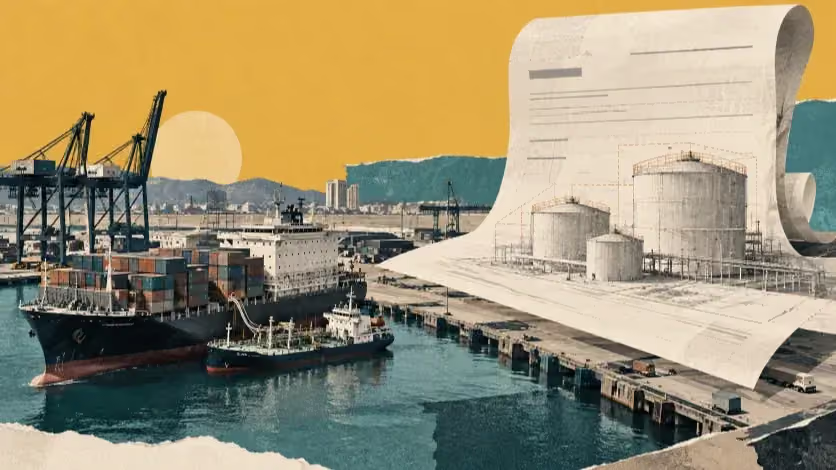 NewsOct 22, 2026
Busan Port’s LNG and Methanol Plan: Who Pays to Keep Fuel Ready?
Busan already supplies ships with LNG and methanol, drawing on regional and i...
 NewsOct 16, 2026
What Is Still Worth Going to See?
Busan’s biennale faces questions of artistic judgment and institutional care....
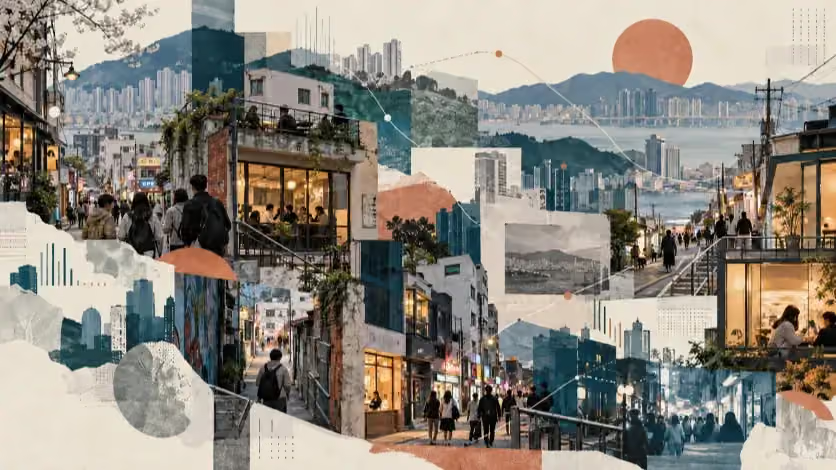 NewsOct 14, 2026
What Became of Busan’s University Streets?
From 2015 to 2023, registered businesses grew near Pusan National University...
More from the author
More from this byline
Stay with the same line of reporting through more work from this byline.
- NewsOct 22, 2026
Busan Port’s LNG and Methanol Plan: Who Pays to Keep Fuel Ready?
 NewsOct 12, 2026
Bukangi, the Shark That Stayed in Busan’s North Port
Reader Signal
Community readWhat did this report leave you with?
Choose the signal that best reflects your reading. Select it again to remove it.
One response per article
No response selected
A moderated conversation about the reporting.
One-level replies and newsroom moderation keep the conversation anchored to this article.
Discussion Status
Open
Please sign in to join the discussion.
Newsletter
Weekly reporting and context from Busan and Korea.