Busan’s Bright Facade and Its Deepening Divide
Busan’s skyline gleams, but its economy tells a quieter story — one of slow consumption, aging demographics, and unbalanced growth.

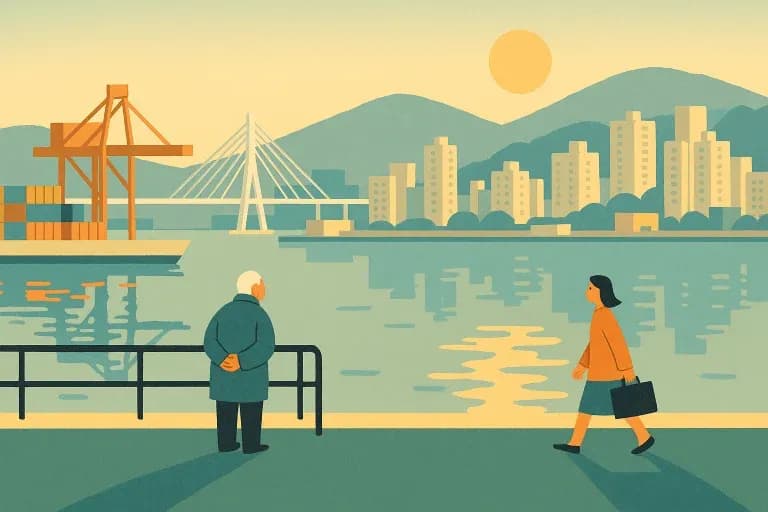
How South Korea’s maritime capital glitters abroad while hollowing within
Busan, South Korea — Busan is a city of paradoxes. Containers stack higher than ever at its harbor, cranes dot the skyline of a metropolis long synonymous with trade, and municipal spending has rarely been larger. Yet behind the statistics, the pulse of the local economy is slowing. Retail turnover fell three percent in August, industrial output slipped more than six, and unsold housing units have reached a record 7,146. The data describe an economy whose surface remains polished while its interior weakens.
For years, Busan has relied on the confidence that global logistics could lift all tides. But the port’s prosperity no longer circulates through the city’s veins. Wages have stagnated, young workers continue to leave, and consumption is shrinking faster than official optimism admits. Growth persists in volume, not in vitality — a pattern of expansion without diffusion.
The city administration is betting on infrastructure to restore momentum: a new airport on Gadeokdo Island, the redevelopment of the Busan North Port, and a smart-city district in the Eco Delta Zone. These projects, worth more than ₩20 trillion in aggregate, promise scale but not immediacy. Their schedules are slipping, their returns uncertain, and their fiscal weight already visible in next year’s budget. For now, Busan’s economy stands between endurance and erosion — resilient in appearance, brittle in depth.
The Numbers Behind the Facade
Busan’s outward vitality rests on selective strength. The port handled more than twelve million containers in the first half of 2025, a modest rise that still secures its place among the world’s busiest terminals. Logistics and ship repair remain steady employers, and the city’s exposure to global trade cushions it from the national slowdown.
Beyond the docks, however, momentum fades. The city’s industrial production index dropped 6.2 percent in August, reflecting weaker output in machinery and automotive parts. Retail sales declined for a fifth consecutive month, and vacancy rates in mid-tier shopping districts are at a decade high. Household credit growth has stalled, a quiet signal that consumption is running out of leverage.
Housing adds a second layer of strain. With more than seven thousand unsold apartments — nearly three thousand already completed — the property market is approaching oversupply. Prices in high-income coastal districts such as Haeundae and Suyeong remain firm, but outer wards record discounts that deepen each quarter. Analysts describe the gap as “a two-speed city,” where capital gravitates to view and prestige while the rest of the market cools into inertia.
These figures suggest not collapse but asymmetry — prosperity that concentrates rather than circulates. For policymakers, the challenge is not to generate growth but to distribute it before confidence erodes. The next question is whether City Hall’s grand projects can bridge that divide.
Policy Momentum and the Limits of Scale
City Hall’s answer to stagnation has been scale. Busan’s development blueprint reads like a catalogue of ambition: a new international airport on Gadeokdo Island, the reconstruction of the Busan North Port, and a national smart-city pilot at the Eco Delta zone. Together, these projects represent more than ₩20 trillion in public and private commitments — a fiscal reach unmatched outside the capital region.
The momentum, however, is uneven. The Gadeokdo Airport schedule has already been revised; the target year of 2029 is now framed as “flexible” by the transport ministry. The Saha–Hadan subway extension, once promoted as a 2026 opening, has slipped a year behind due to ground instability and cost escalation. The Oryukdo tram line, a symbol of low-carbon mobility, has been shelved after feasibility tests failed to justify investment. Each case reflects the same structural issue: execution without elasticity — a policy machine skilled at initiation but slow to adapt.
Fiscal signs tell a similar story. Busan’s 2025 budget stands at ₩18 trillion, but the city’s fiscal self-reliance ratio, at 38 percent, leaves little margin for overruns. Debt remains moderate by national standards, yet the growing share of earmarked spending limits discretion. Auditors note that while expenditure has accelerated — the city earned top marks for “swift execution” — outcome metrics lag behind. Spending is fast; delivery is not.
Even so, not all is inert. The International Finance Center’s third phase has attracted regional fintech firms, and the Eco Delta Smart City is transitioning from pilot to partial habitation. These islands of progress demonstrate capacity, but also fragmentation. The city’s economic map is becoming patchwork — clusters of innovation separated by corridors of stagnation.
Busan’s policy narrative, then, is not one of failure but of dilution. Ambition has scale, but not yet concentration. Until the flow of capital, labor, and policy converges in rhythm, the city’s expansion will remain impressive in form and limited in function.
Social Strain and the Search for Balance
Beneath Busan’s urban brightness, social pressure is thickening. The city’s population, once nearing four million, continues to contract. The share of residents aged sixty-five or older has surpassed twenty-seven percent, while the working-age cohort shrinks each year. In the second quarter of 2025, more than 3,700 young adults left Busan for other regions, the steepest outflow among Korea’s major cities. Demography, not industry, is becoming the city’s dominant economic variable.
The strain shows in the labor market. Employment levels appear stable, but most new positions are concentrated in services and logistics, where wages lag the national median. Manufacturing employment, once Busan’s backbone, has fallen by nearly ten percent over five years. For many graduates, opportunity now lies a train ride away in Seoul, Daegu, or the industrial belt around Ulsan. The result is a hollowing middle — a city rich in retirees and students but thin in producers.
Income and housing disparities mirror that divide. Coastal wards such as Haeundae record average apartment prices more than twice those of Saha or Gangseo. Consumer surveys reveal a widening perception gap: satisfaction with “quality of life” remains high in the east but drops sharply toward the city’s industrial west. Retail data confirm the split; discretionary spending per household in affluent districts is nearly forty percent higher. The geography of prosperity has become visible in daily consumption.
City Hall is aware of the imbalance. Its flagship welfare programs now target senior healthcare, digital-literacy training, and youth-housing subsidies. The local currency scheme, Dongbaekjeon, expanded its cashback rate to thirteen percent to spur spending at small shops, briefly lifting transaction volumes in September. Yet such interventions, while popular, are palliative. They treat symptoms, not causes, and rely on fiscal space that is narrowing each year.
The deeper challenge lies in trust. Residents no longer question the city’s ambition but its cohesion — whether grand projects can still translate into shared well-being. As one local economist noted, “Busan’s problem is not growth fatigue; it’s distribution fatigue.” Unless the next phase of policy couples physical investment with social renewal, the city risks perfecting infrastructure for a population that continues to leave.
Outlook and Strategic Crossroads
Busan enters the latter half of the decade facing a test of endurance. The city’s physical transformation is visible, yet the substance of recovery remains uncertain. Its economy now moves on two tracks: external engines tied to trade and logistics, and internal components weakened by demographic drag and muted consumption. Unless these vectors align, growth will remain statistical rather than structural.
The near term offers mixed signals. Construction indicators suggest continued cooling in residential demand, while manufacturing orders show mild recovery led by marine equipment and electrical components. Consumer prices are stable, but wage growth is flat, limiting disposable income. Local economists project Busan’s real GDP growth at just above one percent for 2025, trailing both the national average and inflation — a technical stagnation in practical terms.
Policy response will determine whether that stagnation becomes chronic. Fiscal room is tightening, yet the next municipal budget will likely expand again to sustain infrastructure projects. The trade-off between investment and liquidity is narrowing. Officials are also weighing regulatory incentives to attract digital-finance firms and logistics startups, an effort to shift from volume-driven growth to value creation. If execution falters, however, these measures risk becoming another layer of aspiration without absorption.
Externally, Busan’s prospects hinge on timing. The Gadeokdo Airport’s revised schedule, if stabilized, could anchor long-term connectivity and logistics competitiveness. The Busan North Port Redevelopment, still uneven in private participation, remains critical to shaping the city’s post-industrial identity. Each milestone will test not just engineering capacity but administrative coherence — the ability to deliver consistency rather than novelty.
In social terms, the outlook depends on restoring confidence. Residents’ expectations have grown more pragmatic; they no longer measure progress by projects, but by outcomes visible in everyday life — jobs, housing stability, and civic balance. The city’s trajectory will be judged less by cranes in the skyline than by retention in the census.
For now, Busan stands poised between transformation and fatigue. Its challenge is not the absence of ambition but the dispersion of it. To translate momentum into resilience, policy must narrow focus, align incentives, and rebuild local faith in growth that reaches the ground. Only then can the city’s outward motion regain inner gravity.
Continue this reporting
Reporting on the same issue
Related coverage selected from the article's desk, topics and newsroom relationships.
 NewsOct 22, 2026
Busan Port’s LNG and Methanol Plan: Who Pays to Keep Fuel Ready?
Busan already supplies ships with LNG and methanol, drawing on regional and i...
 NewsOct 16, 2026
What Is Still Worth Going to See?
Busan’s biennale faces questions of artistic judgment and institutional care....
 NewsOct 14, 2026
What Became of Busan’s University Streets?
From 2015 to 2023, registered businesses grew near Pusan National University...
More from the author
More from this byline
Stay with the same line of reporting through more work from this byline.
- NewsOct 22, 2026
Busan Port’s LNG and Methanol Plan: Who Pays to Keep Fuel Ready?
 NewsOct 12, 2026
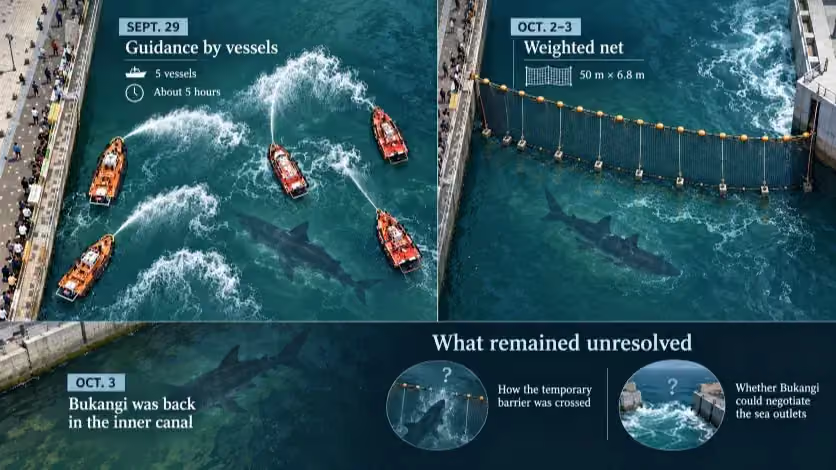
Bukangi, the Shark That Stayed in Busan’s North Port
Reader Signal
Community readWhat did this report leave you with?
Choose the signal that best reflects your reading. Select it again to remove it.
One response per article
No response selected
A moderated conversation about the reporting.
One-level replies and newsroom moderation keep the conversation anchored to this article.
Discussion Status
Open
Please sign in to join the discussion.
Newsletter
Weekly reporting and context from Busan and Korea.